

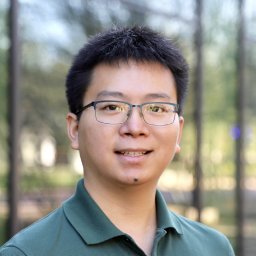
 Pan Xu
· 6 previous affiliations
- Duke UniversitySince 2022
- Assistant Professor · Since 2022
- California Institute of Technology2021–2022
- PIMCO Postdoctoral Fellow · 2021–2022
- Graduate Research And Teaching Assistant · 2018–2021
- Discover2018–2021
- PhD student · 2018–2021
- Research Intern · 2019
- University of Virginia2015–2018
- Graduate Research And Teaching Assistant · 2015–2018
2 other authors named Pan Xu: Pan Xu (New Jersey Institute of Technology · 34 papers), Pan Xu (3 papers)
Research Overview
Pan Xu focuses on machine learning, reinforcement learning, and high-dimensional statistics, with an emphasis on developing computationally and data-efficient algorithms. His early work established theoretical guarantees for nonconvex optimization and scalable Bayesian inference using Langevin dynamics. More recently, his research addresses robust sequential decision-making, exploring how reinforcement learning agents can adapt to shifting environmental dynamics.
Research Trajectory
The early phase of Pan Xu’s research focused on high-dimensional statistics and multi-task learning. In 2016, he introduced Forward Backward Greedy Algorithms for Multi-Task Learning with Faster Rates, presenting MultiFoBa, a non-convex approach for multi-task learning with row-sparsity constraints. By bypassing standard convex relaxations, this method achieved sharper error bounds and improved feature selection consistency.
By 2018, his focus shifted toward the theoretical foundations of nonconvex optimization and Bayesian inference. He analyzed the global convergence properties of gradient Langevin dynamics (GLD) and stochastic gradient Langevin dynamics (SGLD) in Global Convergence of Langevin Dynamics Based Algorithms for Nonconvex Optimization, providing a unified framework to understand their ergodicity in nonconvex finite-sum optimization. To improve the computational efficiency of these methods on massive datasets, he developed Subsampled Stochastic Variance-Reduced Gradient Langevin Dynamics (SVRG-LD+). By replacing expensive full gradient passes with subsampled estimates, this work advanced the research direction of Variance Reduction for Stochastic Gradient Langevin Dynamics and contributed to the broader area of Scaling Bayesian Inference with Stochastic Gradient Langevin Dynamics.
In 2019, he extended these variance-reduction techniques to sample from complex, multi-modal distributions. He established non-asymptotic convergence guarantees for variance-reduced Langevin dynamics in Sampling from Non-Log-Concave Distributions via Variance-Reduced Gradient Langevin Dynamics, proving that these algorithms achieve target accuracy in the 2-Wasserstein distance with significantly fewer gradient evaluations. This work is central to the area of Sampling from Non-Log-Concave Probability Distributions. He further accelerated sampling efficiency by combining the mechanics of Hamiltonian Monte Carlo with recursive variance reduction in Stochastic Gradient Hamiltonian Monte Carlo Methods with Recursive Variance Reduction, contributing to the broader field of Scalable Bayesian Inference via Stochastic Gradient MCMC.
Around 2020, his research expanded into the theoretical analysis of reinforcement learning (RL) and multi-armed bandits. He provided a rigorous non-asymptotic analysis of a prevalent deep RL algorithm in A Finite-Time Analysis of Q-Learning with Neural Network Function Approximation, which intersects with the research direction of The Width Gap Between Deep Learning Theory and Practice. In the bandit setting, he solved an open problem regarding the optimality of Thompson Sampling by introducing a clipping mechanism and variance inflation in MOTS: Minimax Optimal Thompson Sampling, achieving minimax optimal regret bounds. He also explored contextual bandits with unknown reward functions in Neural Contextual Bandits with Deep Representation and Shallow Exploration, proposing an algorithm that pairs deep ReLU network representation learning with upper confidence bound (UCB) exploration in the final linear layer to achieve finite-time regret guarantees. Continuing this line of inquiry, with collaborators, he developed $\epsilon$-Exploring Thompson Sampling in Thompson Sampling with Less Exploration is Fast and Optimal. By performing posterior sampling only occasionally, the algorithm maintains theoretical optimality while significantly improving computational speed, advancing the area of Efficient Bandit Exploration via Occasional Posterior Sampling.
More recently, his trajectory has heavily emphasized robust and off-dynamics reinforcement learning, where agents must learn from fixed datasets and perform reliably when deployment dynamics differ from training environments. In Robust Offline Reinforcement Learning with Linearly Structured $f$-Divergence Regularization, he tackled the challenge of learning policies that remain effective under shifting environmental physics. He investigated the intrinsic difficulty of exploration in online robust Markov decision processes (RMDPs) without access to generative models in Sample Complexity of Distributionally Robust Off-Dynamics Reinforcement Learning with Online Interaction. To leverage data from accessible source domains for target domains with limited data, his group utilized return-conditioned supervised learning and Decision Transformers in Return Augmented Decision Transformer for Off-Dynamics Reinforcement Learning. Additionally, he proposed the We-DRIVE-U algorithm for off-dynamics RL under linear RMDPs in Near-Optimal Reinforcement Learning for Linear Distributionally Robust Markov Decision Processes, establishing strong average suboptimality bounds.
Current Directions
The most recent papers in the evidence continue to deepen the theoretical understanding of robust reinforcement learning, focusing on how standard algorithmic components can be mathematically formalized to handle unexpected changes in environment dynamics. Recent work investigates the hidden properties of common RL heuristics; for instance, Clipped Q-Learning: Your Value Clipping Is Secretly A Robust Operator demonstrates that value clipping—often treated merely as a trick for training stability—is actually a principled robust operator optimized for dynamic shifts.
Furthermore, ongoing research addresses the unification of policy and environment regularization. Doubly Regularized Markov Decision Processes for Robust Reinforcement Learning introduces a framework that simultaneously regularizes both the agent's policy and the environment's dynamics. This dual approach provides new theoretical regret guarantees for online robust RL, yielding stochastic policies that are highly exploratory and resilient to environmental perturbations.
Profile updated
Loading new papers…
Other researchers whose papers cluster into the same research directions — a proxy for overlapping technical interests and shared intellectual neighborhoods.
See something wrong? Report a mistake