

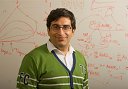
 Nitesh V. Chawla
· 2 previous affiliations
- University of Notre DameSince 2007
- Full Professor · Since 2007
- University of South Florida1997–2002
- PhD student · 1997–2002
Research Overview
Nitesh V. Chawla focuses on artificial intelligence, data science, and network science, with an emphasis on developing foundational algorithms for complex, imbalanced, and interconnected data. His trajectory spans early foundational work in handling class imbalance to scalable representation learning in heterogeneous networks. Currently, he investigates the evaluation, efficient adaptation, and structural distillation of large language models and graph neural networks.
Research Trajectory
Early in his career, he collaborated on Decision tree learning on very large data sets (1998), addressing the challenge of extracting salient subsets from terabyte-scale data to assist user browsing. This work naturally led to the foundational problem of class imbalance, where normal examples vastly outnumber abnormal or interesting ones. In 2002, he introduced SMOTE: Synthetic Minority Over-sampling Technique, a method for generating synthetic examples to improve classifier sensitivity to minority classes. He subsequently extended this approach with SMOTEBoost: Improving Prediction of the Minority Class in Boosting (2003), integrating synthetic over-sampling directly into the boosting procedure to avoid the biases of standard equal-weight misclassification penalties.
The focus on non-stationary and skewed data continued with a comprehensive overview of Learning from streaming data with concept drift and imbalance: an overview (2012). As data structures grew more complex, his research expanded into network science and representation learning. With collaborators, he developed metapath2vec: Scalable Representation Learning for Heterogeneous Networks (2017), formalizing meta-path-based random walks and a heterogeneous skip-gram model to perform node embeddings that capture both structural and semantic correlations.
In 2020, he explored complex multi-step dependencies in sequential data with Efficient modeling of higher-order dependencies in networks: from algorithm to application for anomaly detection, introducing the BuildHON+ algorithm to construct higher-order networks for more accurate anomaly detection. Concurrently, he addressed data scarcity in relational structures through Few-Shot Knowledge Graph Completion (2020), proposing a model to discover facts for new relations using very few references, thereby contributing to the broader area of Few-Shot Relational Learning in Knowledge Graphs.
A major recent theme has been improving the scalability and deployment of Graph Neural Networks (GNNs). In Learning MLPs on Graphs: A Unified View of Effectiveness, Robustness, and Efficiency (2023), he investigated the challenges of training student multi-layer perceptrons on node content features to bypass the multi-hop data dependencies of GNNs. This work anchors his extensive contributions to research directions such as Distilling Graph Neural Networks into Structure Aware MLPs, Distilling Graph Neural Networks into Graph Free Models, and Accelerating Graph Inference by Decoupling Topology from Computation. He further consolidated this field by co-authoring Knowledge Distillation on Graphs: A Survey (2025), which categorizes methods for transferring knowledge from complex graph models to efficient architectures.
His work on graph structures also encompasses advanced link prediction methodologies. In Node Duplication Improves Cold-start Link Prediction (2025), he proposed a method to enhance GNN performance on low-degree nodes, directly addressing the cold-start problem in recommendation systems. He also explored in-context learning paradigms for graphs in Universal Link Predictor By In-Context Learning on Graphs (2025), advancing the area of Scaling Link Prediction Beyond Per-Pair Subgraph Extraction.
Returning to his early work on synthetic data, he recently developed $\epsilon$-PrivateSMOTE in Differentially-private data synthetisation for efficient re-identification risk control (2025), a method that balances privacy and utility by applying differential privacy with a SMOTE-inspired interpolation technique. Simultaneously, his research has heavily engaged with Large Language Models (LLMs). He addressed efficient adaptation in FLAME: Towards Federated Fine-Tuning Large Language Models Through Adaptive SMoE (2025), utilizing a Sparse Mixture-of-Experts architecture to dynamically vary activated experts per client. He also tackled interpretability via combinatorial multi-armed bandits in Context Attribution with Multi-Armed Bandit Optimization (2025), efficiently exploring context subsets to determine which retrieved segments support a generated answer.
A critical focus has been the rigorous evaluation and continuous improvement of foundation models. He co-authored BenchmarkCards: Standardized Documentation for Large Language Model Benchmarks (2025) to systematize evaluation protocols and reduce benchmark misuse. Pushing beyond static benchmarks, he introduced ATLAS in Adaptive Testing for LLM Evaluation: A Psychometric Alternative to Static Benchmarks (2026), applying Item Response Theory to dynamically assess latent model abilities with significantly fewer test items. He also contributed to Dynamic Noise Preference Optimization: Self-Improvement of Large Language Models with Self-Synthetic Data (2026), a framework enabling LLMs to iteratively enhance performance by selecting high-quality synthetic data and introducing trainable noise. Finally, extending in-context learning to scientific domains, he participated in the development of DemoDiff in Graph Diffusion Transformers are In-Context Molecular Designers (2026), a foundation model that designs high-performing molecules for new tasks based on few-shot examples.
Current Directions
Recent work investigates the evaluation, adaptation, and interpretability of Large Language Models (LLMs), alongside advanced applications of graph machine learning. In the domain of foundation models, the most recent papers in the evidence explore psychometric approaches to dynamic model evaluation, federated fine-tuning using sparse mixture-of-experts architectures, and self-improvement pipelines driven by synthetic data. Concurrently, his graph learning research focuses on distilling complex graph neural networks into efficient multi-layer perceptrons, mitigating cold-start problems in link prediction, and applying graph diffusion transformers to in-context molecular design.
Profile updated
Loading new papers…
Other researchers whose papers cluster into the same research directions — a proxy for overlapping technical interests and shared intellectual neighborhoods.
See something wrong? Report a mistake