

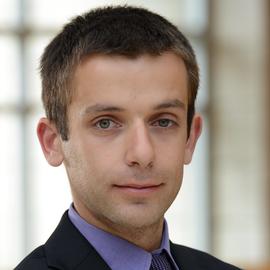
 Mladen Kolar
· 2 previous affiliations
- University of Southern CaliforniaSince 2024
- Full Professor · Since 2024
- University of Chicago2013–2024
- Associate Professor · 2013–2024
Research Overview
Mladen Kolar focuses on high-dimensional statistical inference, probabilistic graphical models, and stochastic optimization. His early work developed methods for estimating dynamic networks and varying-coefficient models to uncover structural changes in complex systems over time. More recently, his research addresses adaptive optimization techniques for large-scale machine learning and direct differential inference in time-varying probabilistic models.
Research Trajectory
Kolar's early research concentrated on the challenge of estimating dynamic networks and time-varying models from high-dimensional data. In 2009, he introduced Time-Varying Dynamic Bayesian Networks, a framework combining kernel smoothing with sparse regression to recover transient interactions in complex systems that static models fail to capture. This focus on temporal evolution extended to biological applications, where he participated in developing KELLER: estimating time-varying interactions between genes to model topological changes in gene regulatory networks. Concurrently, he addressed the broader problem of dynamic system modeling by investigating Sparsistent Learning of Varying-coefficient Models with Structural Changes, proposing a two-stage adaptive procedure to infer jump points and estimate model structure across piecewise constant segments.
Moving into multi-task learning and broader high-dimensional structures, Kolar analyzed the theoretical conditions under which penalized methods succeed in identifying relevant features across multiple tasks in Union Support Recovery in Multi-task Learning (2011). This work contributed to the broader area of Extended Information Criteria for High Dimensional Model Selection, providing sharp theoretical characterizations for feature recovery using techniques like the Lasso and group Lasso. This foundational work on extracting hidden structures from noisy data culminated in his 2013 synthesis, Uncovering Structure in High-Dimensions: Networks and Multi-task Learning Problems.
In the subsequent years, his focus expanded to more complex graphical models and the rigorous statistical inference of their properties. He developed a novel framework for Graph estimation from multi-attribute data (2014), leveraging partial canonical correlations to infer conditional independence relationships when nodes contain rich, multivariate information. To address the computational challenges of high-dimensional inference, he introduced Statistical Inference for Pairwise Graphical Models Using Score Matching (2016), utilizing the Hyvärinen scoring rule to bypass intractable normalizing constants and provide robust confidence intervals. This trajectory naturally progressed into the research area of Direct Estimation of Sparse Differential Networks. Rather than estimating separate high-dimensional networks and computing their difference, he and his collaborators proposed Direct Estimation of Differential Functional Graphical Models (2019), a method that directly estimates the difference between two functional undirected graphical models. This approach significantly advanced the broader area of Direct Learning of Sparse Structural Changes. His contributions during this period also intersected with the research direction of Disentangling Direct and Indirect Network Connections, providing principled ways to isolate true dependencies in complex multivariate data.
In recent years, Kolar's research has heavily emphasized stochastic optimization and advanced inference techniques for modern machine learning. In the domain of optimization, he analyzed the theoretical underpinnings of accelerated methods in Convergence Analysis of Accelerated Stochastic Gradient Descent Under the Growth Condition (2024), demonstrating near-optimal convergence rates under realistic noise assumptions. This aligns with his contributions to the research area of Adaptive Optimization via Gradient Noise Statistics. He also developed the Fast Overlapping Temporal Decomposition (FOTD) algorithm in A Fast Temporal Decomposition Procedure for Long-Horizon Nonlinear Dynamic Programming (2024) to efficiently solve complex, long-horizon problems. Expanding into large-scale distributed training, he addressed the area of Adaptive Batch Size Scaling via Gradient Noise Estimation by proposing dynamic schedules for language models in Adaptive Batch Size Schedules for Distributed Training of Language Models with Data and Model Parallelism (2025). Further advancing stochastic optimization, he introduced a trust-region method for problems with deterministic equality constraints in Trust-Region Sequential Quadratic Programming for Stochastic Optimization with Random Models (2025).
Parallel to his optimization work, Kolar has continued to innovate in statistical modeling. He explored causally interpretable dependence structures using continuous Lyapunov equations in On the Lasso for Graphical Continuous Lyapunov Models (2024). Building on his earlier work with score matching, he developed methods for High-Dimensional Differential Parameter Inference in Exponential Family using Time Score Matching (2025), allowing for the direct estimation of parameter derivatives in time-varying probabilistic models. His recent collaborative efforts also include participation in genomic research, such as the detection of functional turnover in transcription factor binding sites in CSMET: comparative genomic motif detection via multi-resolution phylogenetic shadowing (2026), and the development of the DeltaBO algorithm in Provable Accelerated Bayesian Optimization with Knowledge Transfer (2026) to accelerate optimization by transferring historical knowledge across related tasks. Additionally, Kolar collaborated on Fast and Consistent Structure Learning in Graphical Models via Approximate Cross-Validation (2026), resolving the tension between flexibility and selection consistency in large-scale graphical models through a scalable approximate cross-validation framework.
Current Directions
The most recent papers in the evidence indicate a strong focus on stochastic optimization and advanced statistical inference for dynamic, high-dimensional models. In optimization, recent work investigates adaptive techniques for large-scale machine learning, including dynamic batch size schedules for distributed language model training and trust-region sequential quadratic programming for stochastic objectives. Theoretically, this includes analyzing the convergence of accelerated stochastic gradient descent under realistic noise growth conditions and developing algorithms for Bayesian optimization that leverage knowledge transfer across related tasks. In statistical modeling, current efforts address differential parameter inference in time-varying exponential family models using time score matching, enabling the direct estimation of structural changes without the intermediate step of fitting separate high-dimensional models.
Profile updated
Loading new papers…
Other researchers whose papers cluster into the same research directions — a proxy for overlapping technical interests and shared intellectual neighborhoods.
See something wrong? Report a mistake