

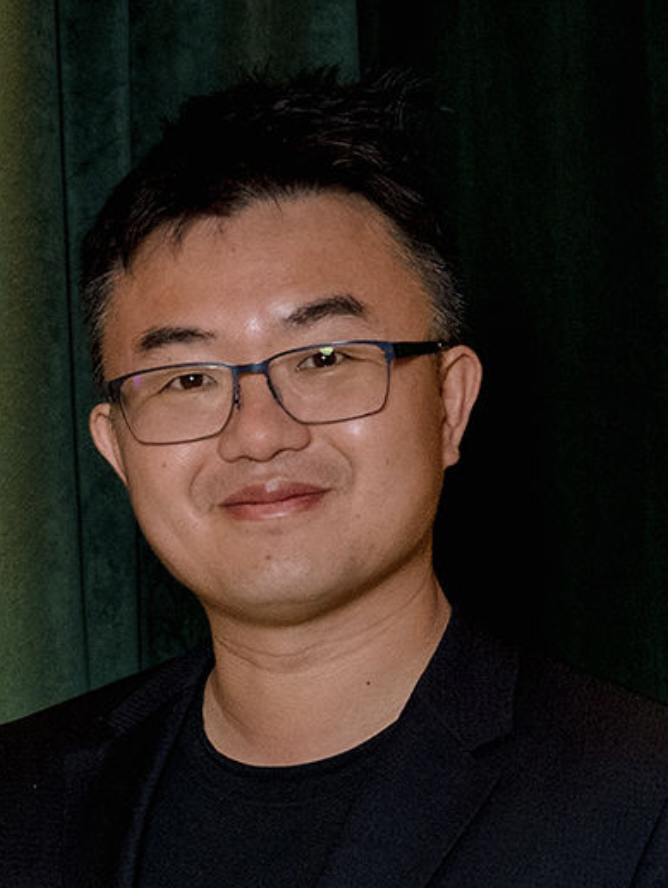
 Ming-Yu Liu
· 5 previous affiliations
- Nvidia (United States)Since 2016
- Researcher · Since 2016
- Principal Research Scientist · 2012–2016
- University of Maryland, College Park2006–2012
- PhD student · 2006–2012
- Intel (United States)2005–2006
- Software Engineer · 2005–2006
- Bachelor, Electrical Engineering · 2000–2003
Research Overview
Ming-Yu Liu focuses on generative artificial intelligence, computer vision, and the development of world foundation models for physical AI. His trajectory spans early work in image segmentation and optical flow to foundational contributions in high-resolution image synthesis and unsupervised domain translation. Currently, he investigates scalable video tokenization, 3D neural fields, and simulated environments that enable robotic systems to reason and interact with the physical world.
Research Trajectory
Liu’s early research addressed foundational problems in computer vision, particularly in segmentation and object detection. In 2010, he introduced a method for Pose estimation in heavy clutter using a multi-flash camera, which separated depth and texture edges to locate objects in complex environments. This was followed by Entropy rate superpixel segmentation (2011), where he formulated superpixel generation as an optimization problem on a graph using random walks and matroid constraints.
By 2017, his focus expanded to generative modeling and motion estimation. He developed Unsupervised Image-to-Image Translation Networks, proposing a shared-latent space assumption to translate images across domains without paired training data. Concurrently, he contributed to motion alignment architectures, participating in the development of PWC-Net: CNNs for Optical Flow Using Pyramid, Warping, and Cost Volume (2018). This work advanced the research direction of The Coarse to Fine Failure in Large Displacement Optical Flow and utilized techniques in the area of Expanding the Receptive Field of Convolutional Networks.
In the domain of generative adversarial networks (GANs), Liu’s work significantly improved the resolution and control of synthesized images. He co-developed High-Resolution Image Synthesis and Semantic Manipulation With Conditional GANs (2018), which introduced novel adversarial losses and multi-scale architectures to generate photorealistic images from semantic label maps. He further addressed data efficiency in Few-Shot Unsupervised Image-to-Image Translation (2019), enabling translation to unseen target classes using only a few examples. This line of research culminated in Semantic Image Synthesis With Spatially-Adaptive Normalization (2019), which modulated activations in normalization layers to preserve semantic layout information, greatly enhancing visual fidelity.
Moving into the 2020s, Liu’s research incorporated implicit neural representations, multimodal synthesis, and diffusion models. He oversaw the development of Implicit Neural Representations with Levels-of-Experts (2022), which scaled coordinate-based networks to model large-scale signal distributions. In the area of High-Fidelity Identity Preservation in Generative Face Synthesis, his group introduced Implicit Warping for Animation with Image Sets (2022), utilizing cross-modal attention for image animation. This focus on controllable human animation continued with SPACEx: Speech-driven Portrait Animation with Controllable Expression (2022) and its subsequent iteration, SPACE: Speech-driven Portrait Animation with Controllable Expression (2023), which generated high-resolution talking-head videos with explicit control over facial landmarks and emotional intensity.
Simultaneously, Liu advanced multimodal and large-scale generative systems. He led the work on Multimodal Conditional Image Synthesis with Product-of-Experts GANs (2022), allowing users to condition image generation on multiple modalities simultaneously. As diffusion models emerged as a dominant paradigm, he contributed to the research direction of Lifting 2D Diffusion Priors for 3D Generation through Magic3D: High-Resolution Text-to-3D Content Creation (2023), which utilized a two-stage optimization framework to accelerate 3D synthesis. He also developed DiffCollage: Parallel Generation of Large Content with Diffusion Models (2023), using factor graphs to generate infinite or panoramic images in parallel, and eDiff-I: Text-to-Image Diffusion Models with an Ensemble of Expert Denoisers (2023), which improved text alignment and spatial control.
Most recently, Liu’s trajectory has pivoted toward physical AI and world foundation models. In his role as Vice President of Research at NVIDIA, he participated in the release of the Cosmos World Foundation Model Platform for Physical AI (2025), an open-weight platform providing video tokenizers and diffusion architectures to create digital twins for robot training. This work aligns with the broader area of Video Foundation Models for Robotic Manipulation. His recent contributions also include PARTFIELD: Learning 3D Feature Fields for Part Segmentation and Beyond (2025), a feedforward model for rapid, hierarchical 3D part segmentation. In 2026, his group introduced InfoTok: Adaptive Discrete Video Tokenizer via Information-Theoretic Compression, which dynamically adjusts token allocation based on scene complexity, and DiffusionNFT: Online Diffusion Reinforcement with Forward Process, which applies reinforcement learning to align diffusion models more efficiently. Continuing work on multimodal reasoning and video evaluation in 2026, Liu contributed to Audio-Visual Flamingo: Open Audio-Visual Intelligence for Long and Complex Videos, an open audio-visual large language model trained for joint reasoning and temporal grounding across long-form video, and PhyProbe: Rethinking Physical Consistency Evaluation in Generated Videos, which uses spatiotemporal encoders to evaluate physical consistency violations in generated video. Additionally, Liu participated in developing AVO: Agentic Variation Operators for Autonomous Evolutionary Search (2026), leveraging autonomous coding agents to discover highly optimized GPU attention kernels.
Current Directions
Liu’s most recent work investigates the intersection of generative AI and physical simulation, focusing on architectures that enable machines to reason about and interact with the physical world. A primary theme in his current research is the development of world foundation models, which involve creating highly accurate, scalable digital twins and simulated environments for robotic training. This includes advancing the underlying representations required for these systems, such as continuous 3D feature fields for rapid part segmentation and open-vocabulary 3D perception.
Additionally, recent papers address the computational efficiency and alignment of large-scale generative models. His group is exploring adaptive video tokenization frameworks that use information-theoretic compression to dynamically allocate computational resources based on the complexity of a scene. Furthermore, ongoing work investigates novel reinforcement learning paradigms for diffusion models, seeking to optimize the alignment of generative outputs with complex preferences through more efficient forward-process training methodologies.
Profile updated
Loading new papers…
Other researchers whose papers cluster into the same research directions — a proxy for overlapping technical interests and shared intellectual neighborhoods.
See something wrong? Report a mistake