

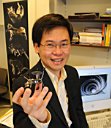
 Melvin Leok
· 2 previous affiliations
- University of California San DiegoSince 2009
- Full Professor · Since 2013
- Associate Professor · 2009–2013
- Purdue University West Lafayette2006–2009
- Assistant Professor · 2006–2009
Research Overview
Melvin Leok focuses on geometric mechanics, structure-preserving numerical integration, and geometric control theory. His trajectory spans the foundational development of discrete variational integrators to advanced applications in Lie group optimization and multi-time dynamical systems. Recent work investigates $q$-cosymplectic geometry and the geometric formulation of complex physical and robotic systems.
Research Trajectory
In the early 2000s, Leok established foundational frameworks for computational geometric mechanics. His early research explored discrete analogues of differential geometry, as detailed in Discrete Exterior Calculus. This theoretical groundwork was expanded in Foundations of computational geometric mechanics, where he and his collaborators constructed discrete theories for reduction by symmetry and connections on principal bundles. By deriving these algorithms from a discrete Hamilton's principle, the work yielded computational methods with excellent structure-preserving properties.
By the late 2000s, his research expanded into digital control systems and aerospace robotics, contributing extensively to the area of Singularity Free Parameterizations for Three Dimensional Rotations. Work in the area of Bridging the Continuous-Discrete Gap in Digital Control includes Controlled Lagrangians and stabilization of discrete mechanical systems, which introduced novel techniques for discrete kinetic and potential shaping to stabilize mechanical systems. Applying these geometric methods to robotics, he advanced the research direction of Coordinate Free Dynamics on Lie Group Manifolds and the broader area of Geometric Control on the Special Euclidean Group through applied studies such as Geometric tracking control of a quadrotor UAV on SE(3).
A major theme of his subsequent work involves unifying complex mechanical systems with constraints. Contributing to the direction of Variational Integration for Structure Preserving Mechanics, he introduced a novel framework in Variational and Geometric Structures of Discrete Dirac Mechanics. This research successfully unified discrete Lagrangian and Hamiltonian systems with constraints by developing discrete analogues of geometric structures like Tulczyjew's triple. He further advanced the broader area of Unified Mechanics on Lie Algebroids and Dirac Structures with Dirac Structures and Hamilton-Jacobi Theory for Lagrangian Mechanics on Lie Algebroids, providing a generalized Hamilton-Jacobi theory capable of handling implicit systems—such as those with nonholonomic constraints or degenerate Lagrangians—that are traditionally difficult to treat in classical mechanics.
In the 2020s, his focus expanded to applying geometric numerical integration to optimization and complex dynamics. In Variational Symplectic Accelerated Optimization on Lie Groups, his group discretized continuous-time Bregman dynamics using Lie Group Variational Integrators, treating optimization as a mechanical system to achieve high-order convergence while naturally preserving manifold structures. Addressing the need for variable time-steps without losing energy conservation, he developed new frameworks in Adaptive Hamiltonian Variational Integrators and Applications to Symplectic Accelerated Optimization. Continuing this trajectory, High-order symplectic Lie group methods on SO(n) using the polar decomposition utilized polar decomposition rather than the traditional exponential map to create algorithms that preserve rotational geometry to machine precision. He also introduced discrete-time analogs of nearly periodic systems in Nearly Periodic Maps and Geometric Integration of Noncanonical Hamiltonian Systems, offering a way to accurately simulate complex non-canonical systems over long time scales.
Expanding into continuous field theories and complex fluids, his 2024 research investigated the geometric structure of adjoint systems across discrete and continuous levels in On Properties of Adjoint Systems for Evolutionary PDEs. This work established a framework for understanding when discretizing and forming adjoints commute, which is critical for the optimal control of partial differential equations. In parallel, he formalized high energy-density plasmas using an irreversible port-Hamiltonian framework in Geometric formulation of three-temperature radiation hydrodynamics, successfully separating advection, interaction, and diffusion processes into distinct, energy-preserving operators.
Current Directions
The most recent papers in the evidence address multi-time dynamical systems and safe robotic manipulation. A primary theoretical focus is the development of $q$-cosymplectic geometry, a mathematical framework designed to model systems with multiple independent time scales or dimensions. In q-Cosymplectic Geometry, Integrability and Reduction, he introduced rigorous tools for reducing complex symmetric systems and analyzing their integrability beyond the standard one-dimensional time paradigm. This multi-clock framework was further advanced in Integration on q-Cosymplectic Manifolds, which provides geometric integration techniques tailored for these multi-time systems.
Alongside these theoretical advances in geometric mechanics, he has also participated in applied robotics research. This includes the development of neural configuration-space distance fields to accelerate safe motion planning in cluttered environments, as detailed in Neural Configuration-Space Barriers for Manipulation Planning and Control, demonstrating the ongoing applicability of geometric and structural insights to modern control and planning problems.
Profile updated
| Title | Venue | Year |
|---|---|---|
| Neural Configuration-Space Barriers for Manipulation Planning and Control | IEEE Trans Autom. Sci. Eng | 2026 |
| q-Cosymplectic Geometry, Integrability and Reduction | arXiv | 2025 |
| A Type II Hamiltonian Variational Principle and Adjoint Systems for Lie Groups | Journal of Dynamical and Control Systems | 2025 |
| Integration on $q$-Cosymplectic Manifolds | arXiv | 2025 |
| Variational principles for Hamiltonian systems | Geometric | 2025 |
| Learning Generalized Hamiltonians using fully Symplectic Mappings | arXiv | 2024 |
| Geometric formulation of three-temperature radiation hydrodynamics | Openalex | 2024 |
| On Properties of Adjoint Systems for Evolutionary PDEs | J. Nonlinear sci | 2024 |
| Stabilization of Nonlinear Systems through Control Barrier Functions | arXiv | 2024 |
| Safe Stabilizing Control for Polygonal Robots in Dynamic Elliptical Environments | ACC | 2024 |
Loading new papers…
Other researchers whose papers cluster into the same research directions — a proxy for overlapping technical interests and shared intellectual neighborhoods.
See something wrong? Report a mistake