

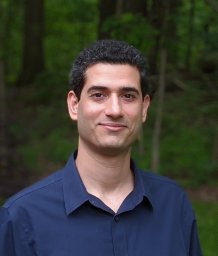
 Maani Ghaffari
· 4 previous affiliations
- University of MichiganSince 2017
- Assistant Professor · Since 2020
- Assistant Research Scientist · 2018–2020
- Postdoctoral Research Fellow · 2017–2018
- FX Palo Alto Laboratory2016–2017
- Intern · 2016–2017
- University of Technology Sydney2012–2017
- PhD student · 2012–2017
- Intern · 2014–2015
Research Overview
Maani Ghaffari focuses on computational autonomy, robotic state estimation, and semantic mapping. His research trajectory spans from foundational work in symmetry-preserving state estimation on Lie groups to recent developments in robust 3D registration and dynamic scene understanding. Currently, his lab investigates equivariant neural networks and ego-vision world models for complex robotic planning and control.
Research Trajectory
Ghaffari’s early work established mathematical foundations for robotic perception and state estimation, particularly leveraging Lie groups and reproducing kernel Hilbert spaces (RKHS). He introduced information-theoretic approaches to robotic exploration in Gaussian processes for information-theoretic robotic mapping and exploration (2017). Building on this geometric perspective, he developed the Contact-Aided Invariant Extended Kalman Filter (RI-EKF) in Contact-Aided Invariant Extended Kalman Filtering for Legged Robot State Estimation (2018). By exploiting symmetries in robot dynamics, this framework improved convergence and reliability, making foundational contributions to the research direction of Symmetry-Preserving State Estimation on Lie Groups and the broader area of robust state estimation for highly nonlinear systems. He further expanded these mathematical tools by applying RKHS regularizers to shape registration in Boosting Shape Registration Algorithms via Reproducing Kernel Hilbert Space Regularizers (2019) and by formalizing pose uncertainty in Characterizing the Uncertainty of Jointly Distributed Poses in the Lie Algebra (2020).
As his research program expanded, Ghaffari’s lab focused on making robotic systems resilient to perceptual degradation. In Proprioceptive Invariant Robot State Estimation (2023), his team demonstrated how robots can maintain accurate state awareness using only internal sensors when exteroceptive modalities like cameras or LiDAR fail. This work advanced the domain of Force Estimation from Proprioceptive Feedback and furthered his ongoing focus on symmetry-preserving estimation. Concurrently, he addressed geometric motion planning in Convex Geometric Motion Planning on Lie Groups via Moment Relaxation (2023). His group also made significant strides in semantic mapping and multi-view registration. They developed ConvBKI: Real-Time Probabilistic Semantic Mapping Network With Quantifiable Uncertainty (2024) to improve spatial understanding, and introduced a correspondence-free pose graph framework in RKHS-BA: A Robust Correspondence-Free Multi-View Registration Framework with Semantic Point Clouds (2024). The latter achieved robust convergence in noisy environments, contributing to the research area of Robust Point Cloud Registration under Extreme Outliers.
More recently, Ghaffari has integrated deep learning, generative priors, and continuous dynamics into robotic perception and control. To address the challenge of scalable dense semantic mapping, his lab proposed Bayesian Spatial Kernel Smoothing for Scalable Dense Semantic Mapping (2025), enabling robots to infer object identities in sparsely observed areas through stochastic generative sampling. In the area of geometric inference for manipulation under partial observability, his team developed Object Reconstruction under Occlusion with Generative Priors and Contact-induced Constraints (2025), which aligns 3D flow-matching models with sparse physical contact points to reconstruct heavily occluded objects. He also addressed sensor drift by modeling continuous bias dynamics using Neural Ordinary Differential Equations on Lie groups in Debiasing 6-DOF IMU via Hierarchical Learning of Continuous Bias Dynamics (2025). To support real-time semantic mapping in dynamic outdoor settings, his group introduced the CarlaSC synthetic dataset and a view-volume network in MotionSC: Data Set and Network for Real-Time Semantic Mapping in Dynamic Environments (2025), bridging the domain gap for synthetic training data. In the control domain, his lab developed a computationally efficient framework for autonomous surface vehicles in Online Learning-Enhanced Lie Algebraic MPC for Robust Trajectory Tracking of Autonomous Surface Vehicles (2025), combining geometric controllers with online Fourier-based learning to compensate for environmental disturbances.
Extending these methodologies to highly articulated systems, Ghaffari’s team developed Ego-Vision World Model for Humanoid Contact Planning (2025). This framework enables humanoid robots to purposefully utilize physical contact for balance and task execution, combining a visual world model trained on offline data with a value-guided sampling planner. Most recently, his research has advanced the fundamental architecture of geometric deep learning. In Equivariant Neural Networks for General Linear Symmetries on Lie Algebras (2026), his lab introduced Reductive Lie Neurons (ReLNs), a novel class of equivariant networks designed to process matrix-valued data like covariances and linear dynamics natively, addressing critical limitations in previous Lie-algebraic models.
Current Directions
The most recent work in Ghaffari’s research program investigates the intersection of geometric deep learning, generative modeling, and complex robotic control. A primary focus is the development of equivariant neural networks capable of natively processing matrix-valued data, such as covariances and linear dynamics, by accommodating the broad linear symmetries of the General Linear Group. This theoretical advancement supports more efficient and accurate geometric deep learning architectures.
In parallel, his lab is exploring advanced planning frameworks for highly articulated systems, such as humanoid robots. This involves creating ego-vision world models that allow robots to purposefully leverage physical contact for balance and task execution in real time, relying solely on egocentric depth vision and proprioception. Additionally, current research addresses perception in degraded or dynamic environments, utilizing Bayesian spatial smoothing, generative priors, and continuous latent trajectories to reconstruct occluded objects, debias inertial sensors, and maintain robust trajectory tracking amidst unpredictable environmental disturbances.
Profile updated
Loading new papers…
Other researchers whose papers cluster into the same research directions — a proxy for overlapping technical interests and shared intellectual neighborhoods.
See something wrong? Report a mistake