

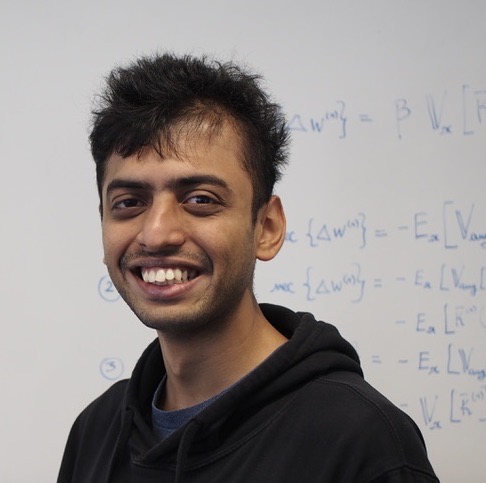
 Manu Srinath Halvagal
· 8 previous affiliations
- Harvard UniversitySince 2025
- Postdoctoral Research Fellow · Since 2025
- Postdoc · 2025–2026
- Friedrich Miescher Institute2020–2025
- Doctoral Student · 2020–2025
- University of Basel2020–2025
- Doctor of Philosophy - PhD, Neurobiology · 2020–2025
- Master of Science - MS, Microengineering and Robotics · 2017–2020
- Amazon (United States)2018–2019
- Applied Science Intern · 2018–2019
- TechSpark Academy2018
- Python Instructor · 2018
- Undergrad student · 2013–2017
- Undergraduate Research Intern · 2016
Research Overview
Manu Srinath Halvagal focuses on predictive representations in artificial and biological neural networks, exploring the mathematical principles underlying self-supervised learning. His trajectory bridges theoretical machine learning and computational neuroscience, investigating how predictive mechanisms shape invariant object recognition and cortical computation. Currently, he investigates the geometry of these representations and their application as world models in reinforcement learning.
Research Trajectory
Manu Srinath Halvagal’s early research explored the intersection of robotics and human-computer interaction. In 2019, he participated in the development of brain-computer interfaces (BCIs) with the paper Inferring subjective preferences on robot trajectories using EEG signals. This work investigated whether Error-related potentials (ErrPs)—temporal deflections in electroencephalogram signals—could be used to teach autonomous agents personalized policies based on individual subjective criteria, rather than relying on uniform objective standards.
Transitioning toward the theoretical foundations of deep learning, Halvagal began investigating the mathematical mechanisms that prevent representational collapse in machine learning models. A major focus of this period was the area of Preventing Representation Collapse in Joint Embedding Architectures. In 2022, he introduced a theoretical framework in Predictor networks and stop-grads provide implicit variance regularization in BYOL/SimSiam. By deriving analytical expressions for representational learning dynamics in linear networks, this research reconciled two seemingly disparate approaches to avoiding collapse: direct covariance regularization and asymmetric loss architectures. This work also contributed to the broader fields of Gaussian Universality in High Dimensional Neural Network Dynamics and Spectral Dynamics of Neural Network Training.
He expanded on these mathematical foundations the following year with Implicit variance regularization in non-contrastive SSL. This paper provided a formal proof that asymmetric predictor networks perform implicit variance regularization under the widely used cosine similarity loss. To address inefficiencies in early training, he proposed "IsoLoss," a novel loss function designed to equalize learning rates across eigenmodes, thereby eliminating the need for an exponential moving average (EMA) target network. This contribution advanced the direction of Reconciling Neural Tangent Kernels with Practical Deep Learning.
Parallel to his work in artificial neural networks, Halvagal has deeply engaged with computational neuroscience, seeking to understand how the brain might employ similar predictive principles. In 2023, he published The combination of Hebbian and predictive plasticity learns invariant object representations in deep sensory networks. Addressing the limitation that standard Hebbian plasticity fails to create invariant object representations in computational models, he demonstrated that combining Hebbian learning with a predictive form of plasticity enables deep neural networks to recognize objects across changes in size, orientation, and context. He derived a local learning rule that naturally accounts for biological constraints and generalizes to spiking neural networks.
Most recently, his research has focused on aligning predictive coding theories with neural anatomy. In 2025, he detailed a biologically plausible framework in Understanding neural circuit principles for representation learning through joint-embedding predictive architectures. This work introduced Recurrent Predictive Learning (RPL), which shifts the predictive objective from reconstructing raw sensory pixels to predicting future internal representations. The model successfully replicated neural activity patterns observed in the human visual cortex and the macaque prefrontal cortex. He further explored these concepts with collaborators in Understanding cortical computation through the lens of joint-embedding predictive architectures, which argued that traditional generative architectures computing prediction errors directly in the input space are difficult to reconcile with biological realities, proposing joint-embedding architectures as a more anatomically grounded alternative for extracting object identities and dynamics from entangled sensory inputs.
Current Directions
The most recent papers in the evidence indicate a sustained focus on NeuroAI, specifically the use of joint-embedding predictive architectures to model cortical computation. Recent work investigates how biological brains untangle complex, dynamic sensory inputs to guide behavior, moving away from pixel-level generative models toward latent space prediction. By framing learning as the prediction of future internal representations, this ongoing research aims to bridge the gap between highly effective self-supervised learning algorithms in artificial intelligence and the anatomical constraints of biological neural circuits. A key open problem in this domain is understanding the precise geometry of these predictive representations and how they might function as internal world models for reinforcement learning and complex decision-making.
Profile updated
Loading new papers…
Other researchers whose papers cluster into the same research directions — a proxy for overlapping technical interests and shared intellectual neighborhoods.
See something wrong? Report a mistake