

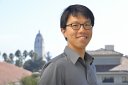
 Li-Yang Tan
· 4 previous affiliations
- Stanford UniversitySince 2018
- Assistant Professor · Since 2018
- Postdoc · 2015–2018
- Postdoc · 2014–2015
- Columbia University2008–2014
- PhD student · 2008–2014
1 other author named Li-Yang Tan: Li-Yang Tan (8 papers)
Research Overview
Li-Yang Tan focuses on theoretical computer science and complexity theory, with an emphasis on the analysis of Boolean functions, circuit complexity, and computational learning theory. His trajectory spans foundational work on random restrictions and sum-of-squares proofs to recent investigations into the inherent computational hardness of interpretable machine learning models. Currently, he investigates the theoretical limits and computational-statistical trade-offs of decision tree learning and property testing.
Research Trajectory
Tan’s early research established foundational results in the analysis of Boolean functions and circuit complexity. In 2010, he contributed to the research area of Weight Degree Tradeoffs in Polynomial Threshold Functions with his work on Bounding the average sensitivity and noise sensitivity of polynomial threshold functions. He subsequently explored the structural properties of Boolean functions through the lens of Fourier analysis, advancing the broader area of Amplifying Complexity Gaps via Function Composition in the 2013 paper A Composition Theorem for the Fourier Entropy-Influence Conjecture.
Expanding his methodological toolkit, Tan began applying advanced proof systems to fundamental inequalities in theoretical computer science. This is exemplified by his 2014 work in the research direction of Certifiable Robust Statistics via Sum of Squares. In Hypercontractive inequalities via SOS, and the Frankl-Rödl graph, he demonstrated how the Sum-of-Squares proof system could be used to certify complex graph properties, such as bounding the size of independent sets in Frankl-Rödl graphs—a task previously intractable for standard optimization algorithms. Around this time, his focus on the structural limits of computation also led to Boolean Function Monotonicity Testing Requires (Almost) n1/2 Non-adaptive Queries (2015) and An Average-Case Depth Hierarchy Theorem for Boolean Circuits (2015). The latter resolved an open question regarding circuit depth, proving that depth-$d$ formulas computing specific functions cannot be approximated by depth-$(d-1)$ circuits without an exponential blowup in size.
By 2018, Tan’s work heavily featured the research direction of The Method of Random Restrictions in Circuit Complexity, particularly in the context of derandomization. In Improved pseudorandom generators from pseudorandom multi-switching lemmas, he introduced highly efficient pseudorandom generators for low-depth Boolean circuits and sparse polynomials by derandomizing Håstad’s multi-switching lemma. He leveraged similar frameworks to break a long-standing quasipolynomial barrier in satisfiability algorithms, presenting an "almost polynomial time" deterministic algorithm in Deterministic search for CNF satisfying assignments in almost polynomial time. Concurrently, he continued his work on property testing, contributing to the area of Spectral Concentration and Junta Approximation with Settling the Query Complexity of Non-adaptive Junta Testing.
In recent years, Tan’s trajectory has increasingly bridged classical complexity theory with the theoretical foundations of machine learning. A major theme of this recent work is understanding the computational hardness of learning algorithms. In Computational-Statistical Tradeoffs from NP-hardnes (2025), his research group established a fundamental link between NP-hardness and the trade-offs between time and sample complexity, demonstrating that requiring more samples can sometimes enable significantly faster algorithms.
This focus on hardness extends deeply into interpretable machine learning models. In 2026, Tan and his collaborators published Superconstant Inapproximability of Decision Tree Learning, proving that learning decision trees remains NP-hard even when the algorithm is permitted to output a tree slightly larger than optimal. They reinforced these limits in Superpolynomial Lower Bounds for Decision Tree Learning and Testing, showing that constructing or verifying small decision trees requires superpolynomial time even with full knowledge of the underlying data distribution. Alongside these lower bounds, Tan has continued to develop positive algorithmic results. Contributing to the area of Analyzing Boolean Functions via Gaussian Invariance, he co-authored A Strong Composition Theorem for Junta Complexity and the Boosting of Property Testers (2026), which introduced generic boosting algorithms that allow property testers for simpler problems to solve more complex ones. Finally, in Samplability makes learning easier (2026), his team explored the distinction between standard PAC learning and samplable PAC learning, proving that restricting the learning requirement to distributions that can actually be sampled substantially expands the power of efficient learners.
Current Directions
The most recent papers in the evidence indicate a strong focus on the intersection of computational complexity and machine learning theory. A primary current direction involves establishing rigorous lower bounds and inapproximability results for interpretable machine learning models, particularly decision trees. This work demonstrates that even with relaxed optimality constraints or full knowledge of the data distribution, learning optimal decision trees remains computationally intractable. Additionally, recent investigations explore how foundational learning frameworks can be refined—such as shifting from standard PAC learning to samplable PAC learning—to reveal new computational-statistical trade-offs and expand the theoretical capabilities of efficient algorithms.
Profile updated
Loading new papers…
Other researchers whose papers cluster into the same research directions — a proxy for overlapping technical interests and shared intellectual neighborhoods.
See something wrong? Report a mistake