

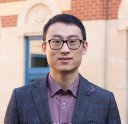
 Li Sun
· 8 previous affiliations
- Robert Bosch (Germany)Since 2024
- engineer · Since 2024
- Horizon Robotics (China)2023–2024
- applied scientist · 2023–2024
- Nio (China)2021–2023
- applied scientist · 2021–2023
- University of Sheffield2019–2021
- Assistant Professor · 2019–2021
- Postdoc · 2019
- University of Lincoln2017–2018
- Postdoc · 2017–2018
- University of Birmingham2016–2017
- Postdoc · 2016–2017
- University of Glasgow2012–2016
- PhD student · 2012–2016
6 other authors named Li Sun: Li Sun (East China Normal University · 274 papers), Li Sun (Beijing University of Post and Telecommunication · 238 papers), Li Sun (University of Hong Kong · 8 papers), Li Sun (Amazon (United States) · Boston University · 8 papers), Li Sun (4 papers), and 1 more
Research Overview
Li Sun focuses on visually guided robotic manipulation, large-scale 3D semantic mapping, and long-term autonomous navigation. His early work addressed the challenges of handling highly deformable objects before expanding into robust spatial perception and localization for mobile robots in dynamic environments. Currently, he investigates advanced world models and vision-language-action policies to close the sim-to-real gap in autonomous driving.
Research Trajectory
Li Sun’s early research focused on the intersection of computer vision and robotic manipulation, specifically targeting the complex dynamics of clothing and fabrics. He developed heuristic-based strategies to flatten crumpled cloth by eliminating visually detected wrinkles, as detailed in A Heuristic-Based Approach for Flattening Wrinkled Clothes. This work utilized a hand-eye interactive learning system alongside a clothing simulator to close the effector-garment-visual sensing loop. He expanded on these interactive manipulation techniques in Accurate garment surface analysis using an active stereo robot head with application to dual-arm flattening. Together, these efforts formed a core contribution to the research direction of Learning Representations for Deformable Object Manipulation.
Following his work on manipulation, his focus shifted toward spatial perception, mapping, and localization for mobile robots. He began integrating semantic understanding into 3D spatial representations. In Integrating Deep Semantic Segmentation Into 3-D Point Cloud Registration, he explored how deep semantic features could improve the alignment of 3D point clouds, advancing the broader area of Probabilistic Bayesian Fusion for 3D Semantic Mapping. He also addressed the computational efficiency of these systems in large spaces, contributing to Localising Faster: Efficient and precise lidar-based robot localisation in large-scale environments.
By 2021, his research increasingly emphasized robust autonomy and the application of deep learning to localization challenges. He introduced methods for robots to monitor their internal neural network uncertainty in Introspective Visuomotor Control: Exploiting Uncertainty in Deep Visuomotor Control for Failure Recovery. This allowed systems to detect high-uncertainty states and backtrack to confident configurations without relying on external failure detectors, contributing to areas such as Backtracking to Known Safe States for Robust Autonomy, Planning and Recovery for Irreversible Agent Actions, and Mitigating Compounding Errors in Imitation Learning. Around the same time, he tackled visual navigation in changing conditions with Robust and Long-term Monocular Teach and Repeat Navigation using a Single-experience Map. To handle large-scale 3D point cloud place recognition in GPS-denied environments, he developed NDT-Transformer: Large-Scale 3D Point Cloud Localisation using the Normal Distribution Transform Representation. This architecture combined the efficient NDT representation with a Transformer network, advancing the research direction of Visual Place Recognition Across Extreme Appearance Changes alongside techniques in Deep Metric Learning with Triplet Loss and Permutation Invariant Architectures for Unordered Point Sets.
As his work progressed, he articulated a broader vision for continuous, in-situ learning. In Towards Long-term Autonomy: A Perspective from Robot Learning, he argued that robots must move beyond static, pre-trained models to adapt to shifting environments and weather conditions. This perspective aligns with the area of Online Adaptation of Robot Dynamics Models, as well as Programmatic Weak Supervision for Scalable Machine Learning and All-Weather Perception for Autonomous Vehicles. He also explored biologically inspired sensors to overcome traditional vision limitations in EventPoint: Self-Supervised Interest Point Detection and Description for Event-based Camera. By proposing a time-surface representation called Ten-code, he enabled the extraction of descriptors without manual annotation, contributing to several areas including Contrast Maximization for Asynchronous Event-based Vision, Dense Scene Understanding from Sparse Event Streams, Polarity Preservation in Event Based Vision, and Overcoming the Data Drought in Event-Based Vision.
Returning to LiDAR and high-definition mapping, he introduced a 3D global descriptor for real-time loop closure detection in NDT-Map-Code: A 3D global descriptor for real-time loop closure detection in lidar SLAM, which reduced computational costs for challenging environments like underground parking and advanced the direction of Hybrid 2D and 3D Representations for Spatial Perception. He further investigated heterogeneous data fusion in A Hybrid Approach for Cross-Modality Pose Estimation Between Image and Point Cloud and Orientation-Aware Multi-Modal Learning for Road Intersection Identification and Mapping, framing intersection identification as an oriented object detection task to build high-definition maps. He also synthesized the state of the field in 3D ToF LiDAR for Mobile Robotics in Harsh Environments: A Review.
Current Directions
The most recent papers in the evidence address the intersection of generative AI, world models, and autonomous driving simulation. Recent work investigates how to efficiently train Vision-Language-Action (VLA) policies without relying on computationally heavy, high-fidelity simulators. For example, IRL-VLA: Training an Vision-Language-Action Policy via Reward World Model introduces a framework that learns a lightweight reward function via inverse reinforcement learning, facilitating closed-loop policy fine-tuning and advancing the broader area of Closing the Sim-to-Real Gap in Robotics.
Building on the need for scalable simulation, VectorWorld: Efficient Streaming World Model via Diffusion Flow on Vector Graphs presents a high-performance, streaming world model. By combining a motion-aware variational autoencoder with a one-step diffusion flow, this approach generates vectorized road-and-agent tiles on demand. This enables kinematically realistic, kilometer-scale closed-loop simulations for real-time interactive testing, contributing to the research direction of One Step Generative Inference via Trajectory Straightening and Consistency.
Profile updated
Loading new papers…
Other researchers whose papers cluster into the same research directions — a proxy for overlapping technical interests and shared intellectual neighborhoods.
See something wrong? Report a mistake