

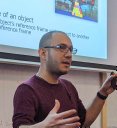
 Gerardo Aragon-Camarasa
· 1 previous affiliation
- University of GlasgowSince 2016
- Associate Professor · Since 2016
Research Overview
Gerardo Aragon-Camarasa focuses on robotic vision, deformable object manipulation, and multimodal perception systems. His early work developed active binocular vision and foveated spatial sampling techniques to optimize visual processing for autonomous systems. More recently, his research investigates the integration of large multimodal models into robotic pipelines and the creation of high-fidelity simulations for complex tasks like garment manipulation and industrial anomaly detection.
Research Trajectory
Aragon-Camarasa's early research concentrated on active robot vision systems. He developed frameworks combining binocular vergence, object recognition, and attention control without requiring explicit camera calibration, as detailed in Towards a unified visual framework in a binocular active robot vision system. Expanding on this pre-attentive visual search strategy, he introduced methods for Unsupervised clustering in Hough space for recognition of multiple instances of the same object in a cluttered scene, enabling the simultaneous detection of heavily occluded objects in cluttered environments.
A major theme in his subsequent work is the area of Foveated Spatial Sampling for Efficient Visual Processing. He proposed a biologically motivated "software retina" to drastically reduce data bandwidth for mobile robot vision in A Biologically Motivated Software Retina for Robotic Sensors for ARM-Based Mobile Platform Technology. During this period, he also contributed to modular robotic automation, applying chemical programming languages to automate complex organic synthesis in Organic synthesis in a modular robotic system driven by a chemical programming language. Simultaneously, he began addressing the challenges of robotic perception for non-rigid items, participating in the development of a hierarchical vision architecture for Autonomous Clothes Manipulation Using a Hierarchical Vision Architecture.
Building on these foundations, his lab advanced the research direction of Learning Representations for Deformable Object Manipulation. He directed research on Continuous perception for deformable objects understanding, which demonstrated that continuously perceiving the dynamic interactions of a garment's material during manipulation improves classification accuracy. He also continued to refine foveated vision systems, integrating them with modern deep learning. In Foveation in the Era of Deep Learning, his team introduced an end-to-end differentiable architecture utilizing graph convolutional networks to process non-uniformly sampled images, outperforming standard convolutional networks on multi-scale classification tasks.
More recently, Aragon-Camarasa has explored the integration of foundation models into robotics and the ergonomics of teleoperation. To simplify complex visual pipelines, he led the development of RoboLLM: Robotic Vision Tasks Grounded on Multimodal Large Language Models, leveraging pre-trained multimodal models to bypass task-specific encoders. This aligns with his broader interest in the area of Unified Representations via Multimodal Feature Fusion, further explored in Multiway-Adapter: Adapting Multimodal Large Language Models for Scalable Image-Text Retrieval, which introduced an efficient method for adapting large models while reducing computational costs. Parallel to this, he investigated the broader area of The Haptic Feedback Gap in Robotic Manipulation and teleoperation accessibility. His team designed TELESIM: A Modular and Plug-and-Play Framework for Robotic Arm Teleoperation using a Digital Twin to decouple control devices from physical hardware, and evaluated cross-cultural non-expert user experiences in Breaking Down the Barriers: Investigating Non-Expert User Experiences in Robotic Teleoperation in UK and Japan.
His most recent work focuses on rigorous benchmarking, simulation fidelity, and industrial applications. To address gaps in deformable object research, his group introduced Flat'n'Fold: A Diverse Multi-Modal Dataset for Garment Perception and Manipulation, providing extensive multi-view data of garment manipulation. They also systematically evaluated physics parameter estimation for sim-to-real transfer in Can Real-to-Sim Approaches Capture Dynamic Fabric Behavior for Robotic Fabric Manipulation?. Expanding into advanced manufacturing, he oversaw the creation of 3D-ADAM: A Dataset for 3D Anomaly Detection in Advanced Manufacturing, a large-scale industrial dataset for surface defect detection. Finally, he contributed to novel paradigms in defect recognition with Is Training Necessary for Anomaly Detection?, which proposed a training-free, memory-based retrieval framework for identifying anomalies.
Current Directions
The most recent papers in the evidence address the intersection of foundation models, high-fidelity simulation, and robust anomaly detection. Recent work investigates how multimodal large language models can be efficiently adapted to serve as unified backbones for robotic vision, reducing the reliance on specialized, task-specific encoders. Concurrently, Aragon-Camarasa's group is advancing the physical grounding of robotic manipulation through large-scale, multi-modal datasets and rigorous evaluations of real-to-sim parameter estimation, particularly for complex, deformable materials like fabrics. Finally, his research extends into industrial applications, focusing on training-free anomaly detection frameworks and comprehensive 3D datasets to improve surface defect recognition in advanced manufacturing environments.
Profile updated
Loading new papers…
Other researchers whose papers cluster into the same research directions — a proxy for overlapping technical interests and shared intellectual neighborhoods.
See something wrong? Report a mistake