

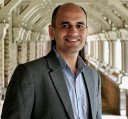
 Kuldeep S. Meel
· 3 previous affiliations
- University of TorontoSince 2023
- Associate Professor · Since 2023
- Current
- Georgia Institute of TechnologySince 2024
- Associate Professor · Since 2024
- National University of Singapore2017–2024
- Associate Professor · 2023–2024
- Assistant Professor · 2017–2023
Research Overview
Kuldeep S. Meel focuses on automated reasoning, scalable model counting, and probabilistic inference. His research bridges theoretical computer science and practical software engineering by developing randomized algorithms and formal methods to handle highly uncertain environments. Recently, his work has expanded to include formal explainability in machine learning and the verification of binarized neural networks.
Research Trajectory
Meel’s early research focused on the foundational challenges of functional verification and propositional model counting. In 2013, he participated in developing techniques for the uniform generation of solutions for Boolean constraints in A Scalable and Nearly Uniform Generator of SAT Witnesses. Concurrently, he contributed to practical alternatives to exact model counting for CNF formulas in A Scalable Approximate Model Counter. These efforts laid the groundwork for his sustained engagement with the broader area of Scalable Model Counting via XOR Partitioning.
Building on this foundation, Meel collaborated on algorithms designed to handle formulas with tens of thousands of variables. In Distribution-Aware Sampling and Weighted Model Counting for SAT (2014), he helped introduce scalable methods for approximate weighted model counting that avoid expensive queries, advancing the research direction of Scaling Probabilistic Inference Under High Distribution Tilt. This work also provided insights into the area of The Gap Between Theoretical and Empirical Error Bounds. He subsequently led work combining universal hashing with SAT solving to maintain correctness guarantees at scale in Constrained Sampling and Counting: Universal Hashing Meets SAT Solving, contributing significantly to the research direction of Weighted Sampling and Counting for Constrained Spaces. Expanding these techniques beyond Boolean domains, he participated in adapting hashing-based model counting for finite discrete domains using Satisfiability Modulo Theories (SMT) solvers in Approximate Probabilistic Inference via Word-Level Counting.
Meel continued to refine hashing techniques for probabilistic inference, as detailed in Sparse Hashing for Scalable Approximate Model Counting: Theory and Practice, which furthered the direction of Sparse Hashing for Scalable Model Counting. In 2022, he oversaw the development of a simplified, space-efficient algorithm for estimating distinct elements in data streams in Distinct Elements in Streams: An Algorithm for the (Text) Book. Returning to the theoretical limits of probabilistic inference, he collaborated on analyzing the complexity of distance measures in On Approximating Total Variation Distance. This work proved that calculating Total Variation distance is #P-complete while providing deterministic approximation schemes, contributing to the research direction of The Computational Intractability of Total Variation Distance. More recently, he investigated the theoretical foundations of automated program generation, detailing the fundamental limits and capabilities of SAT-based tools in The Limitations and Power of NP-Oracle-Based Functional Synthesis Techniques.
Current Directions
Recent work investigates the intersection of automated reasoning with machine learning verification, formal explainability, and the development of practical randomized approximation schemes. In the domain of machine learning, Meel has guided research on formal explainability, focusing on computing mathematically guaranteed "sufficient reasons" for decisions made by linear models in Probabilistic Explanations for Linear Models. He has also directed efforts to apply satisfiability solvers and model counters to the certified reasoning of safety-critical binarized neural networks in Efficient Certified Reasoning for Binarized Neural Networks.
Concurrently, he continues to advance the theory of approximate counting, introducing fully polynomial-time randomized approximation schemes (FPRAS) for complex data structures. This includes new analysis techniques for non-deterministic read-once branching programs in An FPRAS for Model Counting for Non-Deterministic Read-Once Branching Programs and efforts to improve the time complexity of approximations for non-deterministic finite automata in Towards practical FPRAS for #NFA: Exploiting the Power of Dependence. His most recent theoretical investigations also encompass distance estimation for high-dimensional discrete distributions using conditional sampling in Distance Estimation for High-Dimensional Discrete Distributions and techniques for Counting and Sampling Traces in Regular Languages.
Profile updated
| Title | Venue | Year |
|---|---|---|
| Data-Aware Sensitivity Quantification of Tree Ensembles | Openreview | 2027 |
| Artifact of On Lower Bounding Minimal Model Count (ICLP-24) | Dblp | 2026 |
| On the smallest antichain that generates an ideal of a given size | Journal of Combinatorial Theory Series A | 2026 |
| Artifact of ApproxASP- A Scalable Approximate Answer Set Counter | Dblp | 2026 |
| Estimating Size of the Union of Sets in Streaming Model | arXiv | 2026 |
| Counting and Sampling Traces in Regular Languages | Proc. ACM Program. Lang | 2026 |
| Provable Guarantees in Approximate Synthesis | DATE | 2026 |
| Relnet-ASP: A Fast and Accurate ASP Counting Based Network Reliability Estimator | Dblp | 2026 |
| SharpASP Artifact | Dblp | 2026 |
| Supplementary material of MinHit-ASP | Dblp | 2026 |
Loading new papers…
Other researchers whose papers cluster into the same research directions — a proxy for overlapping technical interests and shared intellectual neighborhoods.
See something wrong? Report a mistake