

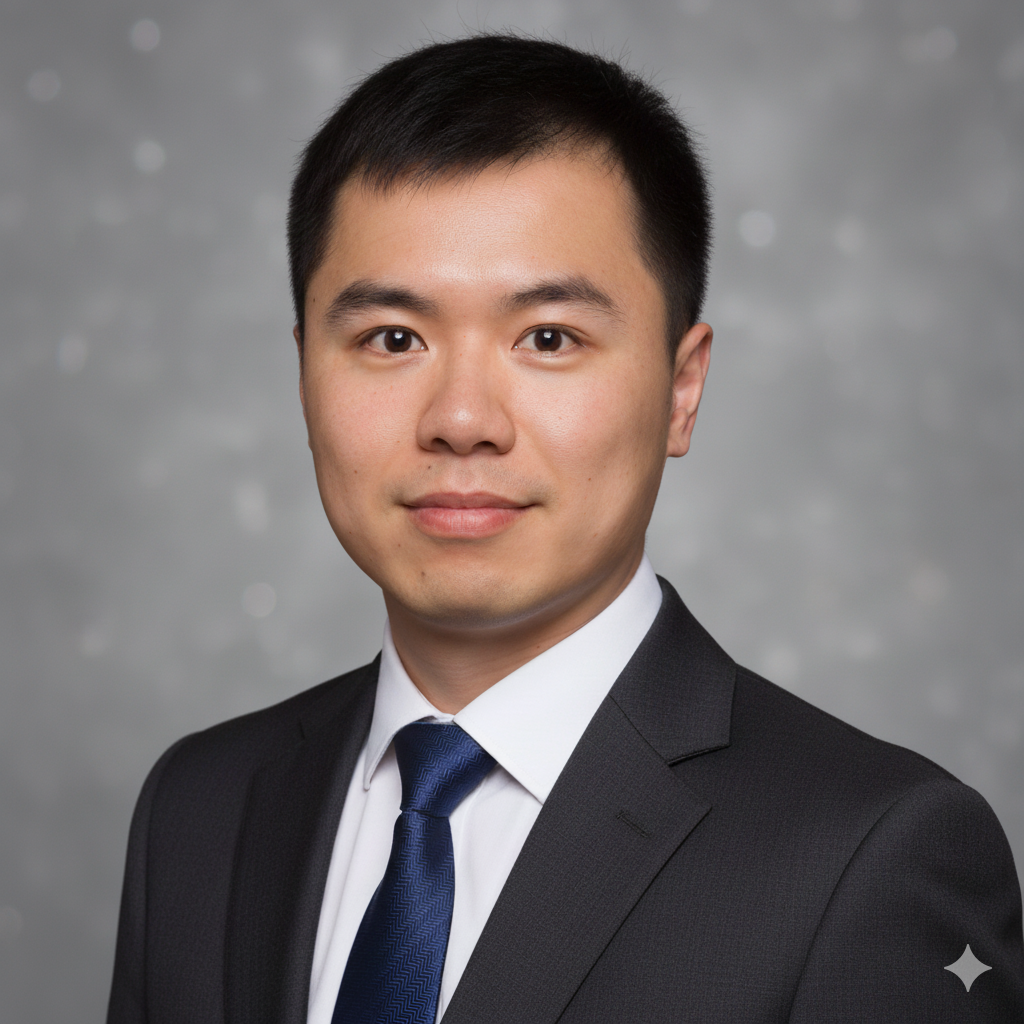
 Kai Wang
· 4 previous affiliations
- Current
- PhD student · 2023–2026
- University of Oregon2020–2023
- PhD student · 2020–2023
- University of Minnesota2018–2020
- MS student · 2018–2020
- Undergrad student · 2012–2016
18 other authors named Kai Wang: Kai Wang (National University of Singapore · 117 papers), Kai Wang (97 papers), Kai Wang (City University of Hong Kong (Dongguan) · 67 papers), Kai Wang (Georgia Institute of Technology · 56 papers), Kai Wang (Shanghai Jiao Tong University · 28 papers), and 13 more
Research Overview
Kai Wang focuses on visual reasoning, reinforcement learning for language-guided agents, and generative modeling for image synthesis. Early work addressed concept induction and hierarchical planning in embodied environments, while more recent efforts explore latent space manipulation and sample-efficient fine-tuning for diffusion models. His current research investigates robust generalization in few-shot learning and disentangled control for generative architectures.
Research Trajectory
Beginning in 2021, Wang contributed to research on concept induction and visual reasoning. In Interpretable Visual Reasoning via Induced Symbolic Space, he and his collaborators developed the object-centric compositional attention model (OCCAM). This work sought to identify concepts and their hierarchical relationships from question-answer pairs associated with images. By leveraging clues from the attention patterns between objects' visual features and question words, the method induces a symbolic concept space that improves the overall interpretability of visual reasoning tasks.
Moving into 2022, he addressed language-conditioned reinforcement learning, specifically focusing on the "reading to act" problem where agents must follow concise instructions using textual knowledge about their environment. He introduced Feudal Reinforcement Learning by Reading Manuals, a framework designed to bridge the semantic gap between high-level language descriptions and low-level environmental actions—a challenge that previously required heavily engineered human curricula. The proposed architecture features a multi-hop planning manager agent that generates sub-goals from abstract information, alongside a worker agent that executes low-level perceptions and actions to achieve those goals.
In subsequent years, Wang's focus expanded to include generative modeling and latent space manipulation. Participating in the research direction of Disentangling Identity from Facial Attributes and the broader area of Disentangled Control in Generative Latent Spaces, he contributed to Decoding Micromotion in Low-dimensional Latent Spaces from StyleGAN. This 2024 paper investigates how temporal motion is implicitly encoded within StyleGAN architectures trained entirely on static images. The research extracts "micromotion" subspaces to enable realistic, controllable facial animations, such as expressions and head movements. Crucially, these discovered motion directions transfer robustly across different identities and artistic domains, offering a lightweight approach to image manipulation.
Most recently, Wang has investigated sample-efficient fine-tuning for large-scale generative models, contributing to the research area of Addressing Overfitting in Few-Shot Learning. In Specialist Diffusion: Plug-and-Play Sample-Efficient Fine-Tuning of Text-to-Image Diffusion Models To Learn Any Unseen Style, he and his co-authors introduced a framework for teaching text-to-image diffusion models new artistic styles using fewer than ten example images. The approach combines custom data augmentation, a content loss mechanism for disentanglement, and sparse updating of diffusion steps to capture sophisticated and unusual styles without extensive retraining.
Current Directions
The most recent papers in the evidence indicate a strong focus on the efficiency and controllability of generative architectures. Recent work investigates how to manipulate the latent spaces of established models—such as extracting implicit temporal dynamics from static image generators—to achieve fine-grained control over outputs. Additionally, Wang is addressing the challenge of sample efficiency in large text-to-image diffusion models. By developing specialized fine-tuning frameworks that require minimal data, this ongoing research aims to improve robust generalization and enable rapid adaptation to unseen visual styles while maintaining strict content disentanglement.
Profile updated
Loading new papers…
Other researchers whose papers cluster into the same research directions — a proxy for overlapping technical interests and shared intellectual neighborhoods.
See something wrong? Report a mistake