

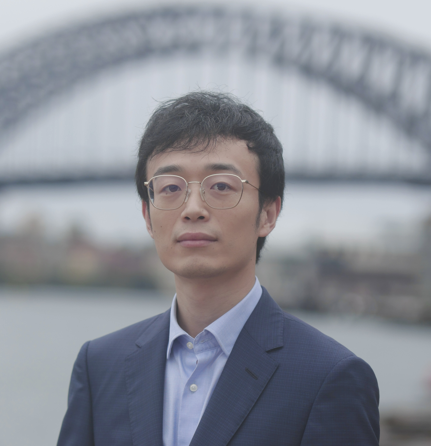
 Kai Wang
· 3 previous affiliations
- Shanghai Jiao Tong UniversitySince 2022
- Associate Professor · Since 2024
- Current
- Assistant Professor · 2022–2024
- UNSW Sydney2016–2022
- Postdoc · 2020–2022
- PhD student · 2016–2020
- Zhejiang University2012–2016
- Undergrad student · 2012–2016
18 other authors named Kai Wang: Kai Wang (National University of Singapore · 117 papers), Kai Wang (97 papers), Kai Wang (City University of Hong Kong (Dongguan) · 67 papers), Kai Wang (Georgia Institute of Technology · 56 papers), Kai Wang (Nankai University · 21 papers), and 13 more
Research Overview
Kai Wang focuses on large-scale graph algorithms, cohesive subgraph mining, and network resilience optimization. His early work developed efficient computational methods for analyzing bipartite and heterogeneous information networks, particularly through core and clique detection. More recently, his research addresses neural community search and combinatorial optimization for robust network design.
Research Trajectory
Wang's early research established foundational algorithms for structural graph analysis, with a particular emphasis on bipartite networks. In 2018, he introduced methods for Efficient Computing of Radius-Bounded k-Cores, addressing the computational challenges of finding densely connected subgraphs with strict distance constraints. Expanding on bipartite graph analytics, he developed Vertex Priority Based Butterfly Counting for Large-scale Bipartite Networks, optimizing the enumeration of fundamental structural motifs in massive datasets.
In 2021, his work broadened to encompass heterogeneous and temporal network models. He contributed to comprehensive frameworks for Cohesive Subgraph Search over Big Heterogeneous Information Networks: Applications, Challenges, and Solutions, exploring how multi-typed objects and links impact community detection, product recommendation, and fraud detection. Concurrently, he investigated temporal dynamics, participating in the design of algorithms for Efficiently Answering Reachability and Path Queries on Temporal Bipartite Graphs. Returning to cohesive structures, he proposed new techniques for Efficient and Effective Community Search on Large-scale Bipartite Graphs.
The following year, Wang deepened his focus on bipartite graph hierarchies and dense subgraph extraction. He presented algorithms for Efficient Personalized Maximum Biclique Search and formulated a novel bipartite hierarchy model based on core connectivity in Discovering Hierarchy of Bipartite Graphs with Cohesive Subgraphs. He also advanced the state of the art in truss analytics with Towards efficient solutions of bitruss decomposition for large-scale bipartite graphs. Alongside his primary focus on graph mining, Wang participated in natural language processing research, specifically addressing the area of Zero-Shot Cross-Lingual Transfer in Multilingual Language Models and the methodological domain of Gradient Surgery for Multi-Task Optimization. In Less-forgetting Multi-lingual Fine-tuning, he collaborated on a constrained optimization approach to mitigate the loss of pre-trained cross-lingual knowledge during multi-lingual fine-tuning.
Moving into 2023 and 2024, Wang's research increasingly integrated neural network architectures and tackled unprecedented scales. He contributed to Scaling Up k-Clique Densest Subgraph Detection, pushing the boundaries of exact subgraph discovery. His work on community search evolved to incorporate representation learning, as seen in his contributions to Efficient Unsupervised Community Search with Pre-trained Graph Transformer. He also continued to refine structural constraints, contributing to Size-bounded Community Search over Large Bipartite Graphs, which intersects with the broader research directions of Strongly Local Graph Clustering and Cohesive Subgraph Mining with Diameter Constraints.
Addressing billion-scale attributed networks, he collaborated on ALICE, a framework detailed in Neural Attributed Community Search at Billion-Scale, which intelligently prunes graphs before applying consistency-aware neural networks to identify communities. Finally, overseeing research on network robustness, he guided the development of Optimizing Network Resilience via Vertex Anchoring. This work introduced the Follower Maximization problem and the AdvGreedy algorithm, advancing the fields of Connectivity Augmentation for Resilient Network Design and Tightening Approximation Guarantees for Combinatorial Optimization by using shell components to efficiently anchor key users and boost overall network engagement.
Current Directions
Wang's most recent work investigates the intersection of massive-scale graph algorithms and deep learning, alongside combinatorial optimization for network robustness. A primary focus is the development of neural frameworks for attributed community search, utilizing pre-trained graph transformers and intelligent pruning techniques to scale community detection to billion-edge networks. Additionally, his recent research addresses network resilience, formulating new optimization problems to maximize user engagement and structural robustness through strategic vertex anchoring.
Profile updated
| Title | Venue | Year |
|---|---|---|
| Account Risk Detection in Large-Scale Financial Graphs With Auxiliary Asset Prediction | IEEE TKDE | 2026 |
| Multivariate Time Series Imputation with Signal-Noise Disentangled Graph Propagation | Openreview | 2026 |
| Awakening the Hydra: Stabilizing Multi-Concept Backdoor Injection in Text-to-Image Diffusion Models | arXiv | 2026 |
| Size-bounded Community Search over Large Bipartite Graphs | Edbt | 2024 |
| Optimizing Network Resilience via Vertex Anchoring | WWW | 2024 |
| Missing Data Imputation with Uncertainty-Driven Network | Proceedings of the ACM on Management of Data | 2024 |
| Efficient Unsupervised Community Search with Pre-trained Graph Transformer | arXiv | 2024 |
| Scaling Up k-Clique Densest Subgraph Detection | Proc. ACM Manag. Data | 2023 |
| Neural Attributed Community Search at Billion Scale | Proceedings of the ACM on Management of Data | 2023 |
| Minimizing the Influence of Misinformation via Vertex Blocking | arXiv | 2023 |
Loading new papers…
Other researchers whose papers cluster into the same research directions — a proxy for overlapping technical interests and shared intellectual neighborhoods.
See something wrong? Report a mistake