

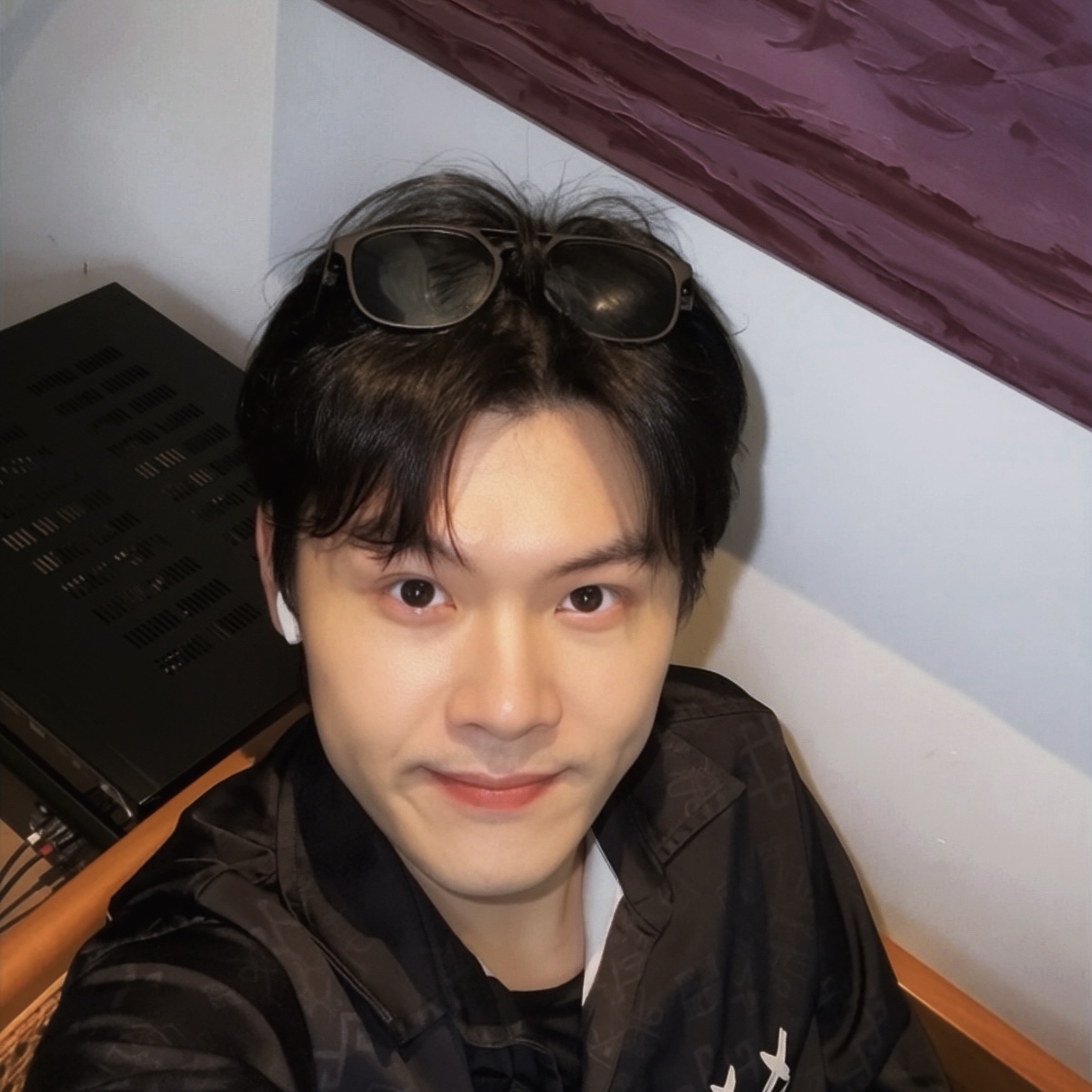
 JUNCHUAN ZHAO
· 5 previous affiliations
- 腾讯Since 2026
- Research Intern · Since 2026
- National University of SingaporeSince 2022
- PhD student · 2024–2028
- Current
- MS student · 2022–2023
- 新加坡国立大学2023–2024
- Student Research Assistant · 2023–2024
- 清华大学2019–2023
- Student Research Assistant · 2023
- Research Assistant · 2019–2020
- Undergrad student · 2018–2022
Research Overview
Junchuan Zhao focuses on sound and music computing, with an emphasis on singing voice synthesis, speech generation, and multimodal emotion recognition. His research explores generative modeling techniques to improve stylistic consistency, precise technique control, and zero-shot capabilities in audio synthesis. Currently, his work addresses efficient bandwidth extension and hierarchical decoding for high-fidelity, naturalistic speech and music generation.
Research Trajectory
Junchuan Zhao’s research trajectory began with symbolic music generation, focusing on the structural coherence of AI-generated compositions. In 2022, he introduced An Improved Time Series Network Model Based on Multitrack Music Generation, which addressed the common issue of structural loss in multitrack music. By implementing a context generator to manage cross-track relationships and a modified mapping model, this work improved rhythmic quality and stylistic consistency, contributing to the broader area of Vertical Synchronization in Multi-Track Music Generation.
Transitioning toward vocal synthesis, his subsequent work emphasized fine-grained control and zero-shot capabilities in singing voice generation. He developed SinTechSVS: A Singing Technique Controllable Singing Voice Synthesis System, which integrated transfer learning to enable precise control over vocal techniques, bridging the gap between synthesized audio and human emotional expression. Expanding on this, he addressed multi-singer scenarios with SPSinger: Multi-Singer Singing Voice Synthesis with Short Reference Prompt. This system utilized a global encoder within a diffusion framework to capture consistent timbre features from brief, five-second audio prompts, allowing for singer-specific generation without prior training on the target voice.
In 2025, his research broadened to encompass zero-shot voice conversion and multimodal communication. With collaborators, he investigated zero-shot voice cloning in Prosody-Adaptable Audio Codecs for Zero-Shot Voice Conversion via In-Context Learning. By introducing a Prosody-Aware Codec Encoder, this research explicitly separated vocal timbre from intonation, advancing the research direction of Decoupling Voice Identity from Prosody in Speech Generation. Concurrently, he explored emotional mismatches in multimodal contexts with InconVAD: A Two-Stage Dual-Tower Framework for Multimodal Emotion Inconsistency Detection. This framework mapped speech and text into a continuous Valence-Arousal-Dominance space to detect sarcasm and incongruity, contributing to research areas such as Modeling Cross Modal Semantic Incongruity and Uncertainty Aware Multimodal Fusion. Extending his work into visual domains, he also developed KSDiff: Keyframe-Augmented Speech-Aware Dual-Path Diffusion for Facial Animation, a diffusion-based framework that disentangles expression and head-pose features to synchronize fluid facial dynamics with audio.
His most recent work in 2026 focuses on the efficiency and fidelity of neural audio codecs and discrete speech synthesis. He proposed CodecFlow: Efficient Bandwidth Extension via Conditional Flow Matching in Neural Codec Latent Space, a framework that operates within compact latent spaces to restore high-frequency audio content. To improve the naturalness of AI-generated speech, he introduced Hierarchical Decoding for Discrete Speech Synthesis with Multi-Resolution Spoof Detection, a training-free method that prunes unnatural patterns in discrete codec tokens during inference. Returning to singing synthesis, he developed CoMelSinger: Discrete Token-Based Zero-Shot Singing Synthesis With Structured Melody Control and Guidance, which leverages discrete tokens for precise melody conditioning and timbre disentanglement. Additionally, he participated in research on symbolic music rendering with Bridging Piano Transcription and Rendering via Disentangled Score Content and Style, exploring the separation of musical content from performance style.
Current Directions
The most recent papers in the evidence indicate a focus on discrete token-based audio generation and the manipulation of neural audio codec latent spaces. Current work investigates training-free decoding strategies to improve the naturalness of synthesized speech, as well as conditional flow matching techniques for efficient bandwidth extension. A continuing theme across these domains is the disentanglement of audio features—specifically separating timbre, prosody, and melody—to enable high-fidelity, zero-shot synthesis across both speech and singing voice applications.
Profile updated
Loading new papers…
Other researchers whose papers cluster into the same research directions — a proxy for overlapping technical interests and shared intellectual neighborhoods.
See something wrong? Report a mistake