

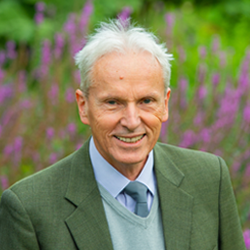
 Josef Kittler
· 1 previous affiliation
- University of SurreySince 1986
- Full Professor · 1996–2028
- Current
- Associate Professor · 1986–1996
Research Overview
Josef Kittler focuses on multi-modal sensor fusion, visual object tracking, and self-supervised learning for vision models. His extensive trajectory spans foundational work in pattern recognition to contemporary architectures for integrating heterogeneous sensor data. Currently, his research addresses adaptive reliability weighting and the geometric modeling of visual features to improve perception in complex, multi-sensor environments.
Research Trajectory
Kittler's early work established foundational methods in pattern recognition and machine learning. In 1973, he explored A New Feature Selection Procedure for Pattern Recognition Based on Supervised Learning. Decades later, he formalized theoretical frameworks for ensemble methods in Combining classifiers: A theoretical framework.
Moving into deep learning for computer vision, he introduced novel loss functions for facial landmark localization. In Wing Loss for Robust Facial Landmark Localisation With Convolutional Neural Networks (2018), he developed a loss formulation that amplifies the impact of small and medium-range errors, advancing the research direction of Wing Loss for High Precision Coordinate Regression. He also began extensive work in the area of Complementary Fusion of Infrared and Visible Imagery. With collaborators, he developed MDLatLRR: A Novel Decomposition Method for Infrared and Visible Image Fusion (2020), a computationally efficient framework leveraging multi-level decomposition based on Latent Low-Rank Representation to preserve the unique strengths of different imaging modalities.
His research subsequently expanded into self-supervised pretraining strategies to improve the data efficiency of Vision Transformers. In GMML is All You Need (2023), his group introduced Group Masked Model Learning, which forces models to learn semantic concepts from context by masking connected tokens. This contributed to the broader areas of Data Efficient Vision Transformers via Self Supervised Pretraining and Semantic Masking for Global Structural Reasoning.
By 2025, his focus heavily emphasized multi-modal perception and tracking. He led the development of comprehensive datasets and algorithms for heterogeneous sensor suites. In Collaborating Vision, Depth, and Thermal Signals for Multi-Modal Tracking: Dataset and Algorithm, his team introduced the RGBDT500 dataset and the RDTTrack algorithm to fuse three data streams for enhanced robustness. He similarly addressed UAV tracking in A Tri-Modal Dataset and a Baseline System for Tracking Unmanned Aerial Vehicles, utilizing RGB, infrared, and event signals. To unify these diverse sensor combinations without requiring separate models, he proposed UASTrack: A Unified Adaptive Selection Framework with Modality-Customization in Single Object Tracking. This body of work significantly advanced the direction of Robust Visual Tracking with Multi-modal Sensor Fusion. He also synthesized the field's progress in Omni Survey for Multimodality Analysis in Visual Object Tracking, challenging the assumption that indiscriminate sensor fusion always improves performance—a key insight for the area of Adaptive Reliability Weighting for Multi Modal Perception.
Concurrently, he continued to innovate in image fusion architectures. He introduced GrFormer: A Novel Transformer on Grassmann Manifold for Infrared and Visible Image Fusion, which models image features as points on a manifold of linear subspaces to decouple high-frequency details from low-frequency semantics. He also developed One Model for ALL: Low-Level Task Interaction Is a Key to Task-Agnostic Image Fusion, a highly efficient framework prioritizing pixel-level guidance over high-level semantic supervision.
His recent work also addresses optimization and adaptation in distributed and zero-shot settings. He tackled performance degradation in federated learning through Hybrid Batch Normalisation: Resolving the Dilemma of Batch Normalisation in Federated Learning. In 2026, he participated in research on object-aware vision features in Object-Centric Refinement for Enhanced Zero-Shot Segmentation. He further explored post-hoc adaptation paradigms in MergeTune: Continued Fine-Tuning of Vision-Language Models, leveraging linear mode connectivity to recover pretrained knowledge lost during adaptation. Finally, he returned to image fusion with Text-Driven Fusion for Infrared and Visible Images: Achieving Image Scene Adaptation on Hyperbolic Space, utilizing hyperbolic geometry and text prompts as anchors during training to achieve scene adaptation. Expanding his work on visual synthesis and analysis in 2026, Kittler co-authored Towards data-efficient generalised portrait animation: Landmark-driven latent traversal with fine-grained control mechanism and contributed to Cog-VADU: A Training-Free Cognitive Reasoning Framework for Video Anomaly Detection and Understanding, which formulates video anomaly detection as a training-free sequential reasoning task using chain-of-thought prompting across video segments.
Current Directions
The most recent papers in the evidence address the complexities of multi-modal perception and the adaptation of large vision models. A primary focus is the development of unified tracking frameworks that can dynamically adapt to varying combinations of visible, thermal, depth, and event-based sensors. Concurrently, recent work investigates the use of non-Euclidean geometries—such as Grassmann manifolds and hyperbolic spaces—to better align and fuse heterogeneous image modalities. Additionally, ongoing research explores post-hoc fine-tuning strategies to merge zero-shot capabilities with task-specific adaptations in vision-language models, ensuring robust generalization without increased computational overhead.
Profile updated
Loading new papers…
Other researchers whose papers cluster into the same research directions — a proxy for overlapping technical interests and shared intellectual neighborhoods.
See something wrong? Report a mistake