

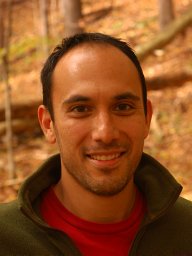
 Jonathan DeCastro
· 6 previous affiliations
- Toyota Research InstituteSince 2016
- Researcher · Since 2017
- Staff Research Scientist · Since 2016
- Cornell University2011–2016
- Graduate Research Assistant (PhD) · 2011–2016
- Cornell Tech2011–2016
- PhD student · 2011–2016
- Impact Technologies Group2008–2011
- Algorithms Specialist · 2008–2011
- Research Scientist · 2003–2008
- Virginia Tech1996–2003
- BS/MS, Mechanical Engineering · 1996–2003
Research Overview
Jonathan DeCastro focuses on the intersection of control theory, formal methods, and dynamical systems for robotics. His early work developed correct-by-construction controller synthesis and falsification algorithms to guarantee safe behaviors in complex physical systems. More recently, his research addresses human-AI shared control, personalized autonomous driving, and neuro-symbolic reinforcement learning for time-critical decision making.
Research Trajectory
During his doctoral studies at Cornell University, DeCastro developed methods to guarantee that high-level mission plans could be safely executed by robots with complex physical dynamics. This early research focused heavily on trajectory-based verification. In Guaranteeing reactive high-level behaviors for robots with complex dynamics (2013), he constructed low-level controllers that ensure the execution of high-level plans by computing robust reach tubes through sum-of-squares optimization. He subsequently addressed the challenge of physical constraints rendering missions impossible in Dynamics-Based Reactive Synthesis and Automated Revisions for High-Level Robot Control (2014). This framework automatically identified when a robot's inertia or other physical limitations violated mission rules and suggested human-readable revisions, contributing to the research direction of Diagnosing Unrealizability in Reactive Synthesis. This foundational period culminated in Synthesis of nonlinear continuous controllers for verifiably correct high-level, reactive behaviors (2015), which formalized the generation of continuous control policies that strictly adhere to reactive behavioral specifications.
After joining the Toyota Research Institute as a Research Scientist, his focus expanded to the safety, coordination, and evaluation of autonomous vehicles. Addressing the difficulty of formally verifying autonomous driving decisions, he proposed an iterative falsification and reachable set computation framework in Counterexample-Guided Safety Contracts for Autonomous Driving (2018). This work generated safety contracts that serve as design requirements for controller synthesis, ensuring adherence to traffic rules and probabilistic safety margins, which aligns with the broader research direction of Scaling Reactive Synthesis for Complex System Design. He also explored how formal properties could improve deep learning models in Better AI through Logical Scaffolding (2019), using lightweight physics laws and common sense as necessary conditions to guide AI training and explain decisions, advancing work in the area of Automated Rule Induction for Neuro-Symbolic AI.
In 2020, DeCastro investigated the complex dynamics of mixed autonomy and unsignalized intersections. Implicit Multi-Agent Coordination at Unsignalized Intersections via Topological Inference modeled traffic maneuvers as discrete topological braids, allowing autonomous agents to coordinate implicitly by choosing actions that reduce uncertainty about other drivers' intentions. Continuing to merge symbolic logic with modern learning techniques, he collaborated on The Logical Options Framework (2021). This hierarchical reinforcement learning approach produced modular policies guaranteed to satisfy rules while maximizing efficiency, contributing to the area of Decomposing Temporal Logic Specifications for Reinforcement Learning.
Between 2022 and 2024, his research increasingly emphasized personalized human-AI interaction and high-speed dynamic control. Learning Latent Traits for Simulated Cooperative Driving Tasks (2022) introduced a framework for extracting individual driver preferences from behavioral data to tailor AI assistance. This concept was deployed in Personalizing driver safety interfaces via driver cognitive factors inference (2024), where recurrent neural networks inferred latent cognitive traits—such as impulsivity—to personalize safety alerts in dilemma zones, a key advancement in the area of The Open-Loop Evaluation Gap in Autonomous Driving. For highly competitive and split-second environments, he developed Neural Nonlinear Opinion Dynamics in Think Deep and Fast: Learning Neural Nonlinear Opinion Dynamics from Inverse Dynamic Games for Split-Second Interactions (2024), enabling autonomous agents to make rapid, deadlock-free decisions in high-speed racing. Similarly, Dreaming to Assist: Learning to Align with Human Objectives for Shared Control in High-Speed Racing (2024) utilized a recurrent state-space model to infer human intent and provide tailored shared control.
Most recently, DeCastro's work addresses time-critical assistive systems and sample-efficient learning architectures. Timing the Message: Language-Based Notifications for Time-Critical Assistive Settings (2025) presents a reinforcement learning framework that optimizes the delivery of AI notifications by explicitly modeling the time required for speech, human comprehension, and subsequent reaction. Concurrently, Learning to Plan, Planning to Learn: Adaptive Hierarchical RL-MPC for Sample-Efficient Decision Making (2025) fuses Reinforcement Learning with Model Predictive Control to create a bi-directional learning pipeline, advancing the research direction of Foresighted Planning and World Models for LLM Agents. Extending these assistive capabilities to broader environments, he participated in the development of On the Strengths and Weaknesses of Data for Open-Set Embodied Assistance (2026), which evaluates how specialized synthetic datasets enable embodied AI models to generalize corrective assistance to unforeseen user errors.
Current Directions
The most recent work in the evidence focuses on the intersection of embodied AI, human-in-the-loop assistance, and sample-efficient control architectures. A major ongoing theme is the development of AI assistants capable of operating in time-critical and open-set environments, where predefined error categories are unavailable and human reaction times must be explicitly modeled to ensure interventions are both timely and informative. To support these complex interactions, current research also investigates hybrid decision-making frameworks that integrate the predictive, physics-aware capabilities of Model Predictive Control with the adaptability of Reinforcement Learning. This fusion aims to create more robust, sample-efficient autonomous systems capable of dynamic planning and real-time human alignment.
Profile updated
Loading new papers…
Other researchers whose papers cluster into the same research directions — a proxy for overlapping technical interests and shared intellectual neighborhoods.
See something wrong? Report a mistake