

 Authors
Export
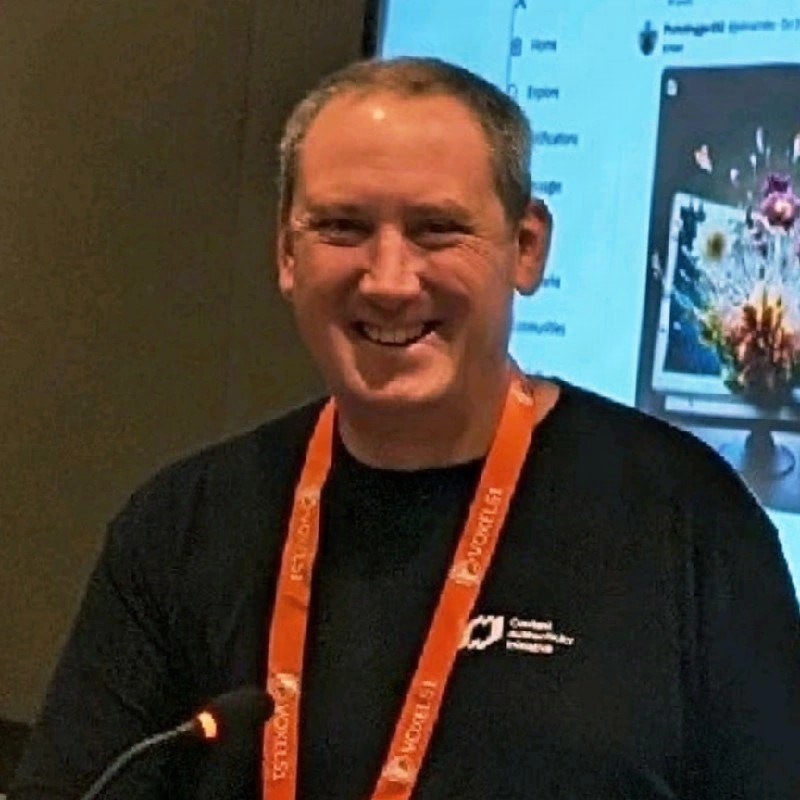
John Collomosse
· 5 previous affiliations
- Adobe Systems (United States)Since 2017
- Senior Principal Scientist. Senior Director / Research Manager. · Since 2024
- Principal Scientist. Research Manager. · Since 2021
- Principal Research Scientist · Since 2019
- Senior Principal Scientist · Since 2017
- University of SurreySince 2009
- Professor of Computer Vision · Since 2018
- Reader (Assoc. Prof.) in Computer Vision · 2017–2018
- Full Professor · 2009–2017
- University of Bath1997–2009
- Lecturer (Asst. Professor) in Computer Science · 2004–2009
- PhD, Computer Science (Vision, Graphics) · 2001–2004
- Bachelor of Science (BSc), Computer Science · 1997–2001
- Vodafone (United Kingdom)2008
- Consulting Research Scientist · 2008
- Hewlett-Packard (United States)2006–2007
- Consulting Research Scientist · 2006–2007
Research Overview
John Collomosse focuses on media provenance, computer vision, and artificial intelligence, with a particular emphasis on establishing trust in digital content. His trajectory spans early innovations in non-photorealistic rendering and 3D motion capture to extensive work in distributed ledger technologies for media integrity. Currently, his research addresses the intersection of generative AI and content authenticity, developing robust watermarking and decentralized attribution systems for digital media.
Research Trajectory
His early research explored non-photorealistic rendering and artistic stylization. In Cubist Style Rendering from Photographs, he introduced a technique to synthesize Cubist-style imagery from multiple 2D viewpoints, using salient facial features as compositional elements to convey motion without temporal dependence. This interest in stylization culminated in a comprehensive survey, State of the "Art": A Taxonomy of Artistic Stylization Techniques for Images and Video, which organized decades of non-photorealistic rendering research and highlighted the growing integration of computer vision into filtering approaches.
Moving into the mid-2010s, his focus expanded to include deep learning applications in retrieval and 3D computer vision. Contributing to the research direction of Deep Metric Learning with Triplet Loss, he helped develop Compact descriptors for sketch-based image retrieval using a triplet loss convolutional neural network. Concurrently, he advanced human pose estimation by fusing visual and inertial data. The paper Total Capture: 3D Human Pose Estimation Fusing Video and Inertial Sensors demonstrated how combining video with wearable sensors could improve tracking. This work evolved into Real-Time Multi-person Motion Capture from Multi-view Video and IMUs, which achieved highly accurate indoor and outdoor tracking without restrictive optical markers, advancing the broader area of Untethering 3D Motion Capture from Studio Infrastructure. He also explored the area of Sparse View 3D Reconstruction with Geometric and Generative Priors through Geo-PIFu: Geometry and Pixel Aligned Implicit Functions for Single-view Human Reconstruction, proposing a deep implicit function-based representation that uses a structure-aware 3D U-Net to recover detailed clothed human meshes from monocular images.
Returning to artistic style through a modern deep learning lens, he led the development of ALADIN: All Layer Adaptive Instance Normalization for Fine-grained Style Similarity. This architecture utilized weakly supervised contrastive learning on user-generated artwork groupings to search images based on subtle stylistic differences. Alongside computer vision, he began pioneering work in media provenance and decentralized systems. As a researcher affiliated with the University of Surrey and Adobe Research, he contributed to ARCHANGEL: Tamper-Proofing Video Archives Using Temporal Content Hashes on the Blockchain. This system introduced a deep network architecture for computing compact, codec-invariant temporal content hashes secured via a proof-of-authority blockchain, ensuring the long-term integrity of digital video archives.
With the rapid rise of generative AI, his recent trajectory has heavily emphasized content authenticity, watermarking, and causal attribution. In ProMark: Proactive Diffusion Watermarking for Causal Attribution, he proposed embedding imperceptible watermarks into training images so that diffusion models retain them in synthesized outputs, enabling the attribution of generated images to specific training concepts or styles. He contextualized these technical efforts in To Authenticity, and Beyond! Building Safe and Fair Generative AI Upon the Three Pillars of Provenance, contrasting metadata, fingerprinting, and watermarking as complementary trust signals. His work on privacy and decentralization in AI continued with PDFed: Privacy-Preserving and Decentralized Asynchronous Federated Learning for Diffusion Models, which introduced a blockchain-based federated learning framework and a novel metric to mitigate data memorization.
Most recently, he has expanded provenance techniques to novel modalities and advanced controllable generation. Addressing the protection of 3D assets, MultiNeRF: Multiple Watermark Embedding for Neural Radiance Fields introduced a framework for embedding multiple independent watermarks into a single NeRF model using conditional modulation. He further investigated the interactions of multiple hidden signals in On the Coexistence and Ensembling of Watermarks. To bridge the gap between generative AI developers and creative rightsholders, he co-authored Content ARCs: Decentralized Content Rights in the Age of Generative AI, contributing to the research direction of Robust Image Provenance Beyond Metadata. Concurrently, his research in generative control includes the papers Multitwine: Multi-Object Compositing with Text and Layout Control, Layout Representation Learning with Spatial and Structural Hierarchies, and Leveraging Multimodality for Controllable Image Generation. Together, these works advance the broader area of Localized and Semantic Control for Neural Stylization and contribute to the research direction of Decoupling Style from Content in Diffusion Models.
Current Directions
Recent work investigates the intersection of generative AI, media provenance, and controllable synthesis. A primary focus is the development of robust watermarking techniques that can coexist within complex digital supply chains, including methods for embedding multiple independent watermarks into novel representations like Neural Radiance Fields (NeRFs). Additionally, recent papers address the mechanisms of causal attribution and decentralized rights management to ensure creators are recognized when their data is used in generative models. Alongside provenance, ongoing research explores controllable image generation, specifically leveraging spatial hierarchies, layout controls, and multimodality to guide multi-object compositing and stylization in diffusion models.
Profile updated
| Paper | Venue | Year |
|---|---|---|
| Everything You Wanted to Know about Deep Learning for Computer Vision but Were Afraid to AskGitHubmaponti/ | Sibgrapi Tutorials | 2017 |
Loading new papers…
Other researchers whose papers cluster into the same research directions — a proxy for overlapping technical interests and shared intellectual neighborhoods.
See something wrong? Report a mistake