

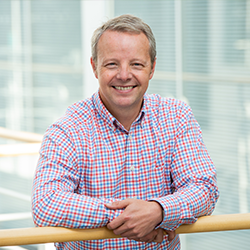
 Adrian Hilton
· 3 previous affiliations
- University of SurreySince 1992
- Director and co-Founder of the Surrey Institute for People-Centred Artificial Intelligence · Since 2021
- Director - Centre for Vision, Speech and Signal Processing · Since 2012
- Professor · Since 1992
- ALIVE · 2016
- Framestore2008–2012
- Royal Society Industry Fellow · 2008–2012
- University of Sussex1985–1991
- PhD student · 1988–1991
- Undergrad student · 1985–1988
Research Overview
Adrian Hilton focuses on 3D computer vision, human motion capture, and the reconstruction of complex dynamic scenes. His early work established foundational techniques for modeling human shape and performance from multi-view images. More recently, his research addresses multi-modal alignment, generative environment mapping, and the integration of deep learning with volumetric geometry for robust spatial reasoning.
Research Trajectory
Adrian Hilton's research trajectory begins in the mid-1990s with foundational contributions to surface reconstruction. He introduced an efficient algorithm for implicit surface polygonization in Marching triangles: range image fusion for complex object modelling, which utilized a local 3D constraint to derive Delaunay surface triangulations from multiple range images. Building on this geometric foundation, he shifted toward modeling human subjects, developing techniques to automatically construct moving 3D models of individuals. This was detailed in Whole-body modelling of people from multiview images to populate virtual worlds, which combined shape-from-silhouette reconstruction with generic humanoid priors to generate realistic facsimiles for virtual environments.
Throughout the 2000s, his research expanded into the analysis and capture of human movement. He participated in synthesizing the field's progress in A survey of advances in vision-based human motion capture and analysis, which reviewed methodologies for tracking and pose estimation in natural scenes. Recognizing the limitations of traditional marker-based skeletal tracking, he explored markerless surface capture techniques to record full-body performances for digital content production, as discussed in Surface Capture for Performance-Based Animation.
By the mid-2010s, the focus evolved toward complex, dynamic environments, integrating temporal coherence and semantic understanding into geometric pipelines. Work such as Segmentation Based Features for Wide-Baseline Multi-view Reconstruction addressed the challenges of multi-view matching. Overseeing the development of broader scene modeling frameworks, he guided methods for Temporally Coherent 4D Reconstruction of Complex Dynamic Scenes, which integrated sparse-to-dense temporal correspondence with joint multi-view segmentation to model moving objects without prior structural knowledge. This period also included research into hybrid capture systems, such as the fusion of video and inertial sensors for robust pose estimation in Total Capture: 3D Human Pose Estimation Fusing Video and Inertial Sensors. A major contribution to the research direction of Joint Semantic and Geometric Optimization for 3D Reconstruction was presented in Semantically Coherent Co-Segmentation and Reconstruction of Dynamic Scenes. This framework simultaneously segmented and reconstructed 3D scenes by enforcing semantic coherence across wide timeframes, utilizing "semantic tracklets" to maintain consistent object labels.
In recent years, the integration of deep learning has allowed for more flexible, monocular, and multi-modal approaches. Directing several projects, he advanced research into rendering and shape estimation from single images. This includes Learning Self-Shadowing for Clothed Human Bodies, which implicitly learns articulated body shapes to generate shadow maps from 2D inputs, and COSMU: Complete 3D Human Shape from Monocular Unconstrained Images, a framework designed to reproduce high-quality details in occluded regions of human bodies. His team also addressed temporal modeling challenges, generating synthetic data to train models for animal tracking in SyDog-Video: A Synthetic Dog Video Dataset for Temporal Pose Estimation, and preserving positional information for overlapping activities in An Effective-Efficient Approach for Dense Multi-Label Action Detection.
Expanding beyond purely visual geometry, he contributed to the broader area of Self-Supervised Learning via Audio-Visual Temporal Alignment with CAD - Contextual Multi-modal Alignment for Dynamic AVQA, a framework that bridges visual and auditory streams to answer complex questions about video content.
Most recently, his work has leveraged generative models and probabilistic spatial reasoning. He introduced specialized architectural adaptations for spherical data in HDR Environment Map Estimation with Latent Diffusion Models, utilizing latent diffusion to generate high-quality 360° maps from standard photographs. Additionally, Enhanced Multi-View Pedestrian Detection Using Probabilistic Occupancy Volume combined deep learning with traditional 3D visual hulls to focus attention on regions likely to contain people, advancing multi-view detection capabilities.
Current Directions
Recent work investigates the intersection of generative artificial intelligence, probabilistic 3D geometry, and multi-modal reasoning. A primary focus is on overcoming the limitations of monocular capture, utilizing latent diffusion models to synthesize high-dynamic-range environments and employing deep neural models to infer complex human shapes and self-shadowing from unconstrained 2D images. Additionally, ongoing research addresses spatial and temporal alignment challenges, ranging from probabilistic volumetric occupancy for multi-view pedestrian detection to contextual frameworks that synchronize audio and visual streams for dynamic video analysis.
Profile updated
Loading new papers…
Other researchers whose papers cluster into the same research directions — a proxy for overlapping technical interests and shared intellectual neighborhoods.
See something wrong? Report a mistake