

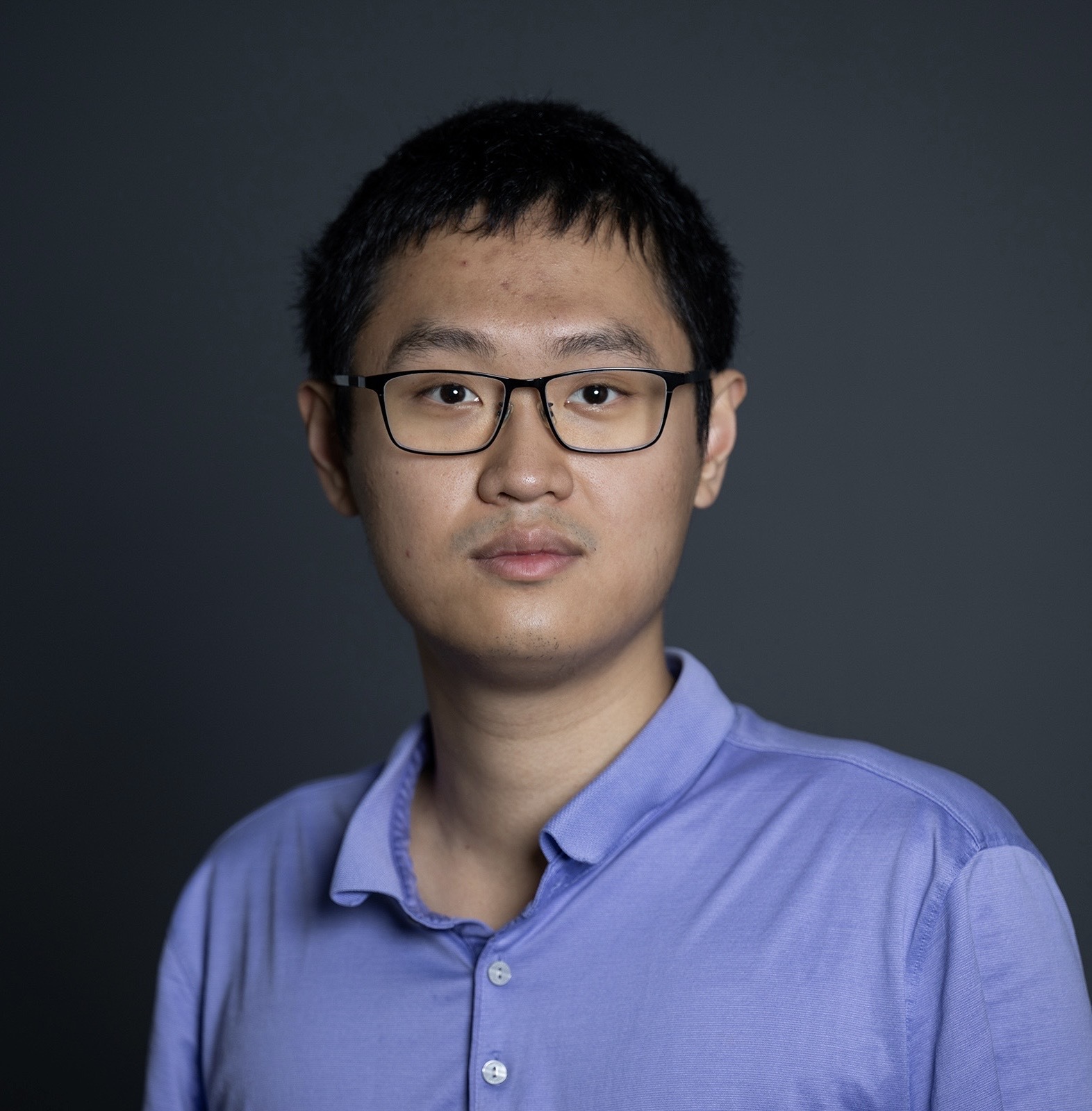
 Jin Peng Zhou
· 6 previous affiliations
- Cornell UniversityCurrent
- Current
- PhD student · 2021–2026
- Research Scientist Intern · 2025
- Student Researcher · 2024
- Google (United States)2021–2023
- Student Researcher · 2022–2023
- Software Engineer · 2021
- University of Toronto2016–2021
- Undergrad student · 2016–2021
- Vector Institute2020–2021
- Machine Learning Researcher · 2020–2021
Research Overview
Jin Peng Zhou focuses on large language models for mathematical reasoning, automated formal verification, and efficient model evaluation. His trajectory spans early work in recommendation systems and privacy to developing neurosymbolic methods that bridge informal mathematical intuition with rigorous theorem proving. Currently, he investigates reinforcement learning techniques for language model alignment and scalable test-time reasoning.
Research Trajectory
His early research explored collaborative filtering with implicit feedback, addressing popularity bias in recommendation systems by distilling user preferences from reviews in TAFA: Two-headed Attention Fused Autoencoder for Context-Aware Recommendations. He subsequently investigated privacy guarantees, contributing to the research direction of Label Differential Privacy and the Feature Proxy Problem by analyzing the effectiveness of label differential privacy against inference attacks in Does Label Differential Privacy Prevent Label Inference Attacks?.
Around 2023 and 2024, his focus expanded to generative models for out-of-distribution (OOD) detection. He proposed using diffusion models to map images toward in-domain distributions by lifting them from their original manifolds in Leveraging diffusion models for unsupervised out-of-distribution detection on image manifold. This approach was extended to zero-shot object-level detection using context-aware inpainting in Zero-shot Object-Level OOD Detection with Context-Aware Inpainting, which conditions the reconstruction process on predicted in-distribution labels to identify anomalous objects.
A major theme in his trajectory is the intersection of large language models and formal mathematics, advancing the research area of Bridging Informal Mathematical Intuition and Formal Verification. He participated in developing methods to map informal mathematical proofs to formal sketches, guiding automated provers toward easier sub-problems in Draft, Sketch, and Prove: Guiding Formal Theorem Provers with Informal Proofs. To improve the reliability of language models on quantitative tasks, he introduced a verification framework that translates informal math problems into formal code for rigorous checking by automated provers in Don't Trust: Verify -- Grounding LLM Quantitative Reasoning with Autoformalization. Contributing to the direction of Overcoming the Premise Selection Bottleneck in Formal Mathematics, he collaborated on a transformer-based approach that utilizes contrastive learning to find relevant mathematical facts in Magnushammer: A Transformer-Based Approach to Premise Selection. Furthering work in the areas of Taming Search Space Explosion in Formal Reasoning and Recursive Subgoal Decomposition for Automated Formal Verification, he developed techniques to extract and reuse theorems from existing proof libraries to augment automated prover accuracy in REFACTOR: Learning to Extract Theorems from Proofs.
Concurrently, he addressed the alignment and evaluation of language models. He explored reinforcement learning from personalized human feedback by merging the outputs of specialized expert models at the token level in Orchestrating LLMs with Different Personalizations. Recognizing the prohibitive costs of evaluating models across numerous prompts, he contributed to the broader area of Adaptive Resource Allocation for Efficient Model Selection by designing an adaptive framework using multi-armed bandits and low-rank matrix factorization in On Speeding Up Language Model Evaluation. He also investigated the paradoxical nature of automated grading, demonstrating that providing evaluator models with privileged information—such as ground-truth solutions and rubrics—yields expert-level assessments in Graders should cheat: privileged information enables expert-level automated evaluations.
In 2025, his collaborative work extended machine learning techniques to quantum computing challenges. He participated in designing a classical artificial intelligence framework utilizing attention mechanisms to characterize quantum state complexity from noisy measurements in Attention to quantum complexity. Additionally, he contributed to a modular machine-learning framework for decoding correlated errors in complex logical circuits in Learning to decode logical circuits.
Returning to language model optimization, he introduced a value-based reinforcement learning algorithm leveraging distributional RL and KL-regularization for fine-tuning in $Q\sharp$: Provably Optimal Distributional RL for LLM Post-Training. To scale test-time compute for deliberative reasoning, he co-developed a method that trains a value model on reasoning traces, allowing smaller models to match the performance of larger counterparts without relying on human-defined steps in Value-Guided Search for Efficient Chain-of-Thought Reasoning. His recent work also explores educational applications, using discrete graph diffusion and reinforcement learning to model student knowledge structures in CSG: Cognitive Structure Generation for Intelligent Education. Finally, he addressed the entanglement of linguistic skills and factual memorization by offloading knowledge to external databases during pre-training in Pre-training Limited Memory Language Models with Internal and External Knowledge.
Current Directions
The most recent papers in the evidence indicate a strong focus on scaling inference-time reasoning and optimizing the post-training of large language models. Recent work investigates value-guided search mechanisms to improve chain-of-thought reasoning efficiency and explores distributional reinforcement learning for mathematically principled model alignment. Additionally, current research addresses the architectural limitations of language models by decoupling factual memorization from linguistic capabilities through external knowledge retrieval, alongside applying cognitive structure generation to intelligent education systems.
Profile updated
Loading new papers…
Other researchers whose papers cluster into the same research directions — a proxy for overlapping technical interests and shared intellectual neighborhoods.
See something wrong? Report a mistake