

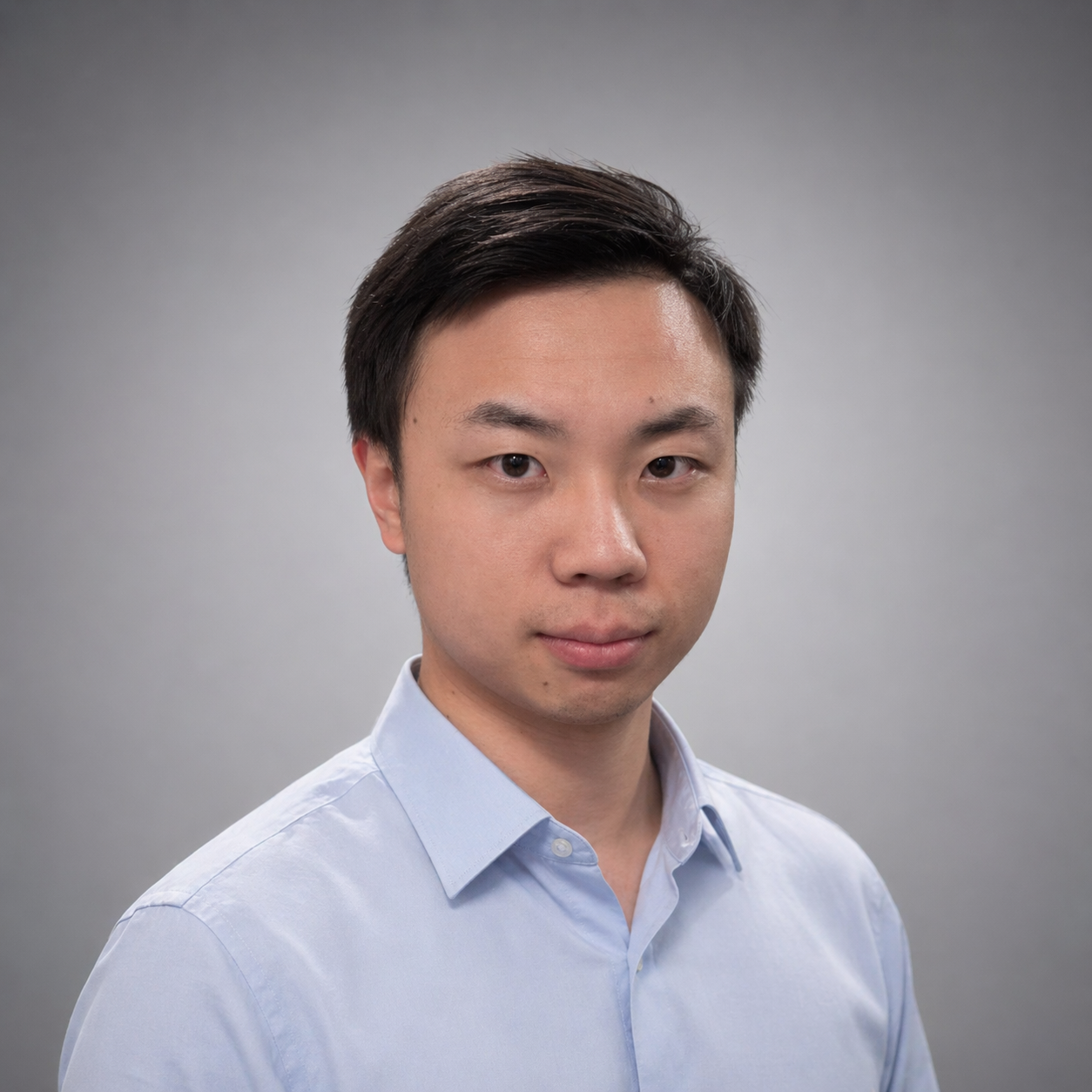
 Jie Ren
· 7 previous affiliations
- PhD student · 2023–2027
- Current
- Intern · 2024
- University of Edinburgh2021–2023
- Intern · 2021–2023
- ETH Zurich2023
- Intern · 2023
- Peking University2021–2022
- Intern · 2021–2022
- Megvii (China)2021–2022
- Researcher · 2021–2022
- Xidian University2017–2021
- Undergrad student · 2017–2021
6 other authors named Jie Ren: Jie Ren (Massachusetts Institute of Technology · 78 papers), Jie Ren (Google (United States) · 27 papers), Jie Ren (Shanghai Jiao Tong University · 23 papers), Jie Ren (9 papers), Jie Ren (1 paper), and 1 more
Research Overview
Jie Ren focuses on the co-design of scientific applications, high-performance middleware, and GPU architectures. His early work explored probabilistic modeling and differentiable optimization for deep reinforcement learning and topic models. Currently, he investigates memory-efficient training frameworks and differential privacy mechanisms to enable the scalable fine-tuning of massive language models on limited hardware.
Research Trajectory
Ren’s early research investigated probabilistic representations and hierarchical latent variable models. He introduced a differentiable probabilistic mixture-of-experts architecture embedded in end-to-end training to capture decomposable and hierarchical structures within complex tasks, improving the learning efficiency of deep reinforcement learning policies in Probabilistic Mixture-of-Experts for Efficient Deep Reinforcement Learning. Concurrently, he contributed to the area of Non-Negative Latent Representations via Weibull Reparameterization by participating in the development of a deep hierarchical topic model. This work, detailed in Sawtooth Factorial Topic Embeddings Guided Gamma Belief Network, utilized residual upward-downward inference networks combined with Weibull distributions to train deep architectures without posterior collapse. This methodology advanced several related research directions, including Sparse Latent Priors for Neural Topic Modeling, Modeling Semantic Dependencies in Correlated Topic Models, and Unified Vector Spaces for Words Senses and Topics.
In 2022, his focus expanded to the co-design of high-performance middleware and distributed optimization systems, particularly addressing the challenges of Parallelizing Sequential Computation for Modern Hardware. He developed MegBA: A GPU-Based Distributed Library for Large-Scale Bundle Adjustment, which partitions large bundle adjustment problems across parallel nodes, assigning sub-problems to distributed precondition conjugate gradient and Schur elimination solvers to match single-node precision at scale. Continuing this emphasis on scalable optimization, he created TorchOpt: An Efficient Library for Differentiable Optimization, a PyTorch-based framework designed to support multi-CPU and GPU execution for complex differentiable algorithms by providing a unified programming abstraction. During this period, he also collaborated on theoretical analyses of stochastic gradient estimators, identifying compositional bias incurred by two-level problem structures in A Theoretical Understanding of Gradient Bias in Meta-Reinforcement Learning. Additionally, he contributed to probabilistic generative modeling for visual tasks in Pluralistic Image Completion with Gaussian Mixture Models, proposing an end-to-end method to balance visual realism and diversity in ambiguous visual scenes.
More recently, Ren has concentrated on the memory and computational bottlenecks associated with training and fine-tuning large language models (LLMs). He helped design frameworks to enable massive model adaptation on constrained hardware, such as ZO-Offloading: Fine-Tuning LLMs with 100 Billion Parameters on a Single GPU, which leverages zeroth-order optimization and CPU offloading to bypass the memory overhead of backpropagation and activation caching. This approach was further refined in Scalable Zeroth-Order Fine-Tuning for Extremely Large Language Models with Limited GPU Memory, introducing the ZO2 framework with an efficient scheduling strategy to fine-tune models as large as OPT-175B on a single 18GB GPU without accuracy degradation.
Parallel to his work on zeroth-order optimization, he has advanced the research direction of Scaling Differentially Private Training by Reducing Gradient Overhead. His collaborative work on FlashDP: Memory-Efficient and High-Throughput DP-SGD Training for Large Language Models addressed the storage complexities of per-sample gradient clipping, which typically inflates memory requirements in private training. This system was subsequently expanded in Private Training Large-scale Models with Efficient DP-SGD, which fuses gradient computation, clipping, and noise addition into a single GPU pass, achieving 90% of the throughput of non-private training while maintaining an identical memory footprint.
Current Directions
The most recent papers in the evidence address the intersection of large language model scalability, data privacy, and hardware constraints. Recent work investigates zeroth-order optimization techniques combined with CPU offloading to enable the fine-tuning of massive models—exceeding 100 billion parameters—on single GPUs. Additionally, ongoing research focuses on memory-efficient differential privacy, specifically designing cache-friendly systems that fuse gradient clipping and noise addition into single GPU passes to make private training nearly as efficient as standard methods without requiring excess memory overhead.
Profile updated
Loading new papers…
Other researchers whose papers cluster into the same research directions — a proxy for overlapping technical interests and shared intellectual neighborhoods.
See something wrong? Report a mistake