

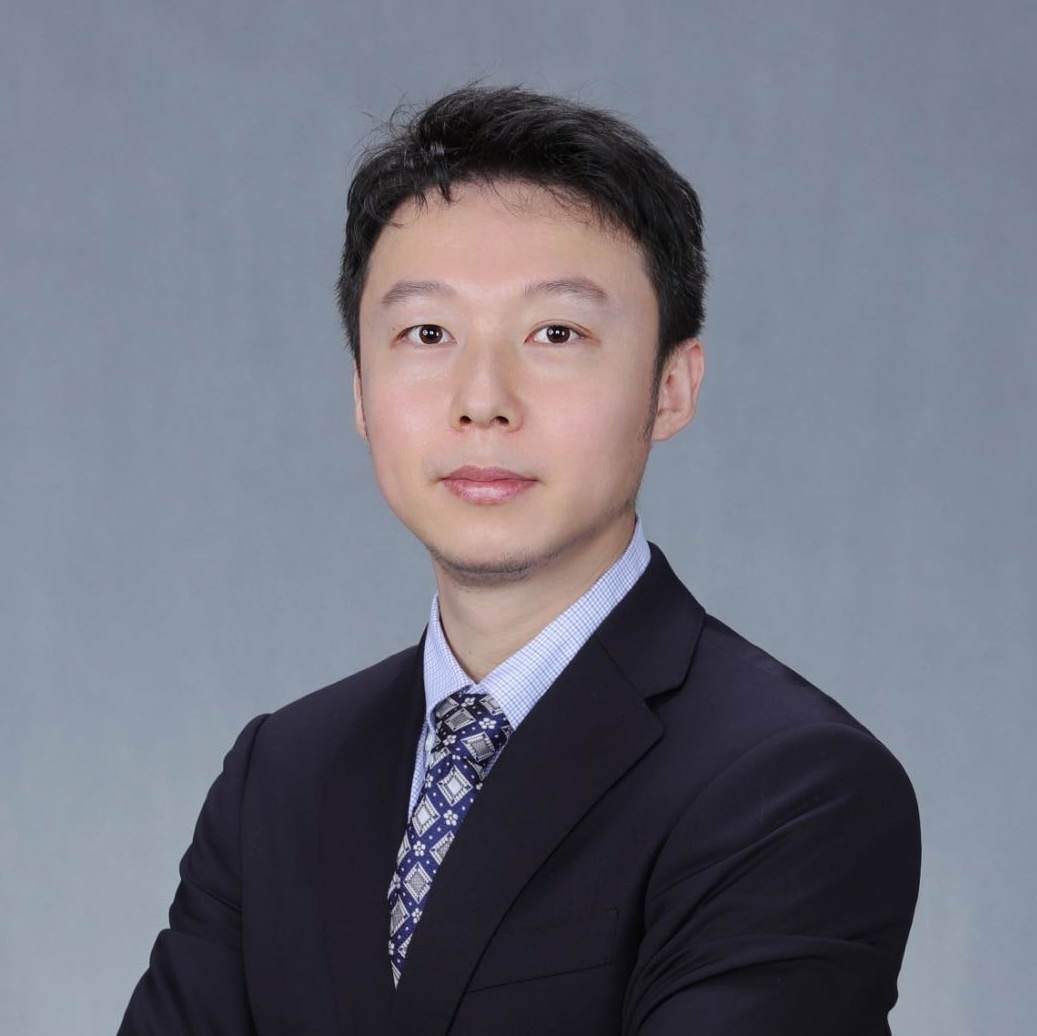
 Jicong Fan
· 4 previous affiliations
- Shenzhen Research Institute of Big DataSince 2020
- Assistant Professor · Since 2023
- Research Assistant Professor · 2020–2023
- Current
- Cornell Tech2018–2020
- Postdoc · 2018–2020
- City University of Hong Kong2015–2018
- PhD student · 2015–2018
1 other author named Jicong Fan: Jicong Fan (1 paper)
Research Overview
Jicong Fan focuses on matrix and tensor methods, clustering algorithms, and anomaly detection within complex data structures. His early work developed nonlinear approaches for matrix completion and scalable subspace clustering, addressing high-dimensional data challenges. More recently, his research investigates graph machine learning and universal anomaly detection, emphasizing robust representation learning across diverse domains.
Research Trajectory
Fan’s early research addressed fault detection in complex dynamic processes. He introduced kernel dynamic independent component analysis in Fault detection and diagnosis of non-linear non-Gaussian dynamic processes using kernel dynamic independent component analysis (2014), applying ICA in a kernel space to extract nonlinear features for multivariate process monitoring.
This interest in nonlinear transformations naturally extended to matrix completion. In Non-linear matrix completion (2018), he developed methods to handle data with nonlinear structures and high-rank matrices, moving beyond conventional linear assumptions. He further scaled these concepts in Online High Rank Matrix Completion. (2019), proposing Kernelized Factorization Matrix Completion (KFMC) to implicitly map data into low-dimensional feature spaces, enabling efficient batch and online processing for streaming data.
Transitioning into clustering, Fan addressed the computational bottlenecks of grouping high-dimensional data. He proposed k-Factorization Subspace Clustering in Large-Scale Subspace Clustering via k-Factorization (2021), a method that bypasses expensive affinity matrix computations to achieve linear time and space complexity. Building on this, he contributed to the area of Linear Time Subspace Clustering with Efficient Deep Embedded Subspace Clustering (2022). This work replaced traditional self-expressive models with learnable subspace bases, reducing the complexity of deep subspace clustering to scale effectively to massive datasets while maintaining high accuracy.
Around 2023, Fan’s focus expanded significantly into graph machine learning and representation. He explored the problem of partitioning sets of graphs in Deep Graph-Level Clustering Using Pseudo-Label-Guided Mutual Information Maximization Network. This research advanced the research direction of Making Graph Kernels Learnable for Adaptive Structural Representation and contributed to the broader area of Local to Global Alignment in Graph Representation Learning.
Concurrently, anomaly detection became a central theme, particularly in adapting geometric and generative models to identify outliers. In the area of Anomaly Detection Under Multi-Modal Normal Distributions, he developed Deep Orthogonal Bi-Hypersphere Compression in Deep Orthogonal Hypersphere Compression for Anomaly Detection (2024). This approach utilized an orthogonal projection layer and a dual-hypersphere boundary to create tighter decision regions, addressing the "soap-bubble" effect in high-dimensional spaces. He also explored generative approaches, introducing a novel adversarial learning method in Unsupervised anomaly detection using inverse generative adversarial networks (2025) that avoids the intricate, time-consuming iterative optimization typical of earlier GAN-based anomaly detection.
In 2025, Fan’s work on anomaly detection diversified across fairness, graph structures, and text. He addressed demographic biases in Fairness-aware Anomaly Detection via Fair Projection, projecting data into a unified target distribution to balance detection accuracy with group fairness. For graph data, he tackled the scarcity of training anomalies in Self-Discriminative Modeling for Anomalous Graph Detection, generating pseudo-anomalous graphs to train robust classifiers. He also evaluated large language model embeddings for outlier detection in Text-ADBench: Text Anomaly Detection Benchmark based on LLMs Embedding, demonstrating that high-quality embeddings allow classical algorithms to perform exceptionally well. In foundational metric learning, he formalized Mutual Regression Distance to measure differences between probability distributions. Furthermore, he advanced the direction of Multi-Scale Graph Anomaly Detection with UniOD: A Universal Model for Outlier Detection across Diverse Domains, a framework that converts tabular data into standardized graphs to learn transferable anomaly patterns without retraining.
Current Directions
The most recent papers in the evidence, published in 2026, indicate a strong ongoing focus on robust density estimation and adaptive graph representations. Fan investigates methods to handle inherent noise in tabular datasets, as seen in Noise-Robust Density Estimation for Tabular Data Anomaly Detection. He is also extending density estimation to non-Euclidean domains, combining graph neural networks with multi-scale estimators in Learnable Kernel Density Estimation for Graphs and Its Application to Graph-Level Anomaly Detection.
Additionally, his current work addresses the geometric heterogeneity of graphs. By developing models that learn node-specific metrics, such as in Adaptive Riemannian Graph Neural Networks, and exploring representation-level interpretability through substructure counting in Explainable Graph Representation Learning via Graph Pattern Analysis, he continues to refine how complex structural data is modeled and understood.
Profile updated
Loading new papers…
Other researchers whose papers cluster into the same research directions — a proxy for overlapping technical interests and shared intellectual neighborhoods.
See something wrong? Report a mistake