

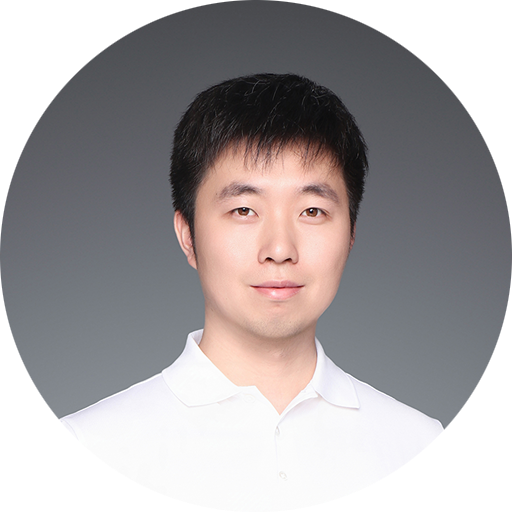
 Jia Zeng
· 4 previous affiliations
- Researcher · Since 2023
- Jingdong (China)Current
- Current
- Shanghai Jiao Tong University2017–2023
- PhD student · 2017–2023
- Central South University2013–2017
- Undergrad student · 2013–2017
2 other authors named Jia Zeng: Jia Zeng (51 papers), Jia Zeng (Jilin University · 2 papers)
Research Overview
Jia Zeng focuses on embodied artificial intelligence, robotic manipulation, and vision-language-action models. His early research addressed autonomous driving perception and trajectory prediction before shifting toward generalist robotic policies and closed-loop visuomotor control. Currently, he investigates scalable training frameworks and cross-embodiment architectures for advanced robotic manipulation.
Research Trajectory
Zeng's early work centered on autonomous driving, specifically addressing perception and trajectory prediction. In 2022, he participated in the development of Towards Capturing the Temporal Dynamics for Trajectory Prediction: a Coarse-to-Fine Approach, which explored multi-step future position forecasting for vehicles. Concurrently, he contributed to a comprehensive evaluation of bird's-eye-view perception in Delving into the Devils of Bird's-eye-view Perception: A Review, Evaluation and Recipe, intersecting with the research direction of Robustness to Extrinsic Calibration Errors in 3D Perception. Expanding on data infrastructure for autonomous systems, he co-authored Open-sourced Data Ecosystem in Autonomous Driving: the Present and Future, a survey analyzing the evolution of datasets and touching upon areas such as Synthetic Corner Case Generation for Autonomous Systems.
By 2024, Zeng's focus began bridging large-scale predictive modeling and 3D perception with embodied AI. He participated in the creation of a video prediction world model in Generalized Predictive Model for Autonomous Driving and contributed to efficient spatial modeling in Fully Sparse 3D Occupancy Prediction, advancing the broader area of Exploiting Spatial Sparsity in Volumetric Neural Networks. During this period, his primary research shifted decisively toward robotic manipulation. He introduced a pre-training framework in Learning Manipulation by Predicting Interaction that teaches robots to interact with objects by forecasting transition states from human videos. Building on generative models, he co-developed Closed-Loop Visuomotor Control with Generative Expectation for Robotic Manipulation, which utilizes text-conditioned video diffusion to generate visual plans that guide feedback-driven policies. He also collaborated on Towards Synergistic, Generalized, and Efficient Dual-System for Robotic Manipulation, a project exploring the integration of generalist and specialist policies, contributing to the research directions of Dual System Architectures for Real Time Robotic Control and Asynchronous Decoupling for Real Time Robotic Foundation Models.
In 2025, Zeng expanded his work on robotic control architectures and simulation environments. He participated in the design of an end-to-end predictive inverse dynamics model in Predictive Inverse Dynamics Models are Scalable Learners for Robotic Manipulation. Directing research on bimanual control, he oversaw the development of Gripper Keypose and Object Pointflow as Interfaces for Bimanual Robotic Manipulation, which integrated target poses and pointflow into a continuous diffusion policy to improve spatial localization and trajectory execution. His collaborative efforts in teleoperation yielded TeleOpBench: A Simulator-Centric Benchmark for Dual-Arm Dexterous Teleoperation, standardizing tasks across modalities and supporting work in the area of Predictive Correlation for Validating Robot Simulators. He also contributed to humanoid control systems in HOMIE: Humanoid Loco-Manipulation with Isomorphic Exoskeleton Cockpit, which combined reinforcement learning with semi-autonomous teleoperation. Alongside these robotics advancements, he maintained an interest in perception, participating in LiDAR-guided Geometric Pretraining for Vision-Centric 3D Object Detection.
Most recently, Zeng's trajectory has focused on scaling Vision-Language-Action (VLA) models. He collaborated on InternData-A1: Pioneering High-Fidelity Synthetic Data for Pre-training Generalist Policy, which demonstrated the viability of using large-scale synthetic trajectories for pre-training VLA models. Extending this paradigm, he participated in SimpleVLA-RL: Scaling VLA Training via Reinforcement Learning, exploring how reinforcement learning can optimize manipulation strategies beyond supervised fine-tuning. He also contributed to X-VLA: Soft-Prompted Transformer as Scalable Cross-Embodiment Vision-Language-Action Model, which introduced a soft-prompt mechanism to unify training across diverse robot embodiments.
Current Directions
The most recent papers in the evidence address the scalability and generalization of Vision-Language-Action (VLA) models for robotic manipulation. Recent work investigates the use of high-fidelity synthetic data to pre-train generalist policies, reducing the reliance on expensive real-world data collection. Additionally, this research explores reinforcement learning frameworks to optimize VLA models using sparse reward signals, enabling the discovery of novel manipulation strategies. Another active area involves cross-embodiment architectures, where soft-prompting mechanisms are employed to train unified models capable of controlling diverse robotic hardware across varied tasks.
Profile updated
Loading new papers…
Other researchers whose papers cluster into the same research directions — a proxy for overlapping technical interests and shared intellectual neighborhoods.
See something wrong? Report a mistake