

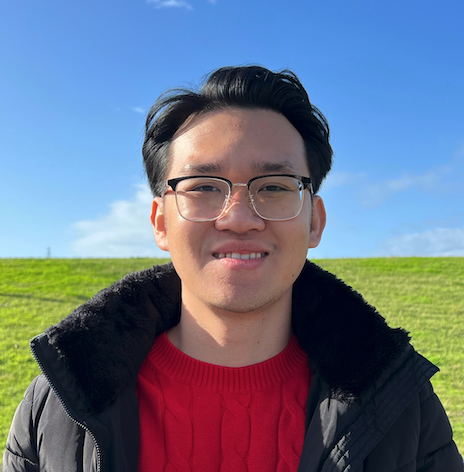
 Huy Nguyen
· 5 previous affiliations
- The University of Texas at AustinSince 2022
- Doctor of Philosophy - PhD, Statistics and Data Sciences · 2022–2027
- Graduate Research Assistant · Since 2024
- Graduate Teaching Assistant · Since 2022
- Intern · 2024
- VinAI Research2020–2022
- Researcher · 2020–2022
- Bachelor of Science - BS, Mathematics and Computer Science · 2017–2020
- University of Science2017–2020
- Undergrad student · 2017–2020
3 other authors named Huy Nguyen: Huy Nguyen (Northeastern University · 96 papers), Huy Nguyen (1 paper), Huy Nguyen (Queensland University of Technology · 1 paper)
Research Overview
Huy Nguyen focuses on the theoretical foundations and practical scalability of Mixture-of-Experts models and optimal transport. His work investigates the statistical properties of gating mechanisms, routing convergence, and parameter estimation to improve the efficiency of large-scale neural architectures. Recently, he has explored the intersection of sparse expert frameworks with attention mechanisms and parameter-efficient fine-tuning.
Research Trajectory
His early research concentrated on computational optimal transport, specifically addressing the challenges of comparing distributions across mismatched or incomplete data spaces. In On Robust Optimal Transport: Computational Complexity and Barycenter Computation, he and collaborators explored robust variants of optimal transport, relaxing marginal constraints via Kullback-Leibler divergence to develop efficient approximation algorithms. This work contributed to the broader area of Partial Optimal Transport for Mismatched Distribution Alignment. Continuing in this domain, he participated in research on On Multimarginal Partial Optimal Transport: Equivalent Forms and Computational Complexity, which advanced the research direction of Unbalanced Optimal Transport for Incomplete Data and explored techniques for the area of Augmenting Metric Spaces with Virtual Sink Nodes. He also contributed to Entropic Gromov-Wasserstein between Gaussian Distributions, providing closed-form expressions for comparing structured data across incomparable spaces using inner product cost functions.
Subsequently, his focus shifted toward the theoretical underpinnings of Mixture-of-Experts (MoE) models. In Demystifying Softmax Gating Function in Gaussian Mixture of Experts, he addressed long-standing open problems regarding parameter estimation, proposing novel Voronoi loss functions to resolve identifiability challenges caused by the intrinsic interaction between softmax gating and expert functions. He further investigated the sample efficiency and implicit biases of these models in Is Temperature Sample Efficient for Softmax Gaussian Mixture of Experts?. A major theoretical contribution followed with Sigmoid Gating is More Sample Efficient than Softmax Gating in Mixture of Experts, which provided rigorous proofs that sigmoid gating achieves faster, parametric convergence rates by removing the forced competition between experts inherent to softmax gating. This work significantly advanced the area of Parameter Convergence in Overspecified Mixture Models.
Expanding on these convergence properties, he formalized how different gating mechanisms affect learning speeds in Convergence Rates for Softmax Gating Mixture of Experts, demonstrating that simpler linear experts suffer from parameter crosstalk compared to more complex neural network experts, which learn efficiently at polynomial rates. He also analyzed routing mechanisms, showing in Statistical Advantages of Perturbing Cosine Router in Mixture of Experts that adding noise to the normalization step of cosine routers accelerates convergence to polynomial rates, mitigating the slow convergence typically associated with representation collapse prevention.
Applying these theoretical insights to state-of-the-art architectures, he analyzed the statistical benefits of shared experts and normalized sigmoid gating in On DeepSeekMoE: Statistical Benefits of Shared Experts and Normalized Sigmoid Gating, justifying how these architectural choices improve sample efficiency and training stability. He introduced novel training mechanisms in CompeteSMoE - Statistically Guaranteed Mixture of Experts Training via Competition, which routes tokens based on actual neural responses rather than decoupled predictions, contributing to the research direction of Managing Routing Convergence in Mixture of Experts.
Connecting MoE principles to fundamental transformer components, he explored the area of Transformers as Implicit Mixture of Experts with Sigmoid Self-Attention is Better than Softmax Self-Attention: A Mixture-of-Experts Perspective, arguing that non-competitive sigmoid attention overcomes the limitations of softmax constraints. Additionally, he contributed to parameter-efficient fine-tuning methods in DoRAN: Stabilizing Weight-Decomposed Low-Rank Adaptation via Noise Injection and Auxiliary Networks, which utilizes noise injection and auxiliary hypernetworks to prevent gradient explosions and improve training stability.
Current Directions
The most recent papers in the evidence address the intersection of Mixture-of-Experts architectures and parameter-efficient adaptation, specifically focusing on prompt tuning and continual learning. Recent work investigates how static prompt tokens can be transformed into adaptive, input-dependent experts that respond dynamically to visual or textual inputs. By structuring prompts as sparse MoE models, this approach aims to reconcile the trade-offs between computational efficiency and model performance, enabling effective lifelong model adaptation across evolving data streams while significantly reducing parameter counts and computational overhead.
Profile updated
Loading new papers…
Other researchers whose papers cluster into the same research directions — a proxy for overlapping technical interests and shared intellectual neighborhoods.
See something wrong? Report a mistake