

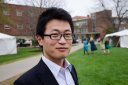
 Huishuai Zhang
· 4 previous affiliations
- Peking UniversitySince 2024
- Assistant Professor · Since 2024
- Microsoft (United States)2018–2023
- Researcher · 2018–2023
- Carnegie Mellon University2017–2018
- Postdoc · 2017–2018
- Syracuse University2012–2017
- PhD student · 2012–2017
Research Overview
Huishuai Zhang focuses on non-convex optimization, differential privacy, and the theoretical foundations of deep learning. His early work established convergence guarantees for signal recovery and phase retrieval problems before shifting toward the stability and optimization dynamics of neural networks. Currently, he investigates memory-efficient differentially private training and advanced optimization algorithms for large-scale foundation models.
Research Trajectory
His early research examined structural recovery in convex programming, specifically addressing matrix decomposition. In Analysis of Robust PCA via Local Incoherence, he investigated the robust Principal Component Analysis (PCA) problem, characterizing conditions under which a matrix can be correctly decomposed into low-rank and sparse error components even when entries are corrupted with unequal probabilities.
Following this, he made significant contributions to the research direction of Signal Recovery Beyond the Gaussian Measurement Assumption, focusing on phase retrieval—the challenge of recovering a signal from magnitude-only measurements. He developed gradient-based approaches to minimize non-convex loss functions, demonstrating geometric convergence to global optima. This work included Reshaped Wirtinger Flow for Solving Quadratic System of Equations, which adopted a non-smooth, lower-order loss function to improve upon standard Wirtinger flow. Expanding on this in the broader area of Robust Spectral Initialization for Non-Convex Optimization, he addressed scenarios involving corrupted data in Provable Non-convex Phase Retrieval with Outliers: Median TruncatedWirtinger Flow, providing theoretical guarantees for signal recovery even in the presence of outliers.
Transitioning toward the mechanics of deep neural networks, he began analyzing the optimization landscape and stability of complex architectures. In On the Local Hessian in Back-propagation, he explored the efficiency of back-propagation by framing it as a sequence of back-matching losses, studying the local Hessian to better understand phenomena like vanishing gradients. He continued this architectural analysis in On the Stability of Multi-branch Network, establishing forward and backward stability conditions for multi-branch designs and clarifying the critical role of normalization layers in controlling the backward process.
A major theme in his subsequent work is the domain of The Privacy-Utility Trade-off in Differentially Private Learning. Recognizing that differential privacy often degrades model utility, he collaborated on Do not Let Privacy Overbill Utility: Gradient Embedding Perturbation for Private Learning. This paper introduced a method to project private gradients into a non-sensitive anchor subspace, perturbing only a low-dimensional embedding to maintain accuracy. As models grew in scale, this focus naturally extended to the specialized area of Scaling Differentially Private Training by Reducing Gradient Overhead. He led the development of parameter-efficient frameworks in Differentially Private Fine-tuning of Language Models, achieving state-of-the-art privacy and utility tradeoffs while significantly reducing computational and memory costs.
Investigating the mechanics of private optimization further, he contributed to work in Gradient Clipping Dynamics in Differentially Private Training. In Exploring the Limits of Differentially Private Deep Learning with Group-wise Clipping, he and his co-authors demonstrated that per-layer clipping could be performed alongside backpropagation, making private learning nearly as fast and memory-efficient as standard training. He also refined how privacy guarantees are measured; in Individual Privacy Accounting for Differentially Private Stochastic Gradient Descent, he proposed output-specific metrics to characterize privacy for individual examples, revealing that most data points enjoy stronger protections than worst-case bounds suggest.
Parallel to his privacy research, he continued to advance foundational optimization theory. In Provable Adaptivity in Adam, he provided theoretical grounding for why the Adam optimizer often outperforms stochastic gradient descent in practice, attributing the advantage to Adam's ability to adapt to local gradient Lipschitz constants across the domain.
His recent trajectory synthesizes these threads of privacy, optimization, and large-scale modeling. In Selective Pre-training for Private Fine-tuning, he demonstrated that guiding public pre-training with a private dataset is crucial for building small, fast, and private domain-specific language models. Expanding differential privacy into complex generative modalities, he introduced a training-free framework in Synthesize Privacy-Preserving High-Resolution Images via Private Textual Intermediaries, which shifts the privacy-preserving process from the image domain to the text domain to generate high-fidelity synthetic data. He also contributed to core optimization design with OLion: Approaching the Hadamard Ideal by Intersecting Spectral and L inf Implicit Biases, introducing a memory-efficient optimizer that combines orthogonalization with sign-based updates for large-scale language and vision tasks.
More recently, Zhang has expanded into multimodal reasoning and autonomous agent systems. He co-authored MIRA: Reinforcing Multimodal Reasoning via Deceptive Contextual Augmentation, which introduces a reinforcement learning framework using deceptive visual contexts and reflection triggers to overcome the perception–reasoning gap and mitigate compounding hallucinations. Additionally, in ModalSearcher: Weaving Visual Evidence into Autonomous Cross-Modal Deep Search, Zhang contributed to an agentic pipeline and training methodology that enables models to autonomously introduce and switch between visual and textual search modalities across complex multi-hop queries.
Current Directions
The most recent papers indicate a focus spanning foundation model optimization, privacy-preserving generative AI, and robust multimodal reasoning agents. In optimization, recent work investigates how to combine the spectral benefits of orthogonalization with the stability of coordinate-wise updates to improve training efficiency and mitigate performance drops during fine-tuning. In the realm of differential privacy, current efforts address the challenge of applying privacy guarantees to high-dimensional, complex data distributions. This includes developing techniques that use natural language as a secure intermediary to synthesize high-resolution images without requiring direct access to model weights, as well as designing selective pre-training strategies to optimize small, domain-specific language models under strict privacy and memory constraints.
Profile updated
Loading new papers…
Other researchers whose papers cluster into the same research directions — a proxy for overlapping technical interests and shared intellectual neighborhoods.
See something wrong? Report a mistake