

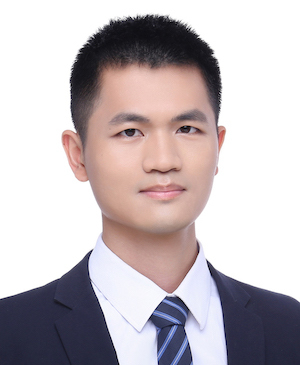
 Hongwen Zhang
· 3 previous affiliations
- Beijing Normal UniversitySince 2023
- Associate Professor · Since 2023
- Tsinghua University2021–2023
- Postdoc · 2021–2023
- Chinese Academy of Sciences2015–2021
- PhD student · 2015–2021
Research Overview
Hongwen Zhang focuses on 3D vision, computer graphics, and embodied AI, specifically targeting the capture and generation of realistic human motion, appearance, and behavior. His trajectory spans from foundational skeleton-based action recognition to high-fidelity monocular human mesh recovery and neural rendering. Most recently, his work emphasizes the development of animatable 3D avatars and dynamic world models for humanoid agents interacting within 3D environments.
Research Trajectory
Zhang’s early research established foundational methods for understanding human movement through graph-based neural architectures. In 2020, he introduced Disentangling and Unifying Graph Convolutions for Skeleton-Based Action Recognition, proposing the MS-G3D framework. By rethinking how graph convolutions process multiple scales and the intricate relationships between space and time, this work provided a robust unified representation for dynamic skeletal systems.
Following this, his focus expanded into the domain of 3D human pose and shape recovery from monocular images. A persistent challenge in regression-based mesh recovery was the misalignment between estimated meshes and underlying image evidence. To resolve this, Zhang developed PyMAF: 3D Human Pose and Shape Regression with Pyramidal Mesh Alignment Feedback Loop in 2021. The framework leveraged a feature pyramid to explicitly rectify predicted parameters based on mesh-image alignment. He subsequently advanced this paradigm with Delving Deep into Pixel Alignment Feature for Accurate Multi-View Human Mesh Recovery (2023). By re-projecting 3D mesh estimates onto 2D images to extract and fuse local feedback features directly on mesh vertices, this work yielded substantial improvements in multi-view accuracy, contributing directly to the research direction of Pixel Aligned Feedback for Iterative 3D Reconstruction.
Parallel to his work on mesh recovery, Zhang explored the synthesis of high-fidelity 3D geometry and surface appearance. In 2022, he presented DoubleField: Bridging the Neural Surface and Radiance Fields for High-fidelity Human Reconstruction and Rendering. By utilizing a shared feature embedding and a view-to-view transformer, DoubleField successfully merged the geometric strengths of surface fields with the appearance modeling of radiance fields, advancing the broader area of Neural Non-Rigid Deformation for 3D Reconstruction.
By 2024, Zhang’s research portfolio broadened significantly, encompassing real-time motion capture, animatable avatars, and complex hand-object interactions. Addressing the need for accessible full-body capture, he built ProxyCap: Real-Time Monocular Full-Body Capture in World Space via Human-Centric Proxy-to-Motion Learning. The system utilized 2D skeletons as proxies alongside a neural motion descent module to achieve physically plausible, 30 FPS world-space capture from a single moving camera. This emphasis on physical realism intersects with the area of Inertia Aware Neural Human Modeling. In the realm of generative motion, he created Lodge++: High-quality and Long Dance Generation with Vivid Choreography Patterns, a two-stage framework that decoupled global choreography from local motion details to generate structurally coherent, ultra-long 3D dances from audio.
To model human appearance dynamically, Zhang engineered GaussianAvatar: Towards Realistic Human Avatar Modeling from a Single Video via Animatable 3D Gaussians. Combining the rendering efficiency of 3D Gaussian Splatting with joint optimization for motion and appearance, the framework enabled the creation of high-fidelity avatars capable of novel pose animation. This work aligns closely with the research direction of Decoupling Non-Rigid Dynamics for Animatable Human Avatars and shares methodological synergies with the area of Generalizing Neural Head Avatars to Unseen Facial Expressions.
Simultaneously, Zhang directed extensive efforts toward the intricate problem of hand and object reconstruction. Serving as the principal investigator, his group presented OmniHands: Towards Robust 4D Hand Mesh Recovery via A Versatile Transformer, a unified architecture that explicitly modeled spatial interactions between hands across single frames, videos, and multi-view sequences. He further unified hand modeling tasks by formulating HHMR: Holistic Hand Mesh Recovery by Enhancing the Multimodal Controllability of Graph Diffusion Models, which integrated generation, inpainting, and fitting into a single shared latent space. To handle the mutual occlusion inherent in manipulation tasks, he designed Learning Explicit Contact for Implicit Reconstruction of Hand-Held Objects from Monocular Images. By predicting contact zones and diffusing them into a 3D volume, the model established a geometric prior that significantly improved the shape completion of obscured objects.
Most recently, Zhang has collaborated on integrating powerful generative priors into 4D spatial reconstruction. In 2025, he participated in the development of SyncMV4D: Synchronized Multi-view Joint Diffusion of Appearance and Motion for Hand-Object Interaction Synthesis. This framework coupled 2D appearance with 4D metric point tracks in a closed-loop diffusion process, touching upon the area of Decoupling Appearance and Motion in Generative Video Models. Continuing this trajectory into 2026, he contributed to DevilSight: Augmenting Monocular Human Avatar Reconstruction through a Virtual Perspective, which leveraged video generative models to synthesize virtual views, thereby overcoming monocular occlusion and preserving fine-grained dynamic details in avatar reconstruction.
Current Directions
The most recent papers in the evidence address the intersection of generative video models and 4D spatial reconstruction. Recent work investigates joint diffusion processes that couple 2D visual appearance with 4D physical motion to synthesize synchronized, multi-view hand-object interactions. Additionally, ongoing efforts focus on augmenting monocular human avatar reconstruction by leveraging video generative priors to synthesize virtual perspectives. By generating plausible novel views, these methods resolve severe occlusions and capture fine-grained dynamic details in 3D space, pointing toward highly realistic, animatable world models for embodied agents.
Profile updated
Loading new papers…
Other researchers whose papers cluster into the same research directions — a proxy for overlapping technical interests and shared intellectual neighborhoods.
See something wrong? Report a mistake