

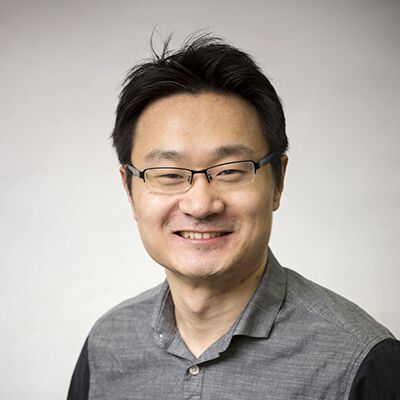
 He Wang
· 2 previous affiliations
- University College LondonSince 2023
- Associate Professor · Since 2023
- University of Leeds2016–2023
- Associate Professor · 2020–2023
- Lecturer · 2016–2020
6 other authors named He Wang: He Wang (Peking University · Galbot · 128 papers), He Wang (Nanjing University of Science and Technology · 11 papers), He Wang (Carnegie Mellon University · 9 papers), He Wang (Zhejiang University · 1 paper), He Wang (Southeast University · 1 paper), and 1 more
Research Overview
He Wang focuses on computer graphics, 3D human motion synthesis, and the adversarial robustness of machine learning models. His early work explored spatial relationships in 3D scenes and real-time character animation, evolving into deep investigations of skeletal action recognition and physics-informed neural networks. Currently, he develops robust, physics-constrained generative models and neural operators for complex physical simulations.
Research Trajectory
He Wang’s early research focused on geometric representations and the parameterization of 3D space. He introduced an object-centric coordinate system in Harmonic parameterization by electrostatics, utilizing electrostatic principles to parameterize the open space around objects and quantify how tightly an object is wrapped by a surface. Following this, he participated in developing methods for 3D scene classification, leveraging the Interaction Bisector Surface to index topological and geometric relationships between objects in Indexing 3D Scenes Using the Interaction Bisector Surface.
As his work progressed, his focus expanded to dynamic human motion and trajectory prediction. In Real-time controllable motion transition for characters, he developed a framework using Conditional Variational Autoencoders to synthesize high-quality, in-between character animations without offline post-processing, contributing to the broader area of Scene Aware 3D Human Motion Synthesis. Concurrently, he explored the intersection of deep learning and physical modeling for crowd dynamics. With collaborators, he integrated a differentiable Social Force Model into neural networks in Human Trajectory Prediction via Neural Social Physics, advancing the research directions of Probabilistic Trajectory Forecasting for Autonomous Systems and Integrating Kinematic Constraints into Neural Trajectory Predictors.
A significant portion of his trajectory investigates the vulnerabilities of skeletal action recognition systems, driving work in the direction of Physically Constrained Adversarial Attacks on Skeletal Motion. He examined these vulnerabilities in Understanding the Robustness of Skeleton-Based Action Recognition Under Adversarial Attack, proposing a perceptual loss to ensure imperceptible attacks. This led to the development of black-box attack methodologies, notably BASAR: Black-Box Attack on Skeletal Action Recognition. He further refined these techniques in Hard No-Box Adversarial Attack on Skeleton-Based Human Action Recognition with Skeleton-Motion-Informed Gradient, which utilized contrastive learning and physical dynamics to execute attacks without access to the victim model. To counter these vulnerabilities, he contributed to defense mechanisms, such as the Bayesian Energy-based Adversarial Training framework introduced in Defending Black-Box Skeleton-Based Human Activity Classifiers, aligning with the area of Decoupled and Model Agnostic Adversarial Defenses.
Parallel to his work on adversarial robustness, he advanced the integration of physical inductive biases into neural architectures. He led research on Fine-grained Differentiable Physics: A Yarn-level Model for Fabrics, which combined gradient-based learning with complex material structures, contributing to the direction of Differentiable Simulation for System Identification and Design. Applying spatial-temporal modeling to environmental systems, he adapted graph neural networks to predict groundwater levels in complex hydrological environments in Spatial-temporal graph neural networks for groundwater data.
His recent work synthesizes these themes across robustness, generation, and physics-informed learning. In the domain of adversarial machine learning, he developed a training-free defense for AI-generated image detectors in Adversarially Robust AI-Generated Image Detection for Free: An Information Theoretic Perspective. He also explored the theoretical trade-offs between classification accuracy, generative capability, and robustness using Joint Energy-based Models in Your Classifier Can Do More: Towards Bridging the Gaps in Classification, Robustness, and Generation. Continuing his focus on skeletal motion, he developed transfer-based attacks to bridge white-box research and real-world scenarios in TASAR: Transfer-based Attack on Skeletal Action Recognition. His ongoing interest in motion synthesis is reflected in AutoKeyframe: Autoregressive Keyframe Generation for Human Motion Synthesis and Editing, while his broader perspective on crowd dynamics was formalized in the review Recent Deep Learning in Crowd Behaviour Analysis: A Brief Review. Finally, he has made significant strides in neural operators for partial differential equations. He introduced a framework for rapid multiphysics predictions in High-fidelity Multiphysics Modelling for Rapid Predictions Using Physics-informed Parallel Neural Operator, and participated in developing an attention-enhanced Fourier Neural Operator to handle multiscale dynamics in ATTENTION-ENHANCED NEURAL OPERATOR FOR VARIABLE-TIMESTEP PREDICTION OF PDES.
Current Directions
The most recent papers in the evidence address the development of highly efficient neural solvers for complex physical systems and the ongoing challenge of adversarial robustness in generative AI. Recent work investigates physics-informed neural operators, specifically focusing on parallel architectures and attention mechanisms to solve multiphysics partial differential equations without relying on traditional numerical solvers or fixed time-stepping schemes. Concurrently, his research explores the theoretical and practical boundaries of adversarial machine learning, seeking to reconcile standard classification accuracy with generative capabilities and robust defenses against transfer-based attacks.
Profile updated
Loading new papers…
Other researchers whose papers cluster into the same research directions — a proxy for overlapping technical interests and shared intellectual neighborhoods.
See something wrong? Report a mistake