

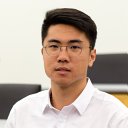
 Hao Wu
2 previous affiliations
- VERSES (United States)2023–2024
- Researcher · 2023–2024
- Northeastern University2017–2023
- MS student · 2017–2023
32 other authors named Hao Wu: Hao WU (87 papers), Hao Wu (Shanghai Jiao Tong University · 68 papers), Hao Wu (Tencent (China) · Tsinghua University · 63 papers), Hao Wu (52 papers), Hao Wu (Eastern Institute for Advanced Study · Shanghai Jiao Tong University · 20 papers), and 27 more
Research Overview
Hao Wu focuses on the intersection of Bayesian inference, probabilistic programming, and deep generative modeling. His research emphasizes the development of scalable, structured variational methods that integrate neural networks with rigorous probabilistic frameworks to improve representation learning and uncertainty quantification. Currently an Applied Scientist at AWS, Wu’s work has transitioned from the foundational modularity of probabilistic programs to the design of hierarchical latent-variable models and, more recently, to gradient-free variational learning and neuroscience-inspired inference algorithms.
Research Trajectory
Wu’s research trajectory began with a focus on the structural and compositional aspects of probabilistic modeling. In 2018, he addressed the challenge of building complex models from simpler components by introducing functional building blocks for probabilistic programming. This work established a framework for composing modeling and inference operations while ensuring mathematical consistency, particularly in the context of dynamic probabilistic programs.
By 2019, Wu shifted his focus toward the problem of representation learning, specifically the challenge of disentanglement in unsupervised models. While standard Variational Autoencoders (VAEs) often struggle to separate independent factors of variation, Wu proposed hierarchical objectives to control the statistical independence between different groups of variables. This period marked a significant engagement with the trade-offs between discrete and continuous latent factors, leading to models capable of more interpretable and generalizable representations.
Between 2020 and 2022, Wu’s work deepened into the mechanics of structured variational inference and alternative generative architectures. He developed methods to handle high-dimensional, correlated latent variables in hierarchical data—such as video or multi-object scenes—where standard amortized inference often fails. During this time, he also explored Energy-Based Models (EBMs) as an alternative to traditional generator-based models, focusing on learning representations through latent space agreement rather than pixel-level reconstruction. This phase of his work was characterized by a move toward more flexible notions of similarity and improved out-of-distribution detection.
In his most recent work (2024–2025), Wu has explored alternative learning paradigms that move away from the heavy computational requirements of standard backpropagation and sampling-based Bayesian methods. This includes the development of gradient-free variational methods for mixture models and the investigation of predictive coding, a brain-inspired framework for inference. These current directions reflect an interest in balancing the expressiveness of deep learning with the efficiency and biological plausibility of structured Bayesian algorithms.
Current Directions
Wu’s current research focuses on two primary areas: gradient-free variational learning and structured Bayesian inference for high-dimensional data. A central theme in his recent work is the development of Conditional Mixture Networks (CMNs), which serve as a probabilistic variant of the mixture-of-experts model. By utilizing conjugate priors and Pólya-Gamma augmentation, Wu and his collaborators have demonstrated that it is possible to achieve fast, calibrated predictions without the need for gradient descent or expensive sampling. This approach aims to provide the uncertainty quantification benefits of Bayesian methods while maintaining the scalability required for complex classification tasks.
Additionally, Wu is active in the development of neuroscience-inspired algorithms, specifically within the framework of predictive coding. His recent contributions involve breaking down global inference problems into local, particle-based updates. This "divide-and-conquer" approach seeks to overcome the historical limitations of predictive coding on high-dimensional data, moving toward architectures that are both biologically plausible and computationally competitive with modern machine learning benchmarks.
Representative Work
In Composing Modeling and Inference Operations with Probabilistic Program Combinators, Wu introduced a library of "combinators" for the Probabilistic Torch framework. This work addressed the lack of modularity in existing probabilistic programming languages by providing reusable functional blocks. By ensuring that these transformations preserve "proper weighting," the research enabled the construction of sophisticated inference strategies, such as Sequential Monte Carlo, within a flexible, dynamic programming environment.
Wu further advanced the field of representation learning in Structured Disentangled Representations, where he proposed Hierarchically Factorized VAEs (HFVAEs). This framework introduced a two-level hierarchical objective designed to disentangle both discrete and continuous factors of variation. By decomposing the VAE objective, the model could separate broad categories of information (such as identity) from specific features (such as style), significantly improving the interpretability of the learned latent space and enabling better zero-shot generalization.
Addressing the limitations of standard VAEs in complex, hierarchical settings, Wu developed Amortized Population Gibbs Samplers with Neural Sufficient Statistics. This work framed structured variational inference as a form of adaptive importance sampling. By iterating over updates to lower-dimensional blocks of variables and parameterizing the model with neural sufficient statistics, Wu created a scalable method for training highly structured deep generative models in an unsupervised manner. This approach proved particularly effective for data with many correlated latent variables, where traditional amortized inference typically struggles to coordinate updates.
In Conjugate Energy-Based Models, Wu proposed a class of deep latent-variable models that omit the standard generator network. Instead of focusing on data reconstruction, these models learn to measure the agreement between data and latent variables in a shared space. This shift allowed for more flexible representations and improved performance in few-label classification and out-of-distribution detection. The research demonstrated that conjugate EBMs could achieve competitive results compared to VAEs while providing a more tractable posterior for certain classes of problems.
Wu’s recent contribution to efficient Bayesian learning is detailed in Gradient-free variational learning with conditional mixture networks. This work introduces a method for training probabilistic mixture-of-experts models using coordinate ascent variational inference (CAVI). By avoiding gradient-based optimization, the method provides a computationally efficient path to calibrated predictions and robust uncertainty quantification, which are often missing in standard deep learning models.
Finally, in Divide-and-Conquer Predictive Coding: a structured Bayesian inference algorithm, Wu and his colleagues developed a new algorithm that scales predictive coding to complex image tasks. By replacing global updates with local, particle-based inference, the Divide-and-Conquer Predictive Coding (DCPC) algorithm maintains biological plausibility while achieving state-of-the-art performance for PC-based models. This work represents a significant step in bridging the gap between cognitive neuroscience theories of the brain and practical machine learning applications.
Profile updated
| Paper | Venue | Year |
|---|---|---|
| Conjugate Energy-Based ModelsGitHubhao-w/ | ICML | 2021 |
Loading new papers…
Other researchers whose papers cluster into the same research directions — a proxy for overlapping technical interests and shared intellectual neighborhoods.
See something wrong? Report a mistake