

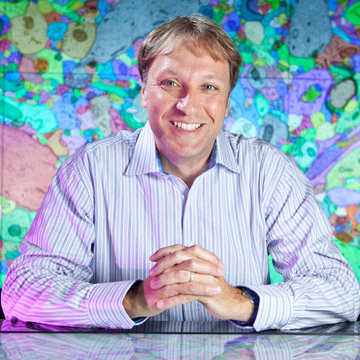
 Hanspeter Pfister
· 4 previous affiliations
- Harvard UniversitySince 2007
- Academic Dean of Computational Science and Engineering · Since 2021
- Affiliate Faculty Member Harvard Center of Brain Science · Since 2011
- An Wang Professor of Computer Science in the School of Engineering and Applied Sciences (SEAS) · Since 2007
- Director, Institute for Applied Computational Science · 2013–2017
- Associate Director and Senior Research Scientist · 1996–2007
- Stony Brook University1991–1994
- Ph.D., Computer Science · 1991–1994
- ETH Zurich1986–1991
- Research Assistant · 1990–1991
- MS student · 1986–1991
1 other author named Hanspeter Pfister: Hanspeter Pfister (24 papers)
Research Overview
Hanspeter Pfister focuses on visual computing, spanning scientific visualization, computer vision, and human-computer interaction. His trajectory evolved from foundational architectures for real-time volume rendering and point-based graphics to interactive visual analytics for complex datasets. Currently, his research investigates the intersection of 3D spatial intelligence, augmented reality, and vision-language models for dynamic scene understanding and embodied robotics.
Research Trajectory
The early phase of his career concentrated on high-performance graphics architectures and novel rendering primitives. He introduced hardware solutions for volumetric data, detailing a slice-parallel ray-casting algorithm in Cube-4 - A Scalable Architecture for Real-Time Volume Rendering. This foundational work on scalable architectures led to the development of The VolumePro Real-Time Ray-Casting System, which enabled interactive exploration of 3D volume datasets.
Moving beyond traditional polygon meshes, he explored alternative surface discretizations. He proposed using point primitives without explicit connectivity in Surfels: surface elements as rendering primitives, utilizing an octree-based representation and hierarchical forward warping. This paradigm was further refined in Surface splatting, which adapted the Elliptical Weighted Average (EWA) filter to screen space for irregularly spaced point clouds, allowing for high-resolution texture rendering. Concurrently, his research expanded into realistic material representation, as seen in his collaborative work on A data-driven reflectance model.
As datasets grew in complexity, his focus shifted toward visual analytics and human-computer interaction. He participated in designing interactive systems to make sense of multidimensional data. This included LineUp: Visual Analysis of Multi-Attribute Rankings, a visual technique for exploring complex, heterogeneous attribute rankings, and UpSet: Visualization of Intersecting Sets, which provided a novel approach to analyzing intersecting sets and their properties. These visualization techniques proved critical for large-scale scientific applications, such as biological imaging and connectomics, demonstrated by his involvement in the Saturated Reconstruction of a Volume of Neocortex.
Bridging visualization with spatial computing, he began investigating how users interact with data in immersive environments. In Embodied Navigation in Immersive Abstract Data Visualization: Is Overview+Detail or Zooming Better for 3D Scatterplots?, his lab systematically compared navigation paradigms in virtual reality, contributing to the broader research area of Reducing Split Attention in Fragmented Visual Interfaces. This line of inquiry extended to augmented reality applications in physical workspaces. With Enhancing User Performance and Human Factors through Visual Guidance in AR Assembly Tasks, he examined the cognitive impacts of extended reality visual guidance, identifying a critical speed-accuracy trade-off where excessive visual cues can inadvertently reduce user vigilance and increase errors.
Most recently, his trajectory has integrated multimodal large language models with advanced 3D scene representations. A major focus has been enhancing Gaussian splatting techniques with semantic language features. His lab developed LangSplatV2: High-dimensional 3D Language Gaussian Splatting with 450+ FPS to achieve real-time, high-dimensional language grounding in static 3D environments. Recognizing the limitations of static models, this was expanded in 4D LangSplat: 4D Language Gaussian Splatting via Multimodal Large Language Models, which tackles the challenge of time-sensitive, open-ended language queries in dynamic, evolving scenes.
Parallel to scene rendering, his recent work addresses the spatial reasoning capabilities of vision-language models (VLMs). In Tree of Attributes Prompt Learning for Vision-Language Models, he introduced a method to distill structured knowledge graphs of visual attributes, improving zero-shot and few-shot performance by guiding the model's focus toward relevant descriptive details. To bridge the modality gap between 2D VLM training and 3D physical understanding, he proposed SandboxVLM in Abstract 3D Perception for Spatial Intelligence in Vision-Language Models, utilizing abstract bounding boxes to encode geometric structure and physical kinematics. This emphasis on 3D priors also informs his robotics research, such as RoboTAG: End-to-end Robot Pose Estimation via Topological Alignment Graph, which co-evolves 2D and 3D representations to estimate robot poses from monocular images without heavy reliance on labeled training data.
Current Directions
Recent work investigates the integration of multimodal large language models with 3D and 4D spatial representations. A primary focus is advancing spatial intelligence in vision-language models, enabling them to comprehend geometric structures, physical kinematics, and dynamic scene evolution. This includes developing real-time, language-embedded rendering techniques like 4D Gaussian splatting, as well as designing frameworks that inject 3D priors into 2D visual backbones for applications in embodied AI and robotic pose estimation. Additionally, ongoing research explores human-computer interaction in augmented reality, specifically addressing the cognitive and human-factor implications of visual guidance systems in complex physical tasks.
Profile updated
Loading new papers…
Other researchers whose papers cluster into the same research directions — a proxy for overlapping technical interests and shared intellectual neighborhoods.
See something wrong? Report a mistake