

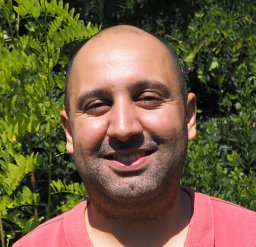
 Hachem Kadri
· 5 previous affiliations
- Aix-Marseille UniversitéSince 2012
- Professor of Computing Science · Since 2024
- Associate Professor in Machine Learning · 2018–2024
- Habilitation à diriger des recherches, Machine Learning, Computer Science · 2018–2019
- Assistant Professor in Machine Learning · 2012–2018
- Société Savante Francophone d'Apprentissage Machine2021–2025
- Vice President-elect · 2021–2025
- Postdoctoral Researcher in Machine Learning · 2009–2012
- École Centrale de Lille2008–2009
- Teaching Assistant · 2008–2009
- National Engineering School of Tunis2004–2008
- PhD Researcher · 2004–2008
Research Overview
Hachem Kadri focuses on the theoretical foundations of kernel methods, functional data analysis, and the integration of algebraic structures into machine learning. His trajectory spans the development of operator-valued kernels for structured outputs to recent innovations in C-algebraic machine learning and quantum-inspired algorithms. Currently, he investigates advanced kernel machines and deep learning frameworks utilizing reproducing kernel Hilbert C-modules.
Research Trajectory
His early work established foundational techniques in the research direction of Operator Valued Kernels for Functional and Structured Data. In 2010, he introduced a functional reproducing kernel Hilbert space approach to handle functional regression in Nonlinear functional regression: a functional RKHS approach, contributing to the broader area of Finite Dimensional Reductions via the Representer Theorem. Building on this foundation, he addressed multi-output learning with infinite-dimensional operator-valued kernels in Multiple Operator-valued Kernel Learning. This work extended functional data analysis to nonlinear contexts and advanced the area of Continuous Functional Representations for Time Series. He subsequently applied these concepts to multimodal data, reframing multi-view learning as a multi-task problem via vector-valued RKHS in The Multi-Task Learning View of Multimodal Data. Expanding the scope to structured outputs, he formulated a kernel dependency estimation approach in A Generalized Kernel Approach to Structured Output Learning, a paper that also intersected with the research direction of Nyström Subsampling for Scalable Kernel Methods.
In the mid-2010s, his focus broadened to include tensor-structured data and comprehensive functional frameworks. With collaborators, he developed the HOLRR algorithm in Low-Rank Regression with Tensor Responses, minimizing a least squares criterion under a multilinear rank constraint. This work contributed to the area of Learning Directly on Multidimensional Tensor Structures. He also synthesized and expanded his earlier functional data research in the comprehensive journal article Operator-valued Kernels for Learning from Functional Response Data, rigorously defining infinite-dimensional operator-valued kernels for supervised classification and regression.
Transitioning toward deep learning and scalable kernel approximations, his group introduced a novel architecture in Deep Networks with Adaptive Nyström Approximation, replacing the final dense layers of convolutional neural networks with an adaptive Nyström kernel to reduce parameters while maintaining performance. He continued to explore advanced regression models, introducing a generalization of the trace regression model in Partial Trace Regression and Low-Rank Kraus Decomposition.
In the early 2020s, his research investigated both multi-view learning and the implicit biases of deep networks. His group developed a method for completing missing data in multi-view kernel matrices in Cross-View kernel transfer. Concurrently, he participated in analyzing deep tensor factorization in Implicit Regularization with Polynomial Growth in Deep Tensor Factorization, proving that depth acts as a powerful implicit regularizer that forces gradient descent toward low-rank solutions, advancing the research direction of Feature Learning Dynamics Beyond the Linear Regime.
A significant recent theme in his trajectory is the intersection of machine learning with quantum computing and C*-algebras. His group explored computational-statistical tradeoffs in quantum machine learning, introducing a hybrid quantum-classical perceptron in Quantum Perceptron Revisited: Computational-Statistical Tradeoffs. They also tackled the quantum separability problem by framing it as a classification task in Large-Scale Quantum Separability Through a Reproducible Machine Learning Lens.
Most recently, he has pioneered the use of C-algebras to generalize kernel machines. In Learning in RKHM: a C*-Algebraic Twist for Kernel Machines, his group generalized supervised learning in RKHS to reproducing kernel Hilbert C-modules (RKHM), enlarging representation spaces beyond traditional methods. This was further integrated with deep learning in Deep learning with kernels through RKHM and the Perron-Frobenius operator, treating data as operators to achieve efficient generalization bounds. He formalized this paradigm shift in Position: C*-Algebraic Machine Learning - Moving in a New Direction, proposing a unified mathematical language for complex structured data. Building on this foundation, his group proposed a new class of positive definite kernels based on spectral truncation in Spectral Truncation Kernels: Noncommutativity in C-algebraic Kernel Machines, demonstrating how noncommutativity can balance representation power and model complexity.
Current Directions
Recent work investigates the theoretical and practical applications of C-algebraic machine learning. The most recent papers in the evidence address the generalization of traditional kernel machines by replacing scalar values with elements of a C-algebra, utilizing reproducing kernel Hilbert C*-modules (RKHM). This includes developing spectral truncation kernels that leverage noncommutativity to manage model complexity and representation power. Additionally, his recent research explores the intersection of machine learning and quantum systems, developing scalable pipelines to address complex challenges such as the quantum separability problem.
Profile updated
Loading new papers…
Other researchers whose papers cluster into the same research directions — a proxy for overlapping technical interests and shared intellectual neighborhoods.
See something wrong? Report a mistake