

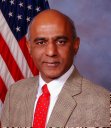
 Guna Seetharaman
· 8 previous affiliations
- US Naval Research LaboratorySince 2015
- Principal Researcher · Since 2015
- Office of the Secretary of Defense2017–2020
- Senior Scientific Advisor, C5ISR-EW Directorate, OUSD R&E · 2017–2020
- Principal Researcher · 2008–2015
- IEEE Mohawk Valley Section2013–2014
- Past Section Chairman · 2013–2014
- Associate Professor · 2003–2008
- University of Louisiana at Lafayette1988–2003
- Associate Professor · 1988–2003
- University of Miami1983–1988
- Ph.D., Electrical and Computer Engineering · 1983–1988
- M.Tech, Electrical Engineering · 1980–1982
Research Overview
Guna Seetharaman focuses on computer vision, wide-area motion imagery (WAMI) analysis, and high-performance graph processing. Early research established techniques for image registration, change detection, and moving object tracking in complex aerial surveillance environments. More recent work investigates hardware-accelerated graph analytics, 3D point cloud classification, and the evaluation of georegistration accuracy in drone-based video analytics.
Research Trajectory
The research trajectory of Guna Seetharaman is characterized by a sustained focus on extracting actionable intelligence from complex, large-scale visual data, particularly in the domain of wide-area motion imagery (WAMI). In the early 2010s, Seetharaman's work as a principal investigator addressed the foundational challenges of integrating hardware, software, and operational environments for persistent surveillance. This systems-level perspective was articulated in Joint data management for MOVINT data-to-decision making, which outlined pragmatic approaches to information fusion, distributed communications, and sensor management. By emphasizing a balanced sensor mix and life-cycle data management, this early work laid the groundwork for robust data-to-decision enterprises in defense and security contexts.
Building on this systems architecture, Seetharaman directed significant research toward the algorithmic challenges of WAMI exploitation, specifically targeting image registration and change detection in degraded or highly dynamic aerial footage. A major obstacle in processing very large motion-blurred images is the computational overhead required to accurately decipher camera motion. In Efficient Change Detection for Very Large Motion Blurred Images, Seetharaman and colleagues developed a reblur-difference framework that utilized judicious sub-image selection to estimate camera motion. This approach enabled efficient change detection even in the presence of occlusions, bypassing the unreasonable memory demands of direct whole-image processing.
As WAMI applications expanded into dense urban environments, the research adapted to handle the severe parallax effects caused by tall structures, which traditionally resulted in high false-alarm rates for motion-based trackers. To mitigate this, Seetharaman led the development of a hybrid approach detailed in Moving object detection for vehicle tracking in Wide Area Motion Imagery using 4D filtering. This work fused motion detection masks—obtained via median-based background subtraction—with accurate multiview depth maps and precise orthorectification techniques for ground stabilization. This synthesis significantly reduced parallax-induced false positives, improving vehicle tracking accuracy in complex cityscapes.
The focus on complex camera distortions continued with investigations into the coalesced effects of rolling shutter and motion blur, common in moving CMOS cameras. In Image Registration and Change Detection under Rolling Shutter Motion Blur, the research team modeled a general image formation framework for 3D scenes and proposed an optimization algorithm that leveraged the sparsity of camera trajectories to perform layered registration and detect changes simultaneously.
In parallel with advances in computer vision, Seetharaman's later work expanded into high-performance computing and graph analytics, addressing the scalability of processing large networked datasets used in route planning and socially-sensitive search. As a senior author, Seetharaman contributed to A Fast and Efficient Parallel Algorithm for Pruned Landmark Labeling, which tackled the inherently sequential nature of state-of-the-art hub labeling techniques for shortest distance querying. This research provided parallelization strategies to drastically reduce the processing time required to construct pruned shortest-path trees for large graphs. Furthermore, Seetharaman participated as a collaborator in hardware-accelerated graph processing research, such as the development of HitGraph: High-throughput Graph Processing Framework on FPGA. This framework optimized data layouts and update merging schemes to increase parallelism and data reuse in edge-centric graph algorithms, masking the internal details of Register Transfer Level (RTL) design from the user.
Current Directions
The most recent papers in the evidence, published between 2020 and 2021, indicate a continued engagement with aerial video analytics, with a specific emphasis on benchmarking and evaluating the robustness of tracking systems. Recent work investigates the critical role of spatial accuracy in downstream computer vision tasks, evaluating how georegistration precision impacts object detection and tracking performance in wide-area motion imagery. Additionally, Seetharaman has participated in large-scale community evaluation efforts, contributing to multiple object tracking (MOT) challenges designed to advance the state-of-the-art in drone-based visual surveillance. These recent directions highlight an ongoing commitment to establishing rigorous metrics, overcoming data format complexities, and utilizing standardized datasets for the next generation of aerial computer vision systems.
Profile updated
Loading new papers…
Other researchers whose papers cluster into the same research directions — a proxy for overlapping technical interests and shared intellectual neighborhoods.
See something wrong? Report a mistake