

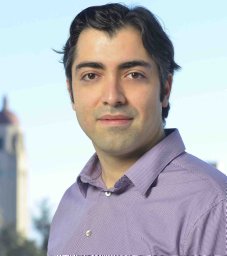
 Amin Arbabian
· 7 previous affiliations
- Plato SystemsSince 2019
- Founder · Since 2019
- Co-Founder [hiring!] · 2020–2025
- Stanford UniversitySince 2012
- Professor · Since 2025
- Associate Professor · 2019–2025
- Assistant Professor · 2012–2019
- University of California, Berkeley2005–2011
- Graduate Student Researcher · 2005–2011
- Researcher · 2010
- Tagarray2007–2009
- Founding Engineer · 2007–2009
- Tagarray Inc2008
- RF Design Engineer · 2008
- Sharif University of Technology2001–2005
- BSc, Electrical Eng. (Communications) · 2001–2005
Research Overview
Amin Arbabian focuses on integrated circuit design, millimeter-wave sensor systems, and communication architectures for resource-constrained devices. His work spans from early contributions to low-power CMOS transceivers to the development of crystal-free radios for the Internet of Things. Most recently, his research investigates data-driven waveform adaptation for high-resolution edge perception and autonomous driving applications.
Research Trajectory
Arbabian’s early work involved collaborative efforts to develop highly integrated, energy-efficient communication hardware. In 2009, as a co-author on A 90nm CMOS low-power 60GHz transceiver with integrated baseband circuitry, he participated in the design of a direct-conversion transceiver optimized for 5-to-10 Gb/s QPSK modulation. Operating from a 1.2 V supply, the design demonstrated the viability of co-integrating millimeter-wave and mixed-signal baseband circuits. This co-optimization was necessary to achieve significant power reductions, bringing consumption down to 170 mW in transmit mode and 138 mW in receive mode.
In subsequent years, Arbabian’s focus as a principal investigator expanded to address fundamental hardware and timing challenges in Internet of Things (IoT) devices. Traditional radios rely heavily on crystal oscillators for accurate timing, which imposes strict integration and scaling limits on system-on-chip IoT applications. To bypass these limitations, his group investigated communication channels that lack a common clock between the transmitter and receiver. In Communication With Crystal-Free Radios, his lab formalized the theoretical impact of two distinct types of clock uncertainty: fast-scale timing jitter (occurring faster than the communication blocklength) and slow-scale clock drift. By studying the zero-error capacity under these specific timing imperfections, the research derived optimal zero-error codes, challenging common assumptions about the necessity of strict clock synchronization in digital communication.
By 2022, Arbabian’s research trajectory incorporated advanced perception systems and edge computing, particularly utilizing millimeter-wave (mm-Wave) technology. As the senior author on A Data-Driven Waveform Adaptation Method for Mm-Wave Gait Classification at the Edge, he addressed the computational bottlenecks associated with processing high-resolution 3D perception data on resource-limited edge devices. The work proposed dynamically controlling the mm-Wave sensor’s waveform parameters based on data-driven insights. This adaptation method was designed to reduce the total computational load required for pedestrian gait analysis, a critical and data-intensive task for autonomous driving systems.
Current Directions
The most recent papers in the evidence, dating to 2022, indicate a focus on the intersection of high-resolution perception sensors and resource-constrained edge processing. Arbabian’s current research addresses the computational challenges of real-time 3D perception for autonomous systems. By developing dynamic, data-driven adaptation methods for millimeter-wave sensors, this work seeks to balance the increasing demand for advanced perception algorithms with the strict power and processing limitations of edge devices. A primary application domain for these optimized perception systems is autonomous driving, where efficient, real-time environmental analysis remains an open challenge.
Profile updated
| Title | Venue | Year |
|---|---|---|
| Adaptive Inference: Theoretical Limits and Opportunities for Efficient AI | Openreview | 2025 |
| Adaptive Inference: Theoretical Limits and Unexplored Opportunities | arXiv | 2024 |
| A Data-Driven Waveform Adaptation Method for Mm-Wave Gait Classification at the Edge | IEEE Signal Processing Letters | 2022 |
| Communication With Crystal-Free Radios | IEEE Trans. Communications | 2018 |
| A 90nm CMOS low-power 60GHz transceiver with integrated baseband circuitry | Isscc | 2009 |
Loading new papers…
Other researchers whose papers cluster into the same research directions — a proxy for overlapping technical interests and shared intellectual neighborhoods.
See something wrong? Report a mistake