

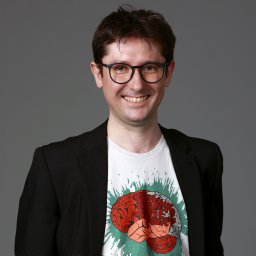
 Guillaume Dumas
· 8 previous affiliations
- Florida Atlantic UniversitySince 2012
- Affiliate Member · Since 2014
- Postdoctoral Research Fellow · 2012–2014
- CHU Sainte-Justine Research CenterSince 2020
- Principal Investigator · Since 2020
- Associate Academic Member · Since 2020
- Université de MontréalSince 2020
- Associate Professor · Since 2022
- Assistant Professor · 2020–2022
- Hôpital Necker-Enfants Malades2019–2020
- Pediatric Neurophysiologist · 2019–2020
- Habilitation à Diriger des Recherches (HDR, Accreditation to Direct Research), Medicine · 2020
- Institut Pasteur2014–2020
- Researcher · 2015–2020
- Postdoc · 2014–2015
- Sorbonne Université2008–2012
- Postdoc · 2011–2012
- Doctor of Philosophy - PhD, Cognitive Neurosciences · 2008–2012
Research Overview
Guillaume Dumas focuses on computational psychiatry, social neuroscience, and the mathematical foundations of machine learning. His early work pioneered hyperscanning techniques to study inter-brain synchronization during human interaction, bridging biological and social scales. More recently, his research investigates the algorithmic alignment between large language models and the human brain, alongside pure mathematical contributions to the representation theory of Lie groups.
Research Trajectory
The early trajectory of this research was defined by foundational contributions to social neuroscience, specifically the shift from studying isolated brains to examining dynamic dyadic interactions. In 2010, he published Inter-Brain Synchronization during Social Interaction, utilizing hyperscanning to demonstrate how two brains physically synchronize their electrical oscillations during live social engagement. This work was instrumental in advancing the research direction of Measuring Neural Communication Beyond Volume Conduction and the broader area of Inter Brain Synchronization During Live Social Interaction. Building on these findings, he articulated the theoretical need for this paradigm shift in Towards a two-body neuroscience, advocating for methodologies that capture continuous mutual adaptation. To facilitate controlled yet dynamic experiments in this vein, he introduced a novel experimental framework in The human dynamic clamp as a paradigm for social interaction, which allowed researchers to manipulate real-time coupling between a human subject and a mathematically driven virtual partner.
As the decade progressed, the focus expanded to include clinical applications and the development of standardized analytical tools. He participated in a massive, multi-center initiative detailed in The EU-AIMS Longitudinal European Autism Project (LEAP): design and methodologies to identify and validate stratification biomarkers for autism spectrum disorders. This project aimed to move beyond simple case-control comparisons by integrating deep clinical phenotyping, genomics, and neuroimaging to identify biological signatures capable of grouping the heterogeneity of autism into predictable subtypes. Recognizing the growing complexity of hyperscanning data, he later developed HyPyP: a Hyperscanning Python Pipeline for inter-brain connectivity analysis, providing the community with an open-source framework to standardize the processing of inter-brain EEG recordings and promote reproducible findings.
Parallel to his work in cognitive neuroscience and computational psychiatry, a distinct track of his research encompasses pure mathematics, specifically harmonic analysis and the representation theory of Lie groups. In 2024, he investigated the smoothness of matrix coefficients in Regularity of matrix coefficients of a compact symmetric pair of Lie groups, contributing significantly to the research direction of Hölder Regularity of Matrix Coefficients. He continued this mathematical trajectory with On quasi-homomorphism rigidity for lattices in simple algebraic groups, extending Property (TTT) to all higher-rank simple algebraic groups over local fields and demonstrating how the failure of this property is controlled by the group's center. Further refining these concepts, he determined the optimal regularity exponents for spherical functions in Regularity of K-finite matrix coefficients of semisimple Lie groups. He subsequently extended these findings to "flat" spaces in Cartan motion groups: regularity of K-finite matrix coefficients, revealing an underlying symmetry in the regularity exponents across compact, non-compact, and flat spaces associated with semisimple Lie groups.
Returning to the intersection of computation, cognition, and artificial intelligence, his recent work addresses scientific machine learning and the psychological evaluation of large language models (LLMs). He guided the development of hybrid architectures that combine deep learning with mechanistic physical priors in Effective Latent Differential Equation Models via Attention and Multiple Shooting, addressing the challenge of applying differential equations to high-dimensional real-world data. Investigating the cognitive properties of AI, his group tested the consistency of LLM personality traits using human psychometric assessments in LLMs and Personalities: Inconsistencies Across Scales. They found substantial variability in responses, challenging the assumption that LLMs possess stable personas. This instability was systematically evaluated across numerous models and millions of responses in Persistent Instability in LLM's Personality Measurements: Effects of Scale, Reasoning, and Conversation History.
Further exploring the divergence between artificial and biological networks, he co-authored Lost in Translation: The Algorithmic Gap Between LMs and the Brain, which advocates for adopting neuroscience-inspired principles like sparsity and modularity to build more biologically plausible AI. His engagement with the broader AI community on these topics includes contributions to the Proceedings of 1st Workshop on Advancing Artificial Intelligence through Theory of Mind. Bridging neurodynamics and human cognition, he proposed a novel framework for intuition in Pathfinding: a neurodynamical account of intuition, synthesizing the Free Energy Principle and metastable brain dynamics to explain how the brain generates rapid, nonconscious decisions. Most recently, he investigated the theoretical mechanics of machine learning generalization in Grokking Finite-Dimensional Algebra, demonstrating how specific mathematical properties like associativity dictate the speed at which a model transitions from memorization to perfect generalization.
Current Directions
The most recent papers in the evidence point to a highly interdisciplinary current focus spanning artificial intelligence, neurodynamics, and pure mathematics. In the realm of AI and cognitive science, recent work investigates the psychological properties and biological plausibility of large language models. This includes systematically evaluating the persistent instability of simulated personalities in LLMs and addressing the algorithmic gap between artificial architectures and the human brain by proposing neuroscience-inspired design principles. Concurrently, research in machine learning theory examines the mechanics of generalization—such as the phenomenon of "grokking" within finite-dimensional algebras—and the integration of mechanistic physical priors into deep learning via latent differential equations. In pure mathematics, ongoing work continues to define and prove the Hölder regularity of matrix coefficients across various classes of Lie groups and Cartan motion groups.
Profile updated
Loading new papers…
Other researchers whose papers cluster into the same research directions — a proxy for overlapping technical interests and shared intellectual neighborhoods.
See something wrong? Report a mistake