

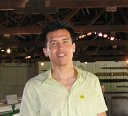
 Greg Mori
· 2 previous affiliations
- Simon Fraser UniversitySince 2004
- Full Professor · Since 2015
- Associate Professor · 2010–2015
- Assistant Professor · 2004–2010
- Borealis AISince 2018
- Researcher · Since 2018
Research Overview
Greg Mori focuses on computer vision, structured prediction, and machine learning interpretability. His trajectory spans early foundational work in shape retrieval and human action recognition to advanced deep learning architectures for graph generation and event sequence modeling. Recently, his research addresses the fairness, explainability, and reasoning capabilities of large-scale models.
Research Trajectory
His early research in computer vision explored efficient methods for object recognition and retrieval. In Shape contexts enable efficient retrieval of similar shapes, he introduced a shape descriptor based on the relative positions of sampled contour points, demonstrating its utility for rapidly pruning search spaces through vector quantization.
Moving into the late 2000s, his focus expanded to modeling complex human behaviors in video. He collaborated on Max-margin hidden conditional random fields for human action recognition, which applied a max-margin formalism to structured latent variables, modeling actions as a global root template with a constellation of parts. This work contributed to the area of Tree Structured Graphical Models for High Dimensional Inference. Building on these structured approaches, his group proposed Beyond Actions: Discriminative Models for Contextual Group Activities. By treating the hidden layer structure as a latent variable to capture person-person and group-person interactions, this research advanced the research direction of Data-Driven Discovery of Adaptive Graph Topologies.
As deep learning became prominent, he integrated neural architectures with structured temporal modeling. In A Hierarchical Deep Temporal Model for Group Activity Recognition, he developed a two-stage Long Short-Term Memory (LSTM) framework to aggregate individual person-level dynamics into a comprehensive understanding of group activities. Concurrently, he explored structured relationships in static images with Learning Structured Inference Neural Networks with Label Relations, utilizing label graphs to improve image classification across different conceptual layers. Recognizing the difficulty of scaling dense annotations for such complex label spaces, he subsequently investigated multi-label classification under constrained supervision in Learning a Deep ConvNet for Multi-Label Classification With Partial Labels..
His work on structured data naturally extended to generative models for graphs. He introduced GraphVRNN in Graph Generation with Variational Recurrent Neural Network, combining autoregressive generation with variational autoencoders to capture structural dependencies and node attributes. This contributed to the domain of Permutation Invariance in Deep Graph Learning and Generation. He later expanded on graph generation with TD-GEN: Graph Generation Using Tree Decomposition, a framework that incrementally generates nodes and edges within clusters defined by a permutation-invariant tree structure.
In parallel with generative modeling, he addressed the interpretability, robustness, and continual learning capabilities of neural networks. To explain decisions in networks trained with dynamically paired examples, his research extended gradient-weighted class activation mapping in Adapting Grad-CAM for Embedding Networks. He also tackled the challenge of ensuring models behave predictably with respect to specific features. In Not Too Close and Not Too Far: Enforcing Monotonicity Requires Penalizing The Right Points, he utilized mixup to generate training points for robust monotonicity enforcement, and further formalized this approach in Monotonicity as a requirement and as a regularizer: efficient methods and applications using point-wise gradient penalties. To address catastrophic forgetting in generative models, he developed frameworks for conditional image generation in Lifelong GAN: Continual Learning for Conditional Image Generation.
More recently, he has explored self-supervised learning for temporal data. In Self-Supervised Pretext Tasks for Event Sequence Data from Detecting Misalignment, he designed auxiliary tasks that learn the coupling relationships between event times and types, providing foundational representations for downstream tasks like next-event prediction and sequence classification.
Current Directions
The most recent papers in the evidence address the alignment, explainability, and fairness of large-scale machine learning models. Recent work investigates the integration of reinforcement learning with large language models (LLMs) to process structured data; for example, TabReason: A Reinforcement Learning-Enhanced Reasoning LLM for Explainable Tabular Data Prediction utilizes custom reward functions to prioritize human-understandable reasoning alongside prediction accuracy. Additionally, his current research tackles algorithmic bias in computer vision architectures. In Improving Fairness via Noise Injection in Vision Transformers, he explores methods for disentangling sensitive information from task-relevant features by injecting calibrated noise into pre-trained models, aiming to improve fairness without sacrificing downstream task performance.
Profile updated
Loading new papers…
Other researchers whose papers cluster into the same research directions — a proxy for overlapping technical interests and shared intellectual neighborhoods.
See something wrong? Report a mistake