

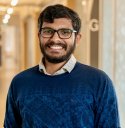
 Gaurav Sahu
· 4 previous affiliations
- Unified SciencesCurrent
- Current
- Postdoc · 2025–2026
- University of Waterloo2018–2024
- PhD student · 2020–2024
- MS student · 2018–2020
- Undergrad student · 2014–2018
Research Overview
Gaurav Sahu focuses on automated scientific workflows, agentic data analysis, and computational creativity. His early work explored multimodal fusion and generative models for dialogue and artistic inspiration. Recently, his research has shifted toward building self-improving agents and robust evaluation frameworks for large language models, particularly in the context of complex reasoning and literature review.
Research Trajectory
Early work investigated structured prediction and generative modeling for natural language. In Free as in Free Word Order: An Energy Based Model for Word Segmentation and Morphological Tagging in Sanskrit, he and his collaborators introduced an energy-based model that jointly tackled word segmentation and morphological tagging by representing sentences as graphs of potential word candidates rather than linear lattices. This interest in structured and generative language modeling extended to dialogue systems in Adversarial Learning on the Latent Space for Diverse Dialog Generation, which contributed to the broader research direction of Adversarial Training in Continuous Latent Spaces.
Expanding beyond text, subsequent research explored how neural networks can optimally combine data from different modalities. In Adaptive Fusion Techniques for Multimodal Data, he introduced Auto-Fusion and GAN-Fusion, lightweight adaptive techniques designed to learn the best representations across text, video, and audio. These methods demonstrated that efficient fusion strategies could outperform larger transformer-based models on tasks like machine translation and emotion recognition, advancing the area of Non-linear Interaction and Decomposition for Multimodal Fusion. Returning to multimodal architectures with a focus on social media moderation, Multi-Modal Discussion Transformer: Integrating Text, Images and Graph Transformers to Detect Hate Speech on Social Media presented a novel system that holistically analyzes text, images, and conversational structure. By interleaving multi-modal fusion with graph transformers, the architecture improved hate speech detection, contributing to the research direction of Detecting Emergent Toxicity in Multimodal Memes.
As large language models became more capable, the focus shifted toward leveraging them for data augmentation and semi-supervised learning, particularly in low-resource settings. PromptMix: A Class Boundary Augmentation Method for Large Language Model Distillation proposed a two-step method utilizing LLMs to generate challenging text augmentations near class boundaries while mitigating the risk of false positives through relabeling. Parallel efforts in summarization led to LLM aided semi-supervision for efficient Extractive Dialog Summarization, which explored building high-performing extractive models for customer service dialogs without massive human-labeled datasets. This line of inquiry culminated in the development of MixSumm and PPSL, strategies introduced in MixSumm: Topic-based Data Augmentation using LLMs for Low-resource Extractive Text Summarization and further detailed in A Guide To Effectively Leveraging LLMs for Low-Resource Text Summarization: Data Augmentation and Semi-supervised Approaches. By using large teacher models to synthesize diverse documents and refine noisy labels, these approaches demonstrated that smaller models could achieve competitive performance with a fraction of the original labeled data.
Alongside core NLP and multimodal research, a distinct thread of work has investigated computational creativity. LyricJam Sonic: A Generative System for Real-Time Composition and Musical Improvisation detailed a bi-modal generative system designed to help electronic musicians navigate studio archives in real-time, acting as a creative partner that suggests congruent sounds to maintain creative flow. This exploration of AI as a creative catalyst continued in Balancing Indeterminacy and Structure: Neural Text Generation for Artistic Inspiration. The study argued that while modern LLMs generate highly polished text, smaller models like LSTM-Variational Autoencoders often produce the syntactic strangeness and semantic openness better suited for the initial seed phase of human artistic inspiration.
Most recently, the trajectory has converged on automated scientific workflows and agentic reasoning. LitLLMs, LLMs for Literature Review: Are we there yet? proposed a modular framework that separates literature review writing into automated retrieval and plan-based text generation. Evaluated on new preprints to prevent data contamination, the system demonstrated that structured planning reduces citation hallucinations and improves relevance. This work intersects with the areas of Shifting from Static Benchmarks to Dynamic Evaluation and The Information Bottleneck of Scientific Abstracts. The application of AI to the scientific process was further explored in AInstein: Can AI Rediscover Scientific Concepts from First Principles? and ReviewerToo: Should AI Join The Program Committee? A Look At The Future of Peer Review, which critically examined the capacity of models to evaluate and synthesize scientific literature. Finally, extending agentic capabilities to business domains, InsightBench: Evaluating Business Analytics Agents Through Multi-Step Insight Generation introduced a benchmark challenging AI agents to perform end-to-end data analytics. The accompanying AgentPoirot model demonstrated the ability to uncover actionable insights by iteratively asking follow-up questions, moving beyond isolated coding tasks toward comprehensive data analysis.
Current Directions
The most recent papers in the evidence address the development and evaluation of autonomous agents for complex, multi-step reasoning tasks, particularly in scientific and business domains. Recent work investigates how modular frameworks and structured planning can mitigate hallucinations in large language models during literature reviews and peer review processes. Additionally, ongoing research focuses on end-to-end agentic data analysis, designing benchmarks that require models to iteratively query datasets and generate actionable insights rather than simply executing isolated code snippets. A parallel focus remains on computational creativity, exploring how the architectural constraints of different generative models influence their utility as collaborative tools for human artists.
Profile updated
Loading new papers…
Other researchers whose papers cluster into the same research directions — a proxy for overlapping technical interests and shared intellectual neighborhoods.
See something wrong? Report a mistake