

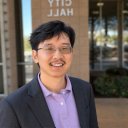
 Fuxun Yu
· 2 previous affiliations
- Microsoft (United States)Since 2022
- Principal Researcher · Since 2022
- George Mason University2017–2022
- PhD student · 2017–2022
Research Overview
Fuxun Yu focuses on adversarial robustness in deep learning, efficient neural network optimization, and geospatial reasoning for vision-language models. Early work concentrated on accelerating adversarial training and mitigating gradient instability in deep architectures. More recently, research has shifted toward foundational models for map generation and zero-shot reasoning in remote sensing domains.
Research Trajectory
The trajectory begins in 2018 with a focus on adversarial machine learning and neural network interpretability. Early collaborative work explored the area of Bypassing the Computational Bottleneck of Adversarial Training through Towards Robust Training of Neural Networks by Regularizing Adversarial Gradients, which proposed penalizing adversarial gradients to achieve robustness without expensive adversarial example generation. Concurrently, Yu contributed to How convolutional neural networks see the world - A survey of convolutional neural network visualization methods and developed faster attack frameworks in the research direction of Amortized Feed Forward Adversarial Generation with ASP: A Fast Adversarial Attack Example Generation Framework based on Adversarial Saliency Prediction. This line of inquiry expanded into evaluating model vulnerabilities, contributing to the broader area of Understanding Gradient Masking in Adversarial Defenses via Interpreting and Evaluating Neural Network Robustness, which framed adversarial vulnerability as a neighborhood under-fitting problem. Shifting toward fundamental optimization, Yu introduced a novel framework in ADMM for Efficient Deep Learning with Global Convergence, addressing the area of Mitigating Gradient Instability in Deep Architectures by adapting the Alternating Direction Method of Multipliers to reduce time complexity in deep neural networks.
In 2020, the research expanded into distributed systems and hardware-aware optimization. Yu participated in developing structural alignment techniques for non-IID data in Heterogeneous Federated Learning. Addressing the research direction of Why Theoretical FLOPs Fail to Predict Real Latency, collaborative work on Towards Latency-aware DNN Optimization with GPU Runtime Analysis and Tail Effect Elimination demonstrated how adjusting layer widths to fit GPU capacities can eliminate under-utilized cycles. This systems-level perspective continued with A Survey of Large-Scale Deep Learning Serving System Optimization: Challenges and Opportunities and the introduction of QuadraLib: A Performant Quadratic Neural Network Library for Architecture Optimization and Design Exploration. Returning to inference efficiency, Yu developed a decomposed convolution scheme in FalCon: Fine-grained Feature Map Sparsity Computing with Decomposed Convolutions for Inference Optimization, enabling dynamic sparsity on standard hardware. Around this time, work also touched on domain adaptation challenges in object detection with SC-UDA: Style and Content Gaps aware Unsupervised Domain Adaptation for Object Detection.
By 2023, the focus transitioned toward remote sensing and geospatial applications. Yu led research in the area of Bridging the Natural to Remote Sensing Domain Gap with Stable Diffusion For Aerial Object Detection, utilizing generative models to synthesize high-quality training data for rare aerial classes. Recent work has increasingly focused on geospatial reasoning and map-based foundation models. Yu oversaw the creation of MapRef: A Referring Expression Comprehension Benchmark for Maps, which evaluates how well vision-language models transfer to structured geospatial imagery. Collaborative efforts also explored reinforcement learning for rare domains in Unlocking Zero-Shot Geospatial Reasoning via Indirect Rewards, demonstrating that indirect verifiable rewards derived from metadata can induce sophisticated zero-shot reasoning. Further advancing map generation, Yu directed the development of MARS - A Foundational Map Auto-Regressor, an end-to-end model capable of generating multi-polyline road networks and polygon buildings in a unified manner.
Current Directions
The most recent papers in the evidence address the intersection of vision-language models and geospatial reasoning. Current work investigates how to adapt foundation models to structured, map-based imagery, overcoming the supervision scarcity inherent in remote sensing domains. This includes exploring reinforcement learning paradigms that utilize indirect, verifiable proxy rewards—such as geolocation metadata—to unlock zero-shot reasoning capabilities without requiring massive task-specific annotations. Additionally, ongoing research focuses on auto-regressive architectures for unified map generation, moving away from multi-stage pixel-wise segmentation toward end-to-end vectorized outputs for complex geographic features.
Profile updated
Loading new papers…
Other researchers whose papers cluster into the same research directions — a proxy for overlapping technical interests and shared intellectual neighborhoods.
See something wrong? Report a mistake