

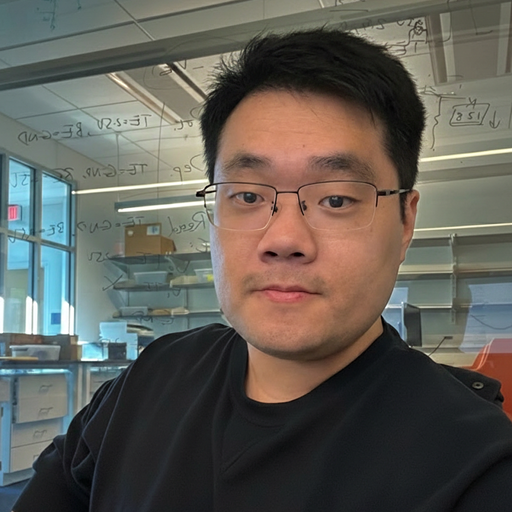
 Cong Guo
· 2 previous affiliations
- Duke UniversitySince 2023
- Postdoc · Since 2023
- Shanghai Jiao Tong University2020–2023
- PhD student · 2020–2023
Research Overview
Cong Guo focuses on computer architecture and scalable hardware-software co-design for efficient artificial intelligence systems. His early work explored sparsity- and quantization-aware architectures to compress deep neural networks and accelerate inference on commodity and custom hardware. More recently, his research investigates specialized architectural designs and memory management strategies tailored for large language models and vision-language models.
Research Trajectory
Starting in 2019, early research explored the internal organization of deep neural networks and the application of functional sparsity. This included participation in Adversarial Defense Through Network Profiling Based Path Extraction, which decomposed neural network models into functional blocks to extract effective paths, demonstrating that adversarial images activate different internal trajectories than normal images.
Around 2020 and 2021, the focus shifted toward accelerating sparse models. Recognizing that sparse models with randomly distributed weights struggle to achieve meaningful speedups on dense commodity hardware, he developed algorithm-software co-design methods in Accelerating sparse DNN models without hardware-support via tile-wise sparsity. This work restructured matrix multiplications to exploit sparsity on existing architectures. Concurrently, he explored custom hardware solutions for sparsity, contributing to the design of the Dual-side Sparse Tensor Core.
In 2022, the research deepened into model quantization, specifically targeting low-bit integers to shrink models for resource-constrained environments. He introduced techniques for activation quantization in Efficient Activation Quantization via Adaptive Rounding Border for Post-Training Quantization, addressing challenges related to the research direction of The Performance Cliff in Ultra-Low Bit LLM Quantization. He further explored numerical representations in ANT: Exploiting Adaptive Numerical Data Type for Low-bit Deep Neural Network Quantization. To support privacy-sensitive scenarios where original datasets are unavailable, he collaborated on an on-the-fly framework, SQuant: On-the-Fly Data-Free Quantization via Diagonal Hessian Approximation, which approximated second-order loss information to calibrate networks on inference-only devices.
By 2023, the scope of his work expanded to address the computational demands of emerging and complex architectures. After contributing to Accelerating Generic Graph Neural Networks via Architecture, Compiler, Partition Method Co-Design, he pivoted to the challenges of Large Language Models (LLMs). He developed OliVe: Accelerating Large Language Models via Hardware-friendly Outlier-Victim Pair Quantization, a framework enabling 4-bit acceleration by sacrificing unimportant values adjacent to critical outliers, thereby handling high-magnitude values locally in a memory-aligned manner.
In 2024, memory bottlenecks in large-scale AI systems became a primary focus. He mapped out the landscape of these challenges in A Survey: Collaborative Hardware and Software Design in the Era of Large Language Models, which discusses strategies for overcoming the memory wall and advancing the area of The Memory Bandwidth Bottleneck in Transformer Decoding. Practically, he addressed GPU memory fragmentation during training with GMLake: Efficient and Transparent GPU Memory Defragmentation for Large-scale DNN Training with Virtual Memory Stitching. For inference, he co-developed vTensor: Flexible Virtual Tensor Management for Efficient LLM Serving, leveraging hardware-level virtual memory management to decouple defragmentation from computation, allowing standard kernels to operate without memory fragmentation overhead.
Moving into 2025, his work increasingly targeted ultra-efficient sequence modeling and specialized hardware. He explored cache compression in Ecco: Improving Memory Bandwidth and Capacity for LLMs via Entropy-Aware Cache Compression. He also contributed to novel hardware paradigms, such as reinterpreting attention mechanisms as associative memory searches in CAMformer: Associative Memory is All You Need, which utilizes a voltage-domain Binary Attention Content Addressable Memory. Similarly, he collaborated on Hamming Attention Distillation: Binarizing Keys and Queries for Efficient Long-Context Transformers, replacing floating-point dot products with Hamming distance computations to advance the research direction of Sparsifying Transformers with Top-k Attention. To support ultra-low-bit quantization, he designed Platinum: Path-Adaptable LUT-Based Accelerator Tailored for Low-Bit Weight Matrix Multiplication, an ASIC accelerator optimized for ternary weights that shifts lookup table generation to an offline phase.
His recent work also extends to multimodal and diffusion models. He introduced Focus: A Streaming Concentration Architecture for Efficient Vision-Language Models, which uses multilevel concentration to prune redundant data at the semantic, block, and vector levels, addressing the challenge of Managing Visual Token Redundancy in Multimodal Models. Most recently, in 2026, he co-authored DPad: Efficient Diffusion Language Models with Suffix Dropout, a training-free inference method that treats future tokens as a sparse scratchpad, contributing to work in the broader area of Native Sparse Attention for Long Context Transformers.
Continuing in 2026, Guo contributed to Gossamer: A Utility-Driven Architecture for Constant-Budget KV Cache Compression in Reasoning LLMs, an architecture that fuses cosine-similarity estimation into idle attention compute cycles to support dynamic quantization, merging, or eviction, addressing challenges in Overcoming the Linear Memory Growth of KV Caches. To target iterative generative latency, Guo co-designed Phantom: Temporal Caching for Diffusion Models, an accelerator that caches activations across timesteps and maps differential outlier updates to systolic arrays, contributing to Accelerating Sparse Neural Networks on Dense Hardware. Additionally, Guo participated in developing ZKPU: Zero-Knowledge Processing Unit for Heterogeneous Workloads, a reconfigurable processing unit tailored for both curve-based and hash-based zero-knowledge proof protocols via flexible Montgomery multiplication.
Current Directions
The most recent papers in the evidence indicate a strong focus on pushing the boundaries of ultra-low-bit quantization and specialized hardware for generative AI. A major current direction involves designing architectures for extreme quantization regimes, such as ternary weight networks and binarized attention mechanisms. This includes developing custom ASIC accelerators and reinterpreting standard transformer operations—such as replacing dense matrix multiplications with associative memory searches or Hamming distance computations—to drastically reduce energy consumption and improve throughput.
Additionally, recent work investigates efficiency bottlenecks in emerging model architectures, particularly Vision-Language Models (VLMs) and diffusion-based language models. This research emphasizes dynamic pruning and sparsity, utilizing techniques like multilevel concentration to mitigate visual redundancy and suffix dropout to accelerate parallel text generation. Across these domains, a unifying theme is the tight co-design of algorithms and hardware to overcome the memory capacity and bandwidth limitations inherent in scaling modern AI systems.
Profile updated
| Paper | Venue | Year |
|---|---|---|
| DPad: Efficient Diffusion Language Models with Suffix DropoutGitHubCrys-Chen/ | arXiv | 2025 |
Loading new papers…
Other researchers whose papers cluster into the same research directions — a proxy for overlapping technical interests and shared intellectual neighborhoods.
See something wrong? Report a mistake