

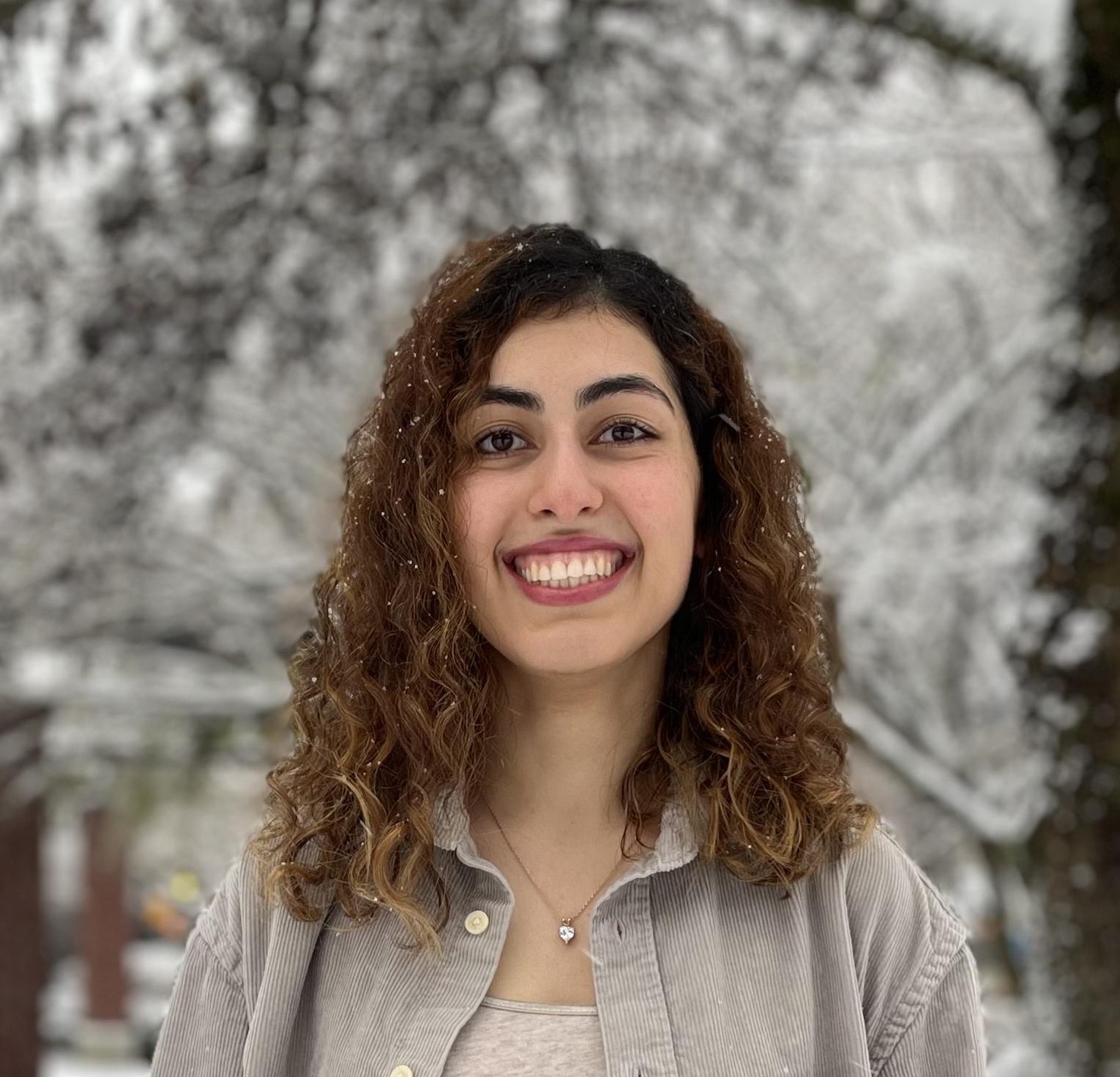
 Farnoosh Hashemi
· 5 previous affiliations
- Cornell UniversitySince 2023
- Doctor of Philosophy - PhD, Information Science · 2023–2028
- Graduate Research Assistant · Since 2023
- Cornell TechSince 2023
- PhD student · 2023–2028
- University of British Columbia2020–2023
- Graduate Research Assistant · 2020–2023
- Master's degree, Computer Science · 2020–2022
- Teaching Assistant2015–2020
- Sharif University of Technology · 2015–2020
- Research Intern · 2018
Research Overview
Farnoosh Hashemi focuses on graph representation learning, temporal network analysis, and the modeling of complex spatiotemporal systems. Their trajectory spans from foundational algorithms for community detection in multilayer networks to advanced state-space models for dynamic brain connectivity. Most recently, their work explores the collective social behaviors and persuasive capabilities of large language model agents interacting within simulated environments.
Research Trajectory
Hashemi’s early research examined spatial and social phenomena, utilizing satellite imagery to correlate urban green space with country-level happiness in Green Space and Happiness of Developed Countries. The focus of their work soon shifted toward the underlying mathematics of complex network structures. To address the computational bottlenecks of analyzing massive datasets, Hashemi developed scalable algorithms for identifying dense communities, introducing the FirmCore framework to accelerate community detection in multilayer networks in FirmCore Decomposition of Multilayer Networks. Concurrently, they explored dynamic processes on networks, leading a project on Misinformation Mitigation under Differential Propagation Rates and Temporal Penalties.
In 2023, Hashemi advanced the modeling of evolving systems using graph neural networks. They addressed personalized community discovery in dynamic environments with CS-TGN: Community Search via Temporal Graph Neural Networks. Recognizing that pairwise edges are often insufficient for capturing the intricacies of complex systems, Hashemi expanded into the research area of Temporal Hypergraphs for High Order Spatiotemporal Modeling. This higher-order perspective was applied to neuroimaging in Learning Temporal Higher-order Patterns to Detect Anomalous Brain Activity, a study that contributed to the broader field of Overcoming Temporal Averaging Bias in Functional Brain Networks and addressed methodological challenges in the area of Resolving the Temporal Window Size Trade-off. To further capture structural processes in these higher-order networks, they co-developed an inductive learning method based on set walks in CAT-Walk: Inductive Hypergraph Learning via Set Walks.
By 2024, Hashemi began integrating State Space Models (SSMs) into graph architectures to overcome the scalability limits and over-squashing issues of traditional Graph Transformers. They introduced Graph Mamba Networks, which utilize bidirectional selective scans for linear scalability on long-range graph benchmarks, in Graph Mamba: Towards Learning on Graphs with State Space Models. This architectural innovation was paralleled by domain-specific applications in neuroscience, such as Brain-Mamba: Encoding Brain Activity via Selective State Space Models. Continuing their focus on neuroimaging, Hashemi led the development of BrainMixer, an unsupervised framework linking fine-grained voxel activity with large-scale functional connectivity in Unsupervised Representation Learning of Brain Activity via Bridging Voxel Activity and Functional Connectivity, advancing the research direction of Decoding Cognitive States from Distributed Neural Patterns. Alongside these deep learning advances, they continued refining foundational network theory, proposing the S-core framework to detect dense subgraphs and model user engagement in multiplex networks in A Unified Core Structure in Multiplex Networks: From Finding the Densest Subgraph to Modeling User Engagement.
Most recently, Hashemi’s trajectory has expanded to encompass the social dynamics of artificial agents and spatial knowledge graphs. They investigated the micro-level interactions of over 32,000 language model agents on a simulated social media platform in Collective Social Behaviors in LLMs: An Analysis of LLMs Social Networks. They also participated in research on improving the cultural nuance and consistency of AI-driven debate in Enhancing LLM-Based Persuasion Simulations with Cultural and Speaker-Specific Information. Returning to spatial data integration, they contributed to KRAFT: A Knowledge Graph-Based Framework for Automated Map Conflation.
Current Directions
The most recent papers in the evidence indicate a dual focus on the collective behavior of generative AI agents and the integration of complex spatial data. Recent work investigates how Large Language Models (LLMs) interact within simulated social networks, analyzing whether iterative interactions among thousands of agents amplify biases or produce exclusive behaviors over time. This includes exploring how to inject cultural nuance and speaker-specific consistency into LLM-based persuasion simulations to overcome the generic nature of standard models. Additionally, ongoing research addresses automated map conflation, utilizing knowledge graph-based frameworks to synthesize and align spatial datasets.
Profile updated
Loading new papers…
Other researchers whose papers cluster into the same research directions — a proxy for overlapping technical interests and shared intellectual neighborhoods.
See something wrong? Report a mistake