

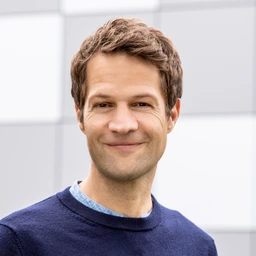
 Fabian J Theis
· 7 previous affiliations
- Technical University of MunichSince 2013
- Full Professor · Since 2013
- Current
- Helmholtz MunichSince 2007
- Scientific Director of Biomedical AI at Helmholtz Pioneer Campus HPC · Since 2022
- Head of Computational Health Center · Since 2021
- Institute Director · Since 2013
- Junior Group Leader · 2007–2013
- Chair of AI Council · Since 2020
- Immunai (United States)Since 2021
- Consulting · Since 2021
- RN.AI TherapeuticsSince 2025
- Co-Founder · Since 2025
- University of Regensburg1995–2008
- Diploma, PhD, Habilitation, Mathematics, Physics, Biophysics · 1995–2008
- Phd, Computer Science
2 other authors named Fabian J Theis: Fabian J. Theis (2 papers), Fabian J Theis (1 paper)
Research Overview
Fabian J Theis focuses on computational biology, single-cell transcriptomics, and machine learning for genomics. His trajectory spans early work in independent component analysis to the development of foundational tools for modeling cellular dynamics, denoising single-cell data, and mapping cell fates. Currently, he investigates generative modeling and self-supervised learning to build robust representations of complex biological systems.
Research Trajectory
Theis’s early research explored foundational machine learning methods, particularly in the domain of signal processing. In Linear Geometric ICA: Fundamentals and Algorithms (2003), he and his collaborators analyzed the theoretical framework and convergence conditions of geometric independent component analysis, establishing uniqueness properties for nongaussian unimodal symmetric cases.
By the mid-2010s, his focus shifted toward computational biology, specifically addressing the analytical challenges posed by high-dimensional single-cell RNA sequencing (scRNA-seq) data. A major theme of his work became the reconstruction of cellular dynamics from snapshot data. He guided the development of Diffusion pseudotime robustly reconstructs lineage branching (2016), introducing a scalable method that uses diffusion-like random walks to infer cellular trajectories, branching events, and metastable states. Concurrently, he contributed to Computational analysis of cell-to-cell heterogeneity in single-cell RNA-sequencing data reveals hidden subpopulations of cells, which utilized latent variable models to account for confounding factors like the cell cycle, enabling the robust identification of hidden cell subpopulations.
As the scale of scRNA-seq data grew, Theis’s lab increasingly leveraged deep learning to model cellular responses and handle inherent data sparsity. He oversaw the creation of scGen predicts single-cell perturbation responses (2019), a model combining variational autoencoders with latent space vector arithmetic to predict out-of-sample cellular responses to perturbations and infections. To address the noise and dropout characteristic of single-cell data, his group proposed a deep count autoencoder network in Single-cell RNA-seq denoising using a deep count autoencoder, which scales linearly to millions of cells by incorporating a negative binomial noise model. Recognizing the rapid proliferation of computational tools in the field, he also co-authored Current best practices in single‐cell RNA‐seq analysis: a tutorial, providing a comprehensive workflow and recommendations for pre-processing and downstream analysis.
Building on his earlier trajectory inference research, his work advanced the modeling of transcriptional dynamics. He led the development of scVelo, detailed in Generalizing RNA velocity to transient cell states through dynamical modeling (2020). This likelihood-based dynamical model solved the full transcriptional dynamics of splicing kinetics, generalizing RNA velocity to systems with transient cell states. This was complemented by CellRank for directed single-cell fate mapping, which reconstructed cell-state dynamics and directed biological processes from single-cell data.
More recently, Theis has integrated gene regulatory networks and advanced optimal transport methods into single-cell analysis. In RegVelo: gene-regulatory-informed dynamics of single cells (2024), his team introduced a deep learning framework that jointly models cell dynamics and regulatory networks, contributing to the broader research direction of Multimodal Foundation Models for Single Cell Biology. He also explored the area of Unbalanced Transport for Population Dynamics through Unbalancedness in Neural Monge Maps Improves Unpaired Domain Translation, relaxing strict mass conservation constraints to improve domain translation tasks like cell trajectory inference. His work on generative models continued with Multi-Modal and Multi-Attribute Generation of Single Cells with CFGen (2025), a flow-based model utilizing compositional guidance to synthesize realistic single-cell data across multiple attributes. Alongside these methodological advances, he has applied single-cell resolution techniques to specific biological systems, providing resources such as Stress in the ventral hippocampus under single-cell resolution.
The most recent papers in the evidence emphasize the critical evaluation and improvement of latent representations in genomics. His group investigated the biological plausibility of compressed representations in What information is preserved in latent cell embeddings? A Benchmark for Single-Cell Reconstruction (2026). To further enhance these embeddings, he oversaw the development of scJEPA: Dual-Space Self-Supervised Learning for Single-Cell Representations, a framework that optimizes both expression and embedding spaces. This work advances techniques in the area of Overcoming Data Sparsity in Single Cell Sequencing and further supports the development of multimodal foundation models. Additionally, he has explored complex data distribution comparisons in high-dimensional genomics through Flow-Based Density Ratio Estimation for Intractable Distributions with Applications in Genomics. In Learning Multimodal Representations from Partially Paired, Small-Scale Data (2026), Theis guided CAMEO, an adversarial learning framework that integrates unimodal encoders with cross-modal latent alignment to learn shared representations from scarce paired biomedical data. That same year, Theis also collaborated on Trajectory Replay: Continuous-Time Mixture Transport for Lifelong Generative Models, introducing a velocity-matching continuous-time transport framework to enable lifelong learning in generative models without catastrophic forgetting.
Current Directions
The most recent papers in the evidence indicate a strong focus on generative modeling and self-supervised learning for single-cell genomics. Recent work investigates the fundamental properties of latent cell embeddings, benchmarking how well compressed representations preserve true biological information rather than treating them merely as implementation details. To improve these representations, his group is developing dual-space self-supervised learning frameworks that simultaneously denoise gene expression and structure the embedding space for downstream tasks.
Additionally, current research addresses the generation of synthetic single-cell data using flow-based models with compositional guidance. This approach allows for the multi-attribute generation of cells—combining specific cell types, tissues, and donors—without requiring exhaustive combinatorial training. He is also exploring advanced statistical techniques, such as flow-based density ratio estimation, to compare intractable, high-dimensional distributions in genomics.
Profile updated
Loading new papers…
Other researchers whose papers cluster into the same research directions — a proxy for overlapping technical interests and shared intellectual neighborhoods.
See something wrong? Report a mistake