

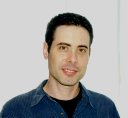
 Eran Treister
· 3 previous affiliations
- Ben-Gurion University of the NegevSince 2017
- Associate Professor · Since 2023
- Current
- Assistant Professor · 2017–2022
- University of British Columbia2015–2016
- Postdoc · 2015–2016
- PhD student · 2009–2014
- Undergrad student · 2004–2008
Research Overview
Eran Treister focuses on scalable numerical methods, algebraic multigrid techniques, and the intersection of partial differential equations with graph neural networks. His trajectory spans from classical solvers for large-scale sparse systems to modern deep learning architectures designed for complex physical simulations. Recently, his work emphasizes multiscale frameworks for graph learning and robust preconditioning for high-frequency wave equations.
Research Trajectory
Eran Treister’s early research established a foundation in scalable numerical methods and optimization for large-scale systems. His initial work included developing adaptive techniques for Markov chains in On-the-Fly Adaptive Smoothed Aggregation Multigrid for Markov Chains and addressing high-dimensional statistical applications with A Block-Coordinate Descent Approach for Large-scale Sparse Inverse Covariance Estimation. He subsequently explored efficient solvers for wave propagation and imaging, introducing A fast marching algorithm for the factored eikonal equation and advancing seismic imaging techniques in Full Waveform Inversion Guided by Travel Time Tomography.
By 2020, Treister began bridging classical numerical analysis with deep learning, particularly focusing on graph neural networks (GNNs). He helped introduce DiffGCN: Graph Convolutional Networks via Differential Operators and Algebraic Multigrid Pooling, which parameterized convolution kernels based on discretized differential operators and leveraged algebraic multigrid (AMG) principles for pooling. This perspective culminated in PDE-GCN: Novel Architectures for Graph Neural Networks Motivated by Partial Differential Equations, which addressed the over-smoothing phenomenon in deep graph networks by designing architectures grounded in the numerical solution of PDEs on manifolds. This work contributed significantly to the research direction of Scaling Graph Neural Networks Beyond Shallow Architectures and the broader area of Preserving Dirichlet Energy in Deep Graph Neural Networks.
In recent years, Treister has extensively applied these hybrid methodologies to complex physical simulations and inverse problems. He developed novel deep learning preconditioners for wave propagation modeling in Multigrid-Augmented Deep Learning Preconditioners for the Helmholtz Equation using Compact Implicit Layers, advancing the area of Scalable Solvers for Indefinite High-Frequency Wave Equations. He further expanded on this challenge by introducing A block-acoustic preconditioner for the elastic Helmholtz equation, a method that also supports the research direction of Robust Simulation of Nearly Incompressible Deformable Solids. His work on physical systems continued with The immersed boundary method: an accelerated SIMPLE approach for moving bodies, which achieved grid-independent convergence rates for massive fluid-structure interaction simulations, and An Over Complete Deep Learning Method for Inverse Problems, which jointly learned embeddings and regularizers to overcome limitations in diffusion-based solvers. He has also contributed to the area of Decomposing Complex Dynamics into Solvable Subproblems through his ongoing work on scalable PDE solvers.
Parallel to his work in physical simulations, Treister has continued to refine the architecture and training of GNNs. He explored continuous dynamics on graphs in Graph Neural Reaction Diffusion Models and proposed novel objective functions to leverage unlabelled data in Every Node Counts: Improving the Training of Graph Neural Networks on Node Classification. To address computational bottlenecks in large-scale graph learning, he introduced a hierarchical framework in Towards Efficient Training of Graph Neural Networks: A Multiscale Approach. He also tackled the challenge of capturing long-range dependencies by drawing parallels to classical computer vision in Improving the Effective Receptive Field of Message-Passing Neural Networks.
Beyond numerical methods and graph learning, Treister has also contributed to algorithmic fairness. In Disparate Conditional Prediction in Multiclass Classifiers, he and his collaborators generalized fairness metrics to multiclass settings, providing efficient optimization algorithms for auditing black-box models. This research aligns with the broader area of Non Convex Optimization for Algorithmic Fairness.
Most recently, Treister has synthesized his expertise in algebraic multigrid methods and graph neural networks. In RAPNet: Accelerating Algebraic Multigrid with Learned Sparse Corrections, he introduced a GNN framework that learns to generate sparse, high-quality AMG operators during the setup phase, significantly accelerating the solution of large sparse linear systems.
Current Directions
The most recent papers in the evidence indicate a dual focus on accelerating classical numerical solvers through machine learning and scaling graph neural networks for complex, long-range tasks. Recent work investigates the use of GNNs to learn sparse corrections for algebraic multigrid operators, aiming to speed up the resolution of large linear systems without sacrificing solve-phase efficiency. Additionally, ongoing research addresses the structural limitations of message-passing neural networks by developing multiscale architectures that expand effective receptive fields and reduce computational overhead during training. A secondary recent direction explores algorithmic fairness, specifically developing optimization frameworks to audit multiclass classifiers using aggregate population statistics.
Profile updated
Loading new papers…
Other researchers whose papers cluster into the same research directions — a proxy for overlapping technical interests and shared intellectual neighborhoods.
See something wrong? Report a mistake