

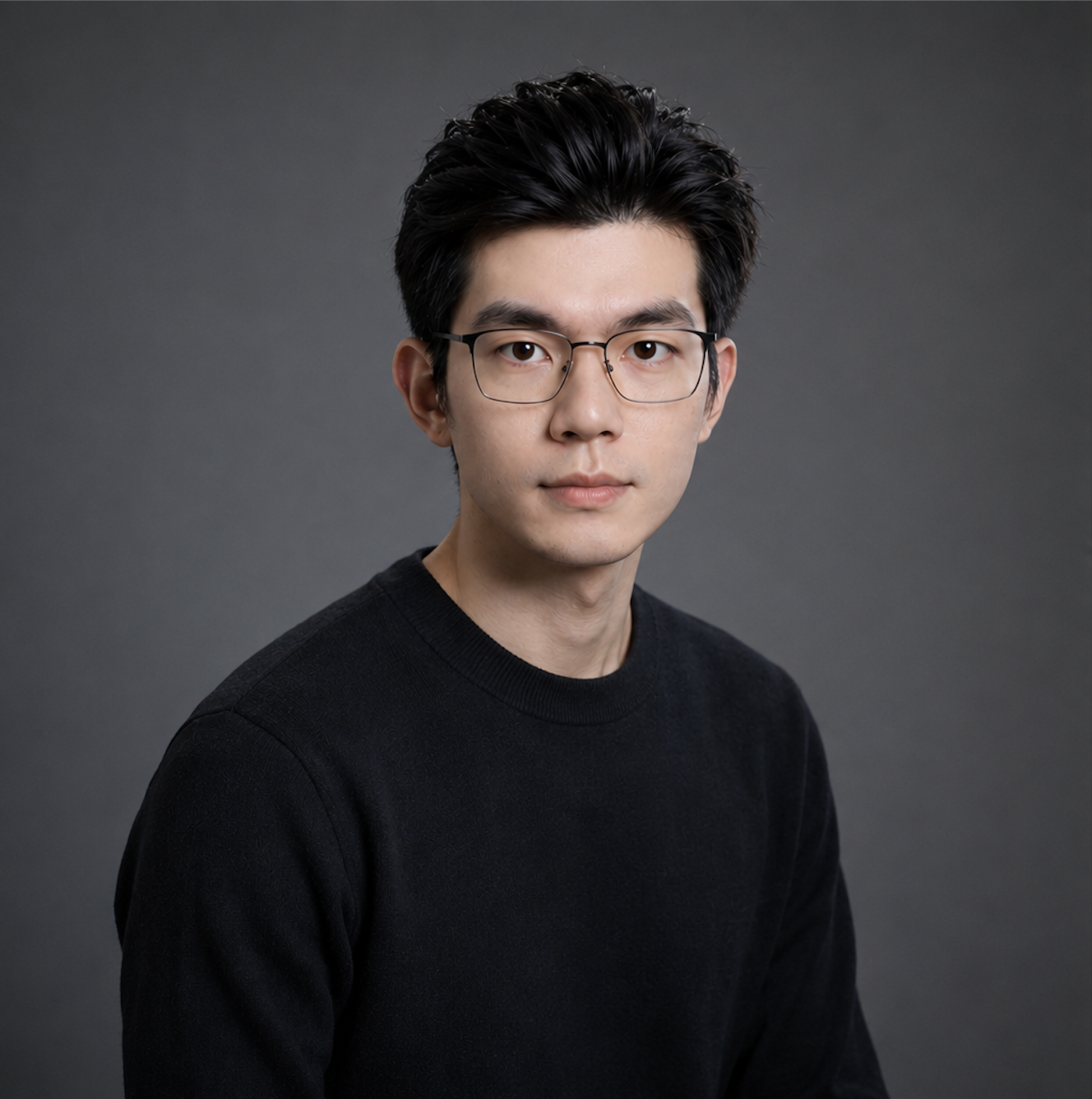
 Enming Liang
· 4 previous affiliations
- City University of Hong KongSince 2021
- Researcher · Since 2025
- PhD student · 2021–2024
- Visiting Researcher · 2024
- Research Intern · 2022
- Sun Yat-sen University2016–2020
- Undergrad student · 2016–2020
Research Overview
Enming Liang focuses on the intersection of machine learning and mathematical optimization, with specific applications in urban mobility and energy systems. His early work addressed reinforcement learning for large-scale transportation networks, while his recent trajectory emphasizes homeomorphism-based methods to guarantee strict constraint satisfaction in neural network proxies. Currently, he investigates efficient generative modeling and projection-free optimization over complex geometric sets.
Research Trajectory
The early phase of Enming Liang's research focused on applying machine learning to large-scale urban mobility and traffic control. In 2022, he developed An Integrated Reinforcement Learning and Centralized Programming Approach for Online Taxi Dispatching, which combined reinforcement learning with a centralized programming structure to manage real-time order matching and vehicle relocation in congested road networks. Around the same time, he participated in research on traffic signal coordination, contributing to OAM: An Option-Action Reinforcement Learning Framework for Universal Multi-Intersection Control, a framework designed to handle diverse intersection topologies across urban environments.
A major methodological shift toward fundamental optimization techniques occurred in 2023, addressing the persistent challenge that neural network predictions often violate strict real-world constraints. He introduced Low Complexity Homeomorphic Projection to Ensure Neural-Network Solution Feasibility for Optimization over (Non-)Convex Set. This work utilized invertible neural networks to map complex constraint boundaries into a simple sphere, providing a mathematically guaranteed mechanism to snap invalid predictions back into the feasible region without degrading solution quality. This methodology contributed significantly to the research direction of Navigating Disconnected Feasible Regions via Infeasible Bridges and the broader area of Neural Network Proxies for Real Time Optimization.
In 2024, his focus expanded to non-convex optimization and the theoretical capabilities of neural networks. To handle optimization problems where a single input maps to multiple valid optimal solutions, he developed Generative Learning for Solving Non-Convex Problem with Multi-Valued Input-Solution Mapping. By utilizing a generative learning approach based on Rectified Flow to model the distribution of optimal solutions, this work advanced the area of Multiple Hypothesis Prediction for Multimodal Regression and touched upon the direction of Overcoming the Label Generation Bottleneck in Neural Optimization. Concurrently, he collaborated on theoretical foundations in Characterizing ResNet's Universal Approximation Capability, proving that constant-width ResNets can achieve optimal approximation rates with significantly fewer parameters than standard feedforward networks, contributing to the field of Breaking the Curse of Dimensionality in Neural Approximation.
The following year saw the development of new projection techniques and decision-focused learning frameworks. He introduced Efficient Bisection Projection to Ensure Neural-Network Solution Feasibility for Optimization over General Set, combining a specialized interior point network with a bisection algorithm to guarantee feasibility under complex non-convex constraints. This methodology was directly applied to energy systems in Solving Chance-Constrained AC-OPF Problem by Neural Network with Bisection-based Projection. He also contributed to the predict-then-optimize paradigm with DFF: Decision-Focused Fine-Tuning for Smarter Predict-Then-Optimize with Limited Data, which embeds decision-focused learning into pipelines to handle limited data and non-differentiable models. Furthermore, he co-developed a novel optimization framework in Fast Projection-Free Approach (without Optimization Oracle) for Optimization over Compact Convex Set. Known as Hom-PGD, this approach mathematically warps constraint sets to bypass expensive projections, advancing the direction of Projection Free Optimization via Linear Minimization Oracles.
His most recent work in 2026 continues to push the boundaries of constrained generative modeling and theoretical neural network complexity. He collaborated on On the Universality and Complexity of GNN for Solving Second-order Cone Programs, providing theoretical proofs that Graph Neural Networks can universally approximate SOCP properties with high parameter efficiency. In another theoretical contribution, $\mathcal{O}(\log N)$ Latent Dimension Suffices for Universal Approximation of Permutation-invariant Function, he helped establish that set-based neural networks require only logarithmic width growth for stable functions. Building on his prior homeomorphism research, he co-authored Gauge Flow Matching: Efficient Constrained Generative Modeling over General Convex Set and Beyond, which uses gauge mappings to ensure generative models strictly obey hard geometric constraints. Finally, he contributed to Hom-PGD$^+$: Fast Reparameterized Optimization over Non-convex Ball-Homeomorphic Set, extending the Hom-PGD framework to non-convex constraint sets using invertible neural networks to achieve faster convergence rates.
Current Directions
The most recent papers in the evidence address the theoretical limits and practical efficiency of neural networks in strictly constrained environments. Recent work investigates advanced generative modeling techniques, such as Gauge Flow Matching, to ensure models adhere to hard geometric and physical boundaries without sacrificing computational speed. Additionally, ongoing research focuses on projection-free optimization frameworks that utilize homeomorphism and reparameterization to warp complex, non-convex constraint sets into simpler domains. This methodological work is complemented by theoretical investigations into the universal approximation capabilities of Graph Neural Networks for Second-Order Cone Programs and the latent dimension requirements for permutation-invariant functions.
Profile updated
Loading new papers…
Other researchers whose papers cluster into the same research directions — a proxy for overlapping technical interests and shared intellectual neighborhoods.
See something wrong? Report a mistake