

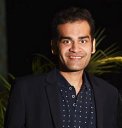
 Dhruv Kumar
· 6 previous affiliations
- Cantina LabsSince 2024
- Member of Technical Staff · Since 2024
- Grammarly2021–2024
- Senior Applied Research Scientist · 2021–2024
- Borealis AI2020
- Machine Learning Research Intern · 2020
- University of Waterloo2018–2020
- Graduate Research Assistant · 2018–2020
- Arcesium LLC2016–2018
- Software Engineer · 2016–2018
- Bachelor’s Degree, Information Technology · 2012–2016
7 other authors named Dhruv Kumar: Dhruv Kumar (Disha AI · Birla Institute of Technology and Science, Pilani · Trustwise · Indraprastha Institute of Information Technology Delhi · Birla AI Labs · 33 papers), Dhruv Kumar (2 papers), Dhruv Kumar (1 paper), Dhruv Kumar (1 paper), Dhruv Kumar (0 papers), and 2 more
Research Overview
Dhruv Kumar focuses on natural language generation, text editing, and multimodal artificial intelligence systems. His research trajectory spans unsupervised sentence simplification and real-time lyric generation conditioned on audio streams. Most recently, his work addresses task-specific instruction tuning to build efficient, state-of-the-art text editing models for writing assistance.
Research Trajectory
In 2020, Kumar led research on controllable text generation, specifically focusing on unsupervised methods for making text more accessible. As first author, he introduced Iterative Edit-Based Unsupervised Sentence Simplification, which proposed a novel approach that bypasses the need for parallel training data. The model iteratively performs word- and phrase-level edits guided by a scoring function that balances fluency, simplicity, and meaning preservation, achieving results competitive with supervised systems.
Concurrently, Kumar served as the senior researcher on projects exploring the intersection of natural language generation and music. He guided the development of Generation of lyrics lines conditioned on music audio clips, which utilized a bimodal neural network comprising a spectrogram variational autoencoder (VAE) and a text VAE to generate novel lyrics matching the emotional impact of short audio segments. This multimodal research expanded the following year with LyricJam: A system for generating lyrics for live instrumental music. As the principal investigator, Kumar oversaw the creation of a real-time system that aligns the latent spaces of audio and text representations—using both adversarial alignment and topology transfer—to generate congruent lyrics during live jam sessions.
During this period, Kumar also contributed to broader efforts in optimizing and evaluating language models. He was a co-author on Optimizing Deeper Transformers on Small Datasets, which investigated training efficiencies for transformer architectures when data is limited. Additionally, he participated as a contributing author to The GEM Benchmark: Natural Language Generation, its Evaluation and Metrics, a large-scale collaborative initiative designed to standardize the evaluation of natural language generation models across a diverse set of tasks and metrics.
Current Directions
The most recent work in the evidence shifts toward instruction-tuned large language models for specialized writing assistance. In 2023, Kumar co-authored CoEdIT: Text Editing by Task-Specific Instruction Tuning, which investigates how models can be optimized to follow explicit user commands, such as requests to simplify a sentence or adjust its tone. This research demonstrates that fine-tuning on a diverse collection of task-specific text editing instructions allows relatively compact models to achieve strong performance on editing benchmarks. The resulting system is capable of generalizing to unseen instructions while remaining significantly smaller than general-purpose large language models.
Profile updated
| Paper | Venue | Year |
|---|---|---|
| CoEdIT: Text Editing by Task-Specific Instruction TuningGitHubvipulraheja/ | EMNLP | 2023 |
Loading new papers…
Other researchers whose papers cluster into the same research directions — a proxy for overlapping technical interests and shared intellectual neighborhoods.
See something wrong? Report a mistake