

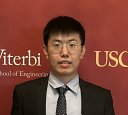
 Defu Cao
1 previous affiliation
- University of Southern California2021–2026
- PhD student · 2021–2026
Research Overview
Defu Cao focuses on developing advanced machine learning algorithms for structured data, with a primary emphasis on time series foundation models and spatio-temporal dynamics. His trajectory spans spectral graph neural networks, causal inference, and diffusion models, aiming to capture complex temporal patterns across diverse domains. Recently, his work investigates the integration of large language models with numerical reasoning and physics-informed architectures for robust forecasting.
Research Trajectory
Early work in 2020 and 2021 established a foundation in modeling complex dependencies in structured data, particularly through spectral methods. He introduced Spectral Temporal Graph Neural Network for Multivariate Time-series Forecasting, an architecture designed to capture both inter-series correlations and temporal dependencies jointly in the spectral domain. This contributed to the broader research direction of Time Series Forecasting in the Frequency Domain. Extending these spectral techniques to spatial contexts, he subsequently developed Spectral Temporal Graph Neural Network for Trajectory Prediction to improve motion forecasting for autonomous agents by leveraging frequency-domain cues alongside spatial and temporal information.
In 2022 and 2023, the research expanded to encompass causal inference, continuous-time dynamics, and robust benchmarking. To address the spread of online misinformation, he collaborated on Counterfactual Neural Temporal Point Process for Estimating Causal Influence of Misinformation on Social Media, building a causal framework based on temporal point processes to estimate the impact of specific narratives on user beliefs. Concurrently, he addressed the need for robust financial modeling by creating A Synthetic Limit Order Book Dataset for Benchmarking Forecasting Algorithms under Distributional Shift, providing labeled out-of-distribution data to simulate market stress scenarios. Further exploring complex physical systems, he participated in developing Coupled Multiwavelet Operator Learning for Coupled Differential Equations. This work decoupled integral kernels in Wavelet space to solve coupled partial differential equations, advancing the area of Accelerating Physical Simulations with Neural Surrogates and intersecting with themes in the broader area of Mitigating Computational Latency in Neural Differential Equation Solvers.
By 2024, the trajectory shifted significantly toward the development of general-purpose foundation models for time series, addressing challenges like irregular sampling and multi-resolution data. He introduced TimeDiT: General-purpose Diffusion Transformers for Time Series Foundation Model, which utilizes diffusion processes and transformer architectures with specialized masking schemes to unify training across various forecasting tasks. In parallel, he explored the adaptation of pre-trained language models for numerical data in TEMPO: Prompt-based Generative Pre-trained Transformer for Time Series Forecasting. By explicitly decomposing time series into trend and seasonal components and using learnable prompts, this framework achieved zero-shot forecasting capabilities. This research directly advanced several key areas, including Zero Shot Generalization in Time Series Foundation Models, Enabling Large Language Models to Reason About Time Series, and Bridging Numerical Trends and Textual Narratives.
In 2025, the focus on foundation models and language model integration deepened, alongside contributions to offline reinforcement learning. He developed a dynamic generalization of the R-learner in Structured Difference-of-Q via Orthogonal Learning to optimize discrete-valued actions using observational data. Returning to time series, he addressed the fundamental challenge of text-based tokenization disrupting numerical order by proposing TempoWave in Speaking Numbers to LLMs: Multi-Wavelet Number Embeddings for Time Series Forecasting. This multi-wavelet embedding method preserves numerical and temporal structures for language models. He also explored the orchestration of multiple models, co-authoring Conversational Time Series Foundation Models: Towards Explainable and Effective Forecasting to intelligently ensemble different architectures for diverse datasets, and introduced a unified framework for supply chain applications in Foundation Models for Demand Forecasting via Dual-Strategy Ensembling. Expanding into the security of complex systems, he investigated communication topologies in Topology Matters: Measuring Memory Leakage in Multi-Agent LLMs, demonstrating how sparse network structures protect against private information leakage.
Most recently, in 2026, Defu Cao introduced PINFDiT: Energy-Based Physics-Informed Diffusion Transformers for General-purpose Time Series Tasks, injecting physical constraints during inference to ensure physically consistent forecasts and imputations. Continuing the application of generative dynamics to physiological signals, Cao contributed to PPG2ECG: Physiology-Guided Latent Rectified Flow for Electro-Hemodynamic PPG-to-ECG Generation, which couples a latent rectified flow with an electro-hemodynamic simulator to reconstruct diagnostic ECGs from wearable PPG readings. Broadening into LLM agents and interactive software synthesis, Cao collaborated on PersonaCodeBench: Evaluating Coding Agents in Persona-driven Human-Interactive Sessions to benchmark how coding agents satisfy personalized user constraints over multi-turn interactions, and senior-authored a matched factorial study in Which Failure Does an Intervention Repair? When Agent Interventions Help, and Where Self-Evolving Skills Stall to evaluate which specific execution failures are resolved by skills, harnesses, and model upgrades.
Current Directions
The most recent papers in the evidence address the intersection of generative foundation models, physical constraints, and multi-agent systems. Recent work investigates how to enforce physical consistency in time series forecasting without retraining, utilizing energy-based diffusion transformers that apply constraints during inference. Concurrently, research explores the orchestration and ensembling of diverse foundation models to handle heterogeneous forecasting tasks across different domains. Another active area involves the evaluation and diagnostics of LLM agents, specifically analyzing multi-agent communication security, personalized interactive coding capabilities, and the precise failure modes repaired by agent skills and harnesses.
Profile updated
Loading new papers…
Other researchers whose papers cluster into the same research directions — a proxy for overlapping technical interests and shared intellectual neighborhoods.
See something wrong? Report a mistake