

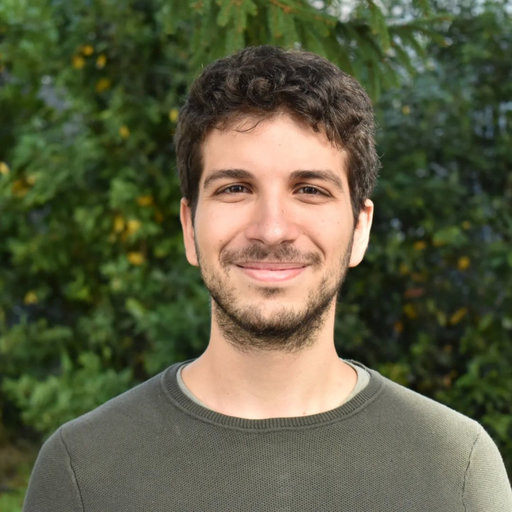
 Daniele Malitesta
· 4 previous affiliations
- Postdoctoral Researcher · Since 2026
- CentraleSupélec2024–2026
- Postdoctoral Researcher · 2024–2026
- Polytechnic University of Bari2017–2023
- Doctor of Philosophy - PhD, Computer Science Engineering · 2020–2023
- Research Assistant · 2020
- Master's degree, Master's degree in Computer Engineering · 2017–2019
- Research Intern · 2023
Research Overview
Daniele Malitesta focuses on multimedia recommender systems, adversarial machine learning, and graph neural networks. His trajectory initially explored the vulnerabilities and defensive mechanisms of visual-based recommenders against adversarial attacks before expanding into broader multimodal frameworks for multimedia recommendation. Most recently, his work investigates the theoretical properties of spectral graph neural networks and the application of efficient large language models.
Research Trajectory
Daniele Malitesta’s early research heavily investigated the intersection of visual-based recommender systems (VRSs) and adversarial machine learning. Between 2020 and 2021, he participated in several collaborative studies demonstrating how human-imperceptible perturbations could alter recommendation performance. For instance, as a second author on TAaMR: Targeted Adversarial Attack against Multimedia Recommender Systems (2020), he contributed to developing targeted adversarial attacks against product images to expose vulnerabilities in visual recommenders.
As his work progressed, the focus naturally shifted from identifying vulnerabilities to developing defensive mechanisms. He collaborated on multiple studies investigating adversarial training and image denoising to robustify recommenders against malicious inputs. A representative collaborative effort in this space is Denoise to Protect: A Method to Robustify Visual Recommenders from Adversaries (2023), where he was part of a team that proposed an adversarial image denoiser designed to clean malicious perturbations from item images while preserving visual fidelity and recommendation accuracy.
Beyond adversarial robustness, Malitesta led efforts to synthesize and structure the broader field of multimedia recommendation. As first author of Formalizing Multimedia Recommendation through Multimodal Deep Learning (published in journal form in 2025), he provided a comprehensive framework for modeling recommendation problems through the lens of multimodality. This work addressed the lack of a universal schema for integrating diverse signals—such as images, audio, and text—to construct more refined user and item profiles.
By 2026, his research trajectory showed a marked expansion into theoretical graph machine learning. As a second author on Generalization Bounds for Spectral GNNs via Fourier Domain Analysis, he contributed to analyzing spectral graph neural networks in the graph Fourier domain. This work focused on making depth and polynomial order explicit to derive data-dependent generalization bounds and stability estimates.
Current Directions
The most recent papers in the evidence indicate a diversification of Malitesta's research interests into theoretical graph machine learning and efficient natural language processing. Recent work investigates the theoretical foundations of spectral graph neural networks, specifically focusing on understanding their behavior with increasing depth and deriving generalization bounds through Fourier domain analysis. Additionally, his recent collaborative involvement in workshop organization suggests an emerging interest in the application of small, efficient large language models for knowledge extraction tasks.
Profile updated
Loading new papers…
Other researchers whose papers cluster into the same research directions — a proxy for overlapping technical interests and shared intellectual neighborhoods.
See something wrong? Report a mistake