

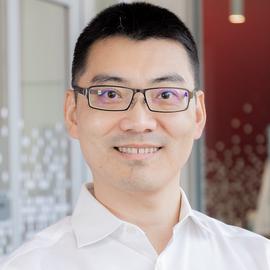
 Dakuo Wang
· 8 previous affiliations
- Association for Computing MachinerySince 2019
- Distinguished Speaker · Since 2019
- Northeastern UniversitySince 2023
- Associate Professor · Since 2023
- Stanford UniversitySince 2025
- Visiting Associate Professor · Since 2025
- Microsoft (United States)Since 2026
- Faculty Advisor · Since 2026
- Amazon (United States)2025–2026
- Researcher · 2025–2026
- Researcher · 2016–2022
- University of California, Irvine2012–2014
- PhD student · 2012–2014
- Beijing University of Technology2005–2009
- Undergrad student · 2005–2009
Research Overview
Dakuo Wang focuses on human-computer interaction, natural language processing, and health informatics to design and evaluate human-centered artificial intelligence systems. His early work explored collaborative writing and user perceptions of technology, evolving into extensive research on human-AI collaboration in clinical decision-making. Currently, he investigates the simulation of complex human behaviors using large language models and reinforcement learning.
Research Trajectory
His early research examined user behavior and collaborative systems. In 2015, he investigated how users perceive information controls in Internet Censorship in China: Examining User Awareness and Attitudes, and developed DocuViz: Visualizing Collaborative Writing to reveal the revision history and contribution patterns of co-authors in shared documents. This interest in human-computer interaction naturally extended to human-AI collaboration, as seen in his work on IBM AutoAI: Human-in-the-Loop Automated Machine Learning Supports Data Scientists to Build Better Models, which explored how automated machine learning tools can better support data scientists in their workflows.
A significant portion of his trajectory focuses on the deployment and perception of AI in healthcare. He studied the real-world challenges of implementing clinical decision support systems in developing regions in "Brilliant AI Doctor" in Rural Clinics: Challenges in AI-Powered Clinical Decision Support System Deployment. Concurrently, he participated in research on patient comprehension of medical data, such as Patients' perceptions of using artificial intelligence (AI)-based technology to comprehend radiology imaging data. This clinical focus deepened with SepsisLab: Early Sepsis Prediction with Uncertainty Quantification and Active Sensing, a system designed to recommend informative tests and reduce uncertainty in early hospital admissions. Further addressing healthcare workflows, he investigated post-surgery care transitions in Exploring Collaboration Breakdowns Between Provider Teams and Patients in Post-Surgery Care, work that aligns with the broader research direction of Ambient AI Scribes for Clinical Documentation.
In parallel with his clinical research, he advanced natural language processing resources and methods. He introduced Fantastic Questions and Where to Find Them: FairytaleQA - An Authentic Dataset for Narrative Comprehension, providing a fine-grained benchmark for evaluating causal reasoning and narrative understanding in language models. He also explored how to improve machine teaching by incorporating human reasoning, presenting Beyond Labels: Empowering Human Annotators with Natural Language Explanations through a Novel Active-Learning Architecture, which contributes to the research area of Rationale-Augmented Classification.
Most recently, his work has heavily emphasized the simulation of human behavior using large language models (LLMs) and reinforcement learning (RL). To support this computationally intensive research, he and his collaborators developed WEBSERV: A Browser-Server Environment for Efficient Training of Reinforcement Learning-based Web Agents at Scale. Leveraging this infrastructure, he has extensively investigated whether AI agents can accurately mimic human users, particularly in online shopping environments. This includes LLM Agent Meets Agentic AI: Can LLM Agents Simulate Customers to Evaluate Agentic-AI-based Shopping Assistants? and the large-scale benchmark Can LLM Agents Simulate Multi-Turn Human Behavior? Evidence from Real Online Customer Behavior Data. To improve the fidelity of these simulations, he has explored multimodal approaches, such as the vision-language framework in See, Think, Act: Online Shopper Behavior Simulation with VLM Agents.
He has also integrated reinforcement learning to refine these behavioral models. He introduced Customer-R1: personalized simulation of Human Behaviors via RL-based LLM Agent in Online Shopping to capture individual user personas, and developed Shop-R1: Rewarding LLMs to Simulate Human Behavior in Online Shopping via Reinforcement Learning, a framework that advances the research direction of Hierarchical Reinforcement Learning for Complex Task Decomposition. Beyond simulation, he has addressed the evaluation of these complex systems, proposing Multi-Agent-as-Judge: Aligning LLM-Agent-Based Automated Evaluation with Multi-Dimensional Human Evaluation to simulate diverse human perspectives. Finally, he contributed to research on model optimization, demonstrating in SFT Doesn’t Always Hurt General Capabilities: Revisiting Domain-Specific Fine-Tuning in LLMs how adaptive weighting can prevent catastrophic forgetting during domain-specific training.
Current Directions
The most recent papers in the evidence address the development and evaluation of autonomous LLM and VLM agents, specifically focusing on their ability to simulate complex, multi-turn human behaviors. This involves creating scalable training environments for reinforcement learning web agents and designing hierarchical reward systems to improve the behavioral accuracy of these models in tasks like online shopping. Additionally, current work investigates multi-agent frameworks for automated evaluation, seeking to align AI-driven assessments with diverse human perspectives, while also exploring techniques to preserve general reasoning capabilities during domain-specific fine-tuning.
Profile updated
Loading new papers…
Other researchers whose papers cluster into the same research directions — a proxy for overlapping technical interests and shared intellectual neighborhoods.
See something wrong? Report a mistake