

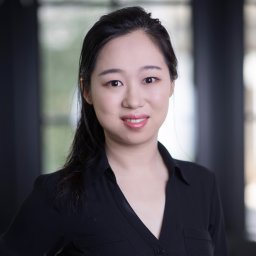
 Chuchu Fan
· 6 previous affiliations
- Massachusetts Institute of TechnologySince 2020
- Associate Professor · Since 2024
- Assistant Professor · 2020–2024
- California Institute of Technology2019–2020
- Postdoctoral Researcher · 2019–2020
- Research Assistant · 2013–2019
- Rational Cyphy, Inc.2016
- Technical Director · 2016
- Research Intern · 2015
- Tsinghua University2009–2013
- Bachelor's degree, Department of Automation · 2009–2013
Research Overview
Chuchu Fan focuses on the design, analysis, and verification of safe autonomous systems, integrating formal methods, machine learning, and control theory. Her early work established rigorous reachability analysis techniques for hybrid systems, while her subsequent research pioneered using neural networks to synthesize safety certificates for complex robotics. Currently, she investigates scalable multi-agent control and the integration of large language models with formal verification tools for rigorous planning.
Research Trajectory
Fan's early research concentrated on the formal verification of complex, nonlinear hybrid systems. In 2014, she contributed to Invariant Verification of Nonlinear Hybrid Automata Networks of Cardiac Cells, which introduced methods for verifying the safety of biological networks by analyzing the electrical behavior of cardiac cells. Building on these foundational verification principles, she subsequently developed automated tools and data-driven frameworks for hybrid models. This included Automatic Reachability Analysis for Nonlinear Hybrid Models with C2E2 and DryVR: Data-Driven Verification and Compositional Reasoning for Automotive Systems, which advanced the ability to verify safety properties in cyber-physical domains like autonomous driving through compositional reasoning.
As autonomous systems grew more complex, Fan's trajectory shifted toward integrating machine learning with rigorous control theory. She began exploring the research direction of Generalizing Provable Control to Nonlinear Systems by co-synthesizing neural network controllers and safety metrics. In Learning Certified Control Using Contraction Metric, she and her collaborators designed a learning framework to find certified control policies that drive robots to desired trajectories under bounded disturbances, providing mathematical guarantees on convergence and tracking error.
Her research further expanded these techniques to quantify risk and guarantee stability in uncertain environments. In Learning Density Distribution of Reachable States for Autonomous Systems, she introduced a semi-supervised approach to compute the density distribution of reachable states for black-box systems, contributing to the broader area of Scaling Reachability Analysis with Neural Network Solvers. Simultaneously, she advanced work in Formal Stability Guarantees for Neural Control Systems with Safe Nonlinear Control Using Robust Neural Lyapunov-Barrier Functions. This work demonstrated how to automatically synthesize robust safety certificates using neural networks, matching the performance of robust Model Predictive Control while running an order of magnitude faster.
A major theme in Fan's subsequent work is the safe coordination of multi-agent systems. Addressing the research direction of Distributed Safety Decomposition for Multi-Agent Systems, she developed decentralized frameworks that scale to large swarms. Learning Safe Multi-agent Control with Decentralized Neural Barrier Certificates proposed jointly learning control policies and control barrier functions to ensure collision avoidance among agents and obstacles. This line of inquiry, which also intersects with the area of Differentiable Safety Layers for Safe Policy Learning, matured over several years. She investigated the training of safety filters in How to Train Your Neural Control Barrier Function: Learning Safety Filters for Complex Input-Constrained Systems. By 2025, this culminated in highly scalable architectures like those presented in Discrete GCBF Proximal Policy Optimization for Multi-agent Safe Optimal Control and GCBF+: A Neural Graph Control Barrier Function Framework for Distributed Safe Multiagent Control. The latter framework utilized Graph Neural Networks to learn distributed safety certificates, successfully generalizing from a small number of simulated agents to swarms of over 1,000 agents on real-world drone hardware.
Most recently, Fan has explored the intersection of large language models (LLMs) and formal verification to solve complex, long-horizon planning problems. In Planning Anything with Rigor: General-Purpose Zero-Shot Planning with LLM-based Formalized Programming, she introduced a framework that shifts the LLM's role from a direct planner to a "formalizer," enabling models to solve highly constrained tasks that typically challenge standard reasoning models. This neuro-symbolic approach was further detailed in Large Language Models Can Solve Real-World Planning Rigorously with Formal Verification Tools. She also expanded LLM capabilities in R1-Code-Interpreter: LLMs Reason with Code via Supervised and Multi-stage Reinforcement Learning, training models to autonomously use code interpreters across diverse reasoning tasks via a multi-stage reinforcement learning curriculum.
Her recent trajectory also includes novel optimization frameworks and system-level evaluation. Learning-to-Optimize via Deep Unfolded Flows presented a flow-based model for iterative optimization, treating the process as a population-based transport problem to overcome complex, non-convex landscapes. Finally, she addressed the challenge of evaluating the ethical alignment of autonomous systems in SEED-SET: Scalable Evolving Experimental Design for System-level Ethical Testing, proposing scalable methods to stress-test systems where ground-truth ethical metrics are subjective or difficult to define in simulation.
Current Directions
The most recent papers in the evidence indicate a strong focus on integrating large language models with formal reasoning tools, alongside advancing scalable optimization and evaluation frameworks. Recent work investigates how LLMs can be utilized as "formalizers" to translate complex, multi-constraint planning problems into rigorous mathematical specifications that can be solved by formal verification tools. Additionally, her current research addresses the autonomous use of code interpreters by LLMs via multi-stage reinforcement learning. Beyond language models, she is actively developing deep flow-based frameworks for non-convex optimization and scalable experimental designs to stress-test the ethical alignment of autonomous systems in complex environments.
Profile updated
Loading new papers…
Other researchers whose papers cluster into the same research directions — a proxy for overlapping technical interests and shared intellectual neighborhoods.
See something wrong? Report a mistake