

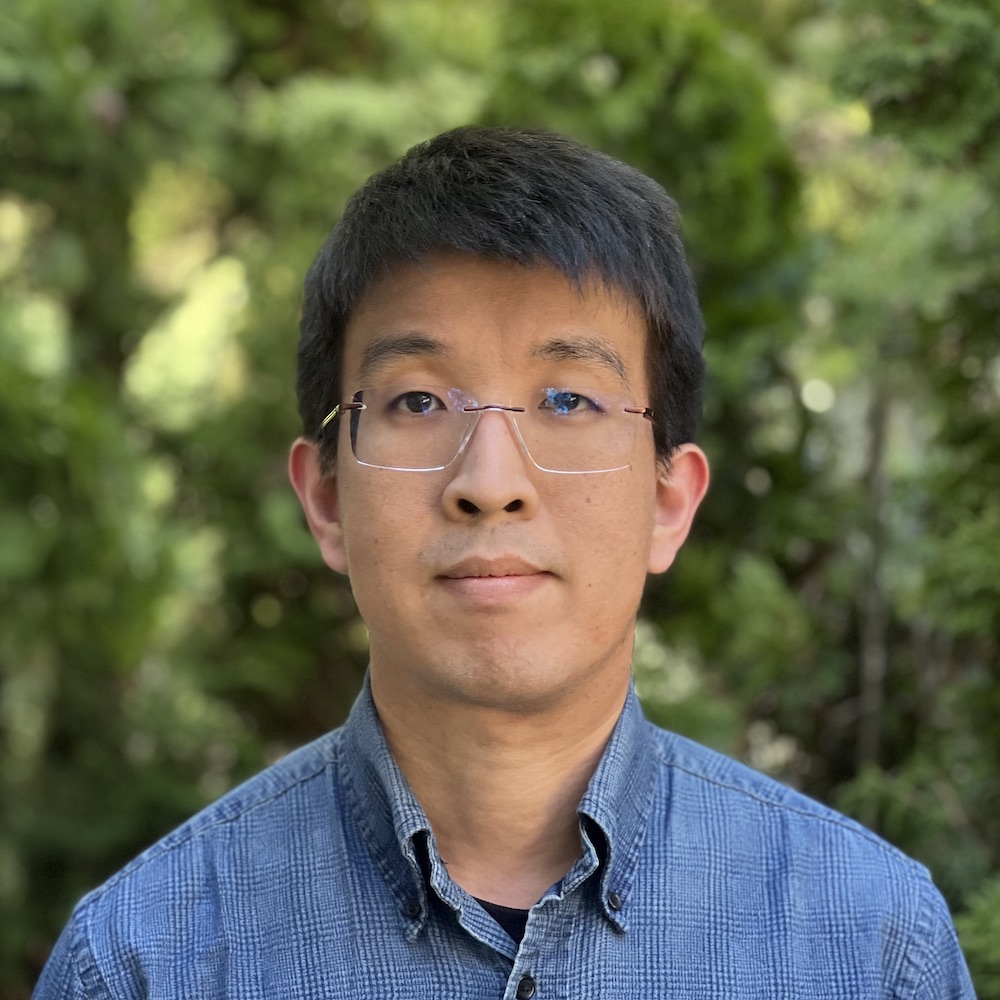
 Chencheng Cai
· 5 previous affiliations
- Microsoft (United States)Since 2025
- Researcher · Since 2025
- Washington State UniversityCurrent
- Current
- Weber State University2023–2025
- Assistant Professor · 2023–2025
- Temple University2020–2023
- Postdoc · 2020–2023
- PhD student · 2014–2020
Research Overview
Chencheng Cai focuses on causal inference, high-dimensional matrix and tensor factorization, and Sequential Monte Carlo (SMC) methodologies. His research develops theoretical frameworks and computational algorithms to address challenges in complex data analysis, including network interference in experimental design, automated rank selection in latent factor models, and constrained sampling in state-space models. His work frequently bridges the gap between statistical theory and applied machine learning, providing robust methods for matrix compression, denoising, and causal estimation in interconnected systems.
Research Trajectory
Cai’s research trajectory began with a focus on computational statistics, specifically the development of efficient sampling methods for dynamic systems. During his doctoral studies at Rutgers University, he addressed the limitations of standard Sequential Monte Carlo methods when applied to systems with strong or rare constraints. In these contexts, traditional particles often fail to satisfy future conditions, leading to computational inefficiency. Cai developed a framework for Resampling Strategy in Sequential Monte Carlo for Constrained Sampling Problems, which introduced a flexible resampling strategy based on time-varying lookahead timescales. This work provided a general formulation for generating sample paths from dynamic systems under rare constraints, improving the reliability of statistical inferences for rare-event and bridge problems.
Following this work in computational sampling, Cai shifted toward high-dimensional statistics, specifically Kronecker Product Approximation via Matrix Rearrangement. While standard low-rank approximations like Singular Value Decomposition (SVD) are ubiquitous, they can be restrictive for matrices with complex internal structures. Cai introduced KoPA: Automated Kronecker Product Approximation, a methodology that generalizes SVD by replacing outer products with Kronecker products. A significant contribution of this work was the development of an automated procedure to determine the optimal configuration and dimensions of these products using information criteria. He extended these concepts to the problem of Stable Matrix Completion using Properly Configured Kronecker Product Decomposition, demonstrating that assuming a low Kronecker rank—rather than a standard low rank—allows for more parsimonious representations of underlying data structures, particularly in denoising and completion tasks.
During his postdoctoral tenure at Temple University and his subsequent faculty appointment at Washington State University, Cai’s focus expanded significantly into Causal Inference under Network Interference. Traditional experimental designs often rely on the Stable Unit Treatment Value Assumption (SUTVA), which posits that one unit's treatment does not affect another's outcome. Cai’s work addresses scenarios where this assumption is violated due to social or physical network spillovers. He contributed to the literature on Overcoming the Variance Explosion in Network Experiments by developing optimized experimental designs. Specifically, his research on Optimizing Randomized and Deterministic Saturation Designs under Interference derived closed-form expressions for the bias and variance of estimators in the presence of interference, showing that carefully tuned saturation designs outperform traditional cluster-randomized or stratified designs.
Current Directions
Cai’s recent work continues to refine high-dimensional optimization and tensor analysis. He has developed novel approaches for State Space Emulation and Annealed Sequential Monte Carlo for High Dimensional Optimization, which reformulates optimization problems as the search for an optimal path in an equivalent state-space model. By integrating simulated annealing with SMC, this method provides a robust mechanism for navigating complex objective function landscapes in high-dimensional spaces.
In the domain of multi-way data, Cai has advanced the theory of tensor decomposition. His work on Semi-parametric tensor factor analysis by iteratively projected singular value decomposition introduced the STEFA framework. This approach incorporates auxiliary side-information (covariates) into low-rank tensor models, using an Iteratively Projected SVD (IP-SVD) algorithm to improve estimation accuracy. This research establishes convergence rates for loading matrices and core tensors, demonstrating that leveraging instrumental covariates can significantly enhance factor estimation in high-noise environments.
Cai’s transition to an applied scientist role at Microsoft suggests a continuing focus on the intersection of these theoretical frameworks—causal inference, high-dimensional factorization, and efficient optimization—within large-scale industrial and technological contexts.
Representative Work
KoPA: Automated Kronecker Product Approximation In this first-author paper, Cai generalizes the Singular Value Decomposition (SVD) by utilizing Kronecker products. The primary contribution is an automated method for selecting the optimal dimensions and configurations of the Kronecker product using information criteria. The paper provides theoretical guarantees that the method can recover hidden structures in high-dimensional matrices, offering a more flexible alternative to standard low-rank approximations for matrix compression and denoising.
Stable Matrix Completion using Properly Configured Kronecker Product Decomposition Cai addresses the matrix completion problem by proposing a low Kronecker rank structure as a more general alternative to the traditional low-rank assumption. The paper introduces a methodology to identify the proper Kronecker configuration using mean squared error and demonstrates that this added flexibility allows for more stable and parsimonious recovery of missing entries in partially observed matrices.
Resampling Strategy in Sequential Monte Carlo for Constrained Sampling Problems This work develops a Constrained Sequential Monte Carlo (cSMC) framework to handle dynamic systems where particles must satisfy specific future constraints or observable features. Cai proposes a resampling strategy that utilizes a time-varying lookahead timescale, effectively guiding particles toward regions that satisfy these constraints. This approach significantly improves sampling efficiency for rare events and bridge problems compared to standard SMC methods.
Optimizing Randomized and Deterministic Saturation Designs under Interference Addressing the challenges of causal inference in networks, this paper provides a rigorous framework for optimizing experimental designs when unit interference is present. Cai derives analytical expressions for the bias and variance of estimators under spillover effects. The research demonstrates that traditional "all-or-nothing" cluster designs are often sub-optimal and proposes tuned saturation designs as a more efficient means of estimating treatment and spillover effects.
State Space Emulation and Annealed Sequential Monte Carlo for High Dimensional Optimization Cai presents a general strategy for high-dimensional optimization by emulating the objective function as the likelihood function of a state-space model. The paper introduces an annealed SMC algorithm that incorporates temperature control into the emulated system, allowing for the identification of the optimal state path that corresponds to the global maximum of the original objective function.
Semi-parametric tensor factor analysis by iteratively projected singular value decomposition As a primary contributor to this framework, Cai introduces STEFA (Semiparametric TEnsor FActor analysis), which integrates auxiliary covariates into tensor decomposition. The paper develops the IP-SVD algorithm, which iteratively projects tensor data onto covariate-spanned linear spaces. The work establishes the convergence rates for the resulting estimates and shows that this semiparametric approach yields higher accuracy than standard Tucker decomposition in noisy high-dimensional settings.
Profile updated
| Title | Venue | Year |
|---|---|---|
| Independent-Set Design of Experiments for Estimating Treatment and Spillover Effects under Network Interference | ICLR | 2024 |
| Semi-parametric tensor factor analysis by iteratively projected singular value decomposition | Journal of the Royal Statistical Society Series B (statistical Methodology) | 2024 |
| State Space Emulation and Annealed Sequential Monte Carlo for High Dimensional Optimization | Openreview | 2023 |
| Bullwhip Effect of Supply Networks: Joint Impact of Network Structure and Market Demand | arXiv | 2022 |
| Optimizing Randomized and Deterministic Saturation Designs under Interference | arXiv | 2022 |
| KoPA: Automated Kronecker Product Approximation | JMLR | 2022 |
| Individualized inference through fusion learning | Wiley | 2020 |
| Advances in complex data analysis | Rutgers | 2020 |
| KoPA: Automated Kronecker Product Approximation | arXiv | 2019 |
| Individualized Group Learning | arXiv | 2019 |
Loading new papers…
Other researchers whose papers cluster into the same research directions — a proxy for overlapping technical interests and shared intellectual neighborhoods.
See something wrong? Report a mistake