

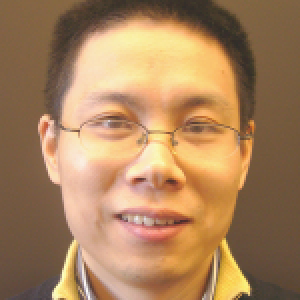
 Han Xiao
1 previous affiliation
- Full Professor · 2023–2025
- Associate Professor · 2017–2023
- Assistant Professor · 2011–2017
5 other authors named Han Xiao: Han Xiao (Chinese University of Hong Kong · 24 papers), Han Xiao (Xiamen University · 5 papers), Han Xiao (Elastic · 4 papers), Han Xiao (Beijing University of Post and Telecommunication · 1 paper), Han Xiao (Hong Kong University of Science and Technology · 1 paper)
Research Overview
Han Xiao focuses on statistical machine learning and linear algebra, with a particular emphasis on matrix approximation and completion techniques. As a senior author, Xiao's trajectory centers on developing automated and hybrid Kronecker product decompositions to extend traditional low-rank matrix methods. Recent work investigates the application of these flexible decomposition strategies to improve matrix denoising and structural approximation.
Research Trajectory
The trajectory visible in the provided corpus begins with methodological improvements to matrix completion, a classic problem in data recovery. Standard approaches to recovering missing entries in a partially observed matrix typically rely on assuming a low regular rank for the underlying complete matrix. In 2019, Xiao served as the senior author on Stable Matrix Completion using Properly Configured Kronecker Product Decomposition. This work proposed substituting the standard low-rank assumption with a low Kronecker rank assumption. Because the regular rank is a special case of the Kronecker rank, this approach offers a more parsimonious and flexible representation of matrices. A key challenge addressed in this research was determining the optimal Kronecker product configuration, which the authors resolved by utilizing the mean squared error to identify the most stable setup.
Building on this foundational work in matrix structures, Xiao continued to explore the theoretical and practical applications of Kronecker products for broader statistical tasks. In 2022, Xiao was the senior author of KoPA: Automated Kronecker Product Approximation. This paper expanded the research focus from matrix completion to general matrix approximation and denoising. By approximating a target matrix as the sum of several Kronecker products, the KoPA method effectively generalizes traditional low-rank matrix approximation, treating the Kronecker product as an extension of the outer product from vectors to matrices. The research highlighted the increased flexibility of this approach, allowing practitioners to specify the dimensions of the constituent matrices while addressing the computational challenges of automating this configuration.
The focus on refining these decomposition techniques continued into 2023. Xiao led further methodological extensions as the senior author of Hybrid Kronecker Product Decomposition and Approximation. The progression from automated approximation to hybrid decomposition indicates a sustained research agenda aimed at maximizing the utility of Kronecker-based matrix operations in computational statistics.
(Note: The available evidence for this profile is sparse, consisting of three primary publications between 2019 and 2023. The trajectory described reflects this specific methodological focus.)
Current Directions
The most recent paper in the evidence is from 2023, indicating a continued focus on advanced matrix decomposition strategies. Recent work investigates hybrid approaches to Kronecker product decomposition, suggesting an ongoing effort to refine the mathematical tools used for matrix approximation. This direction builds directly on earlier automated configuration methods, aiming to provide more robust and flexible linear algebraic foundations for statistical modeling, denoising, and data recovery tasks.
Profile updated
| Title | Venue | Year |
|---|---|---|
| KoPA: Automated Kronecker Product Approximation | JMLR | 2022 |
| Stable Matrix Completion using Properly Configured Kronecker Product Decomposition | arXiv | 2019 |
| Hybrid Kronecker Product Decomposition and Approximation | J. Comput. Graph. Stat | 2019 |
Loading new papers…
Other researchers whose papers cluster into the same research directions — a proxy for overlapping technical interests and shared intellectual neighborhoods.
See something wrong? Report a mistake