

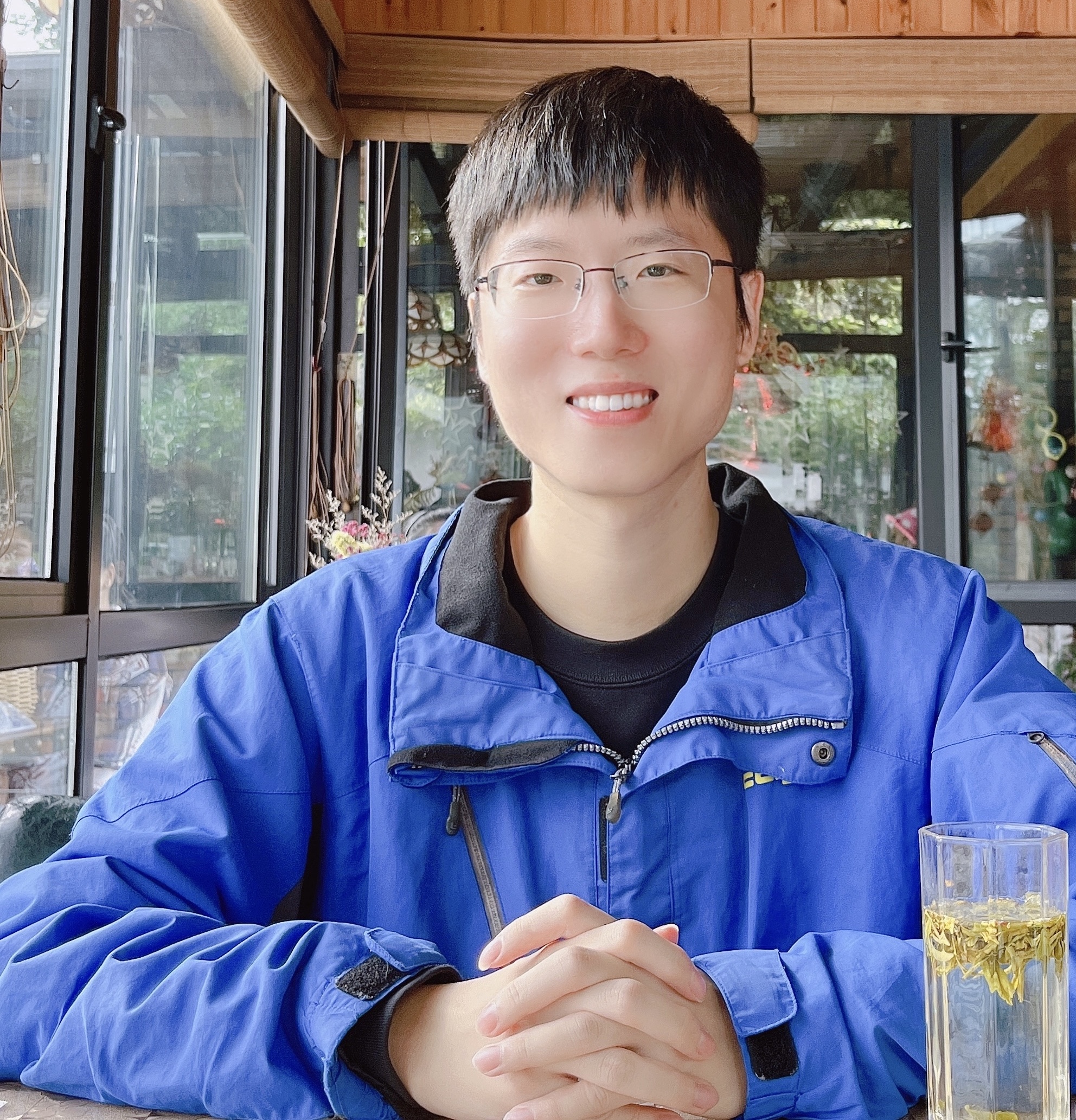
 Chen Chen
· 2 previous affiliations
- Sony AISince 2022
- Researcher · Since 2022
- Zhejiang University2013–2022
- PhD student · 2017–2022
- Undergrad student · 2013–2017
32 other authors named Chen Chen: Chen Chen (University of Central Florida · 429 papers), Chen Chen (University of Virginia · 146 papers), Chen Chen (National Technological University · 113 papers), Chen Chen (University of Wollonong · 68 papers), Chen Chen (Imperial College London · University of Sheffield · 28 papers), and 27 more
Research Overview
Chen Chen focuses on trustworthy machine learning, federated learning systems, and the development of vision foundation models. His trajectory spans from robust and privacy-preserving distributed training to the security and intellectual property implications of generative AI. Most recently, his work addresses the efficiency and knowledge preservation of compact vision foundation models alongside vulnerabilities in federated architectures.
Research Trajectory
Early in his career, Chen explored representation learning, beginning with Two-Stage Label Embedding via Neural Factorization Machine for Multi-Label Classification in 2019, which introduced a paradigm to jointly project features and labels into a latent space to handle complex label hierarchies. By 2022, his focus shifted toward the challenges of distributed and privacy-preserving machine learning. He addressed training instability in federated learning (FL) on non-IID data with CalFAT: Calibrated Federated Adversarial Training with Label Skewness. That same year, he participated in developing DENSE: Data-Free One-Shot Federated Learning, a two-stage framework that enables a central server to learn a global model in a single communication round without requiring a public dataset.
In 2023, Chen expanded his research into the robustness and adaptability of federated systems. He investigated vulnerabilities to malicious participants in GAIN: Enhancing Byzantine Robustness in Federated Learning with Gradient Decomposition, identifying how existing aggregation rules fail in non-IID settings. This work aligns with the research direction of Low-Dimensional Projections for Byzantine-Robust Federated Learning. Concurrently, he explored how data diversity could be leveraged rather than mitigated; Is Heterogeneity Notorious? Taming Heterogeneity to Handle Test-Time Shift in Federated Learning introduced a contrastive learning framework to help models adapt to unexpected distribution shifts. He also tackled the challenge of learning new classes over time without forgetting previous ones in federated environments. Through TARGET: Federated Class-Continual Learning via Exemplar-Free Distillation and the related study Addressing Catastrophic Forgetting in Federated Class-Continual Learning, he developed a privacy-preserving framework that synthesizes data on the server for knowledge distillation, contributing significantly to the area of Continual Learning Without Data Rehearsal. Bridging his distributed systems work with the rise of large-scale models, he co-authored the perspective piece When Foundation Model Meets Federated Learning: Motivations, Challenges, and Future Directions, touching on the broader area of Federated Low-Rank Adaptation of Foundation Models.
As generative AI rapidly advanced, Chen's trajectory incorporated the security, provenance, and intellectual property implications of these models. In 2023, he developed methods for origin attribution—identifying which specific AI model generated an image. This was detailed in Alteration-free and Model-agnostic Origin Attribution of Generated Images and its subsequent publication Where Did I Come From? Origin Attribution of AI-Generated Images, which demonstrated how to reverse-engineer inputs to trace images back to their source models without requiring prior watermarking. He also investigated unauthorized data usage in training sets. How to Detect Unauthorized Data Usages in Text-to-image Diffusion Models and DIAGNOSIS: Detecting Unauthorized Data Usages in Text-to-image Diffusion Models introduced techniques to plant stealthy, element-level memorizations into protected images, allowing creators to prove dataset membership. This advanced the direction of Statistical Verification of Black Box Model Provenance.
Continuing this focus into 2024, Chen evaluated how state-of-the-art visual generative models reproduce protected characters in Evaluating and Mitigating IP Infringement in Visual Generative AI, proposing defenses against such mimicry. He further explored the mechanics of verbatim reproduction in Detecting, Explaining, and Mitigating Memorization in Diffusion Models, introducing gradient-based tools to identify trigger tokens and reduce memorization during both training and inference. These efforts contribute to the areas of Understanding Training Data Memorization in Generative Models and Early Detection of Memorization in Generative Models.
By 2025, Chen's research expanded to the design of highly efficient vision foundation models. Seeing Further on the Shoulders of Giants: Knowledge Inheritance for Vision Foundation Models introduced a method to build versatile models by unifying expertise from existing pre-trained networks rather than relying solely on massive datasets. This approach culminated in Argus: A Compact and Versatile Foundation Model for Vision, a 100-million-parameter model capable of matching the performance of much larger architectures across diverse computer vision tasks. Alongside his work in vision models, he continued to probe the security of distributed systems, revealing in Exploit Gradient Skewness to Circumvent Byzantine Defenses for Federated Learning how malicious updates can hide within the naturally skewed clusters of heterogeneous data to bypass established federated defenses.
Current Directions
The most recent papers in the evidence indicate a dual focus on the architectural efficiency of vision foundation models and the ongoing security challenges in distributed and generative AI. In the vision domain, recent work investigates how to distill, inherit, and unify knowledge from existing pre-trained models to create compact, highly capable architectures. This research aims to deploy state-of-the-art computer vision capabilities in resource-constrained environments without the prohibitive costs of training giant models from scratch. Concurrently, work in trustworthy AI continues to explore systemic vulnerabilities, addressing how data heterogeneity can be exploited to circumvent Byzantine defenses in federated learning, while also developing robust mechanisms to detect and mitigate intellectual property infringement and unauthorized memorization in diffusion models.
Profile updated
Loading new papers…
Other researchers whose papers cluster into the same research directions — a proxy for overlapping technical interests and shared intellectual neighborhoods.
See something wrong? Report a mistake