

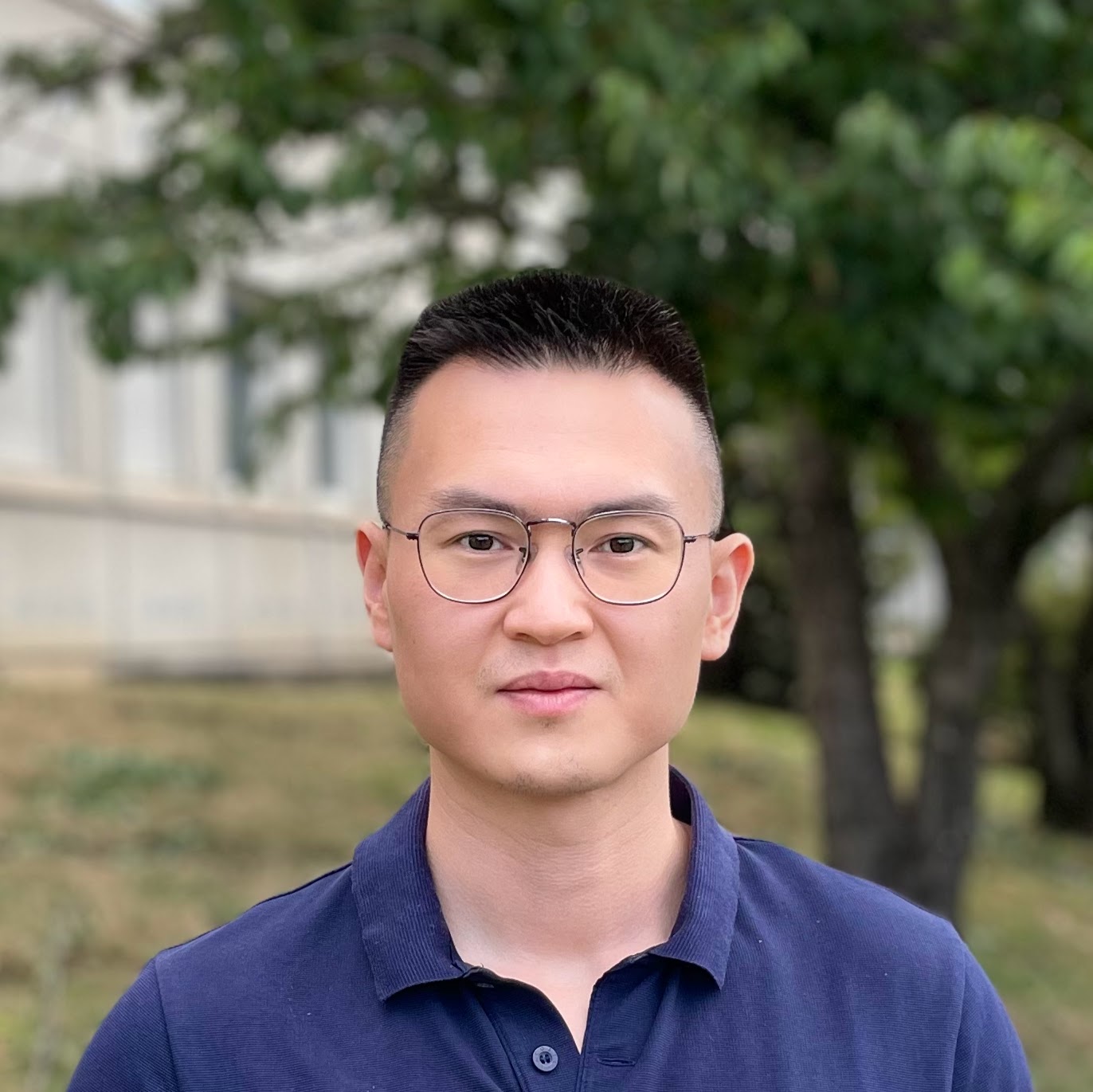
 Chao Zhang
· 6 previous affiliations
- Lyon 1 UniversitéSince 2026
- Junior Professor Chair · Since 2026
- Postdoctoral Researcher · 2021–2022
- University of WaterlooSince 2022
- Adjunct Assistant Professor · Since 2026
- Postdoctoral Researcher · 2022–2026
- Université de LyonSince 2026
- Junior Professor Chair · Since 2026
- Postdoctoral Researcher · 2020–2021
- Université Clermont Auvergne2015–2019
- Doctor of Philosophy - PhD, Computer Science · 2015–2019
- lSIMA Clermont-Ferrand2013–2015
- Engineer's degree, Computer Science · 2013–2015
18 other authors named Chao Zhang: Chao Zhang (Georgia Institute of Technology · 326 papers), Chao Zhang (Tsinghua University · 171 papers), Chao Zhang (University College London · Shanghai Artificial Intelligence Laboratory · Tsinghua University · 84 papers), Chao Zhang (Peking University · 84 papers), Chao Zhang (Zhejiang University · 54 papers), and 13 more
Research Overview
Chao Zhang focuses on data systems, query processing, and the optimization of large-scale analytics. His early work addressed the parallelization of complex aggregate functions in distributed computing environments, establishing formal frameworks for both symmetric and asymmetric operations. Recently, his research has expanded to encompass data lakes, graph data management, and the intersection of data systems with artificial intelligence.
Research Trajectory
Zhang's research trajectory is rooted in the optimization of complex data operations for modern, large-scale computing environments. In his early work, he investigated how to efficiently execute complex aggregation functions across distributed systems. He introduced a generic framework for mapping these functions into massively parallel, MapReduce-style algorithms in Symmetric and Asymmetric Aggregate Function in Massively Parallel Computing. This research distinguished between symmetric functions, where the order of processing does not matter, and asymmetric functions, where it does. By formalizing specific mathematical properties such as "reducibility" and "extractability," he provided a systematic method to ensure these operations could be executed with sublinear space and time requirements on big data platforms.
Building on this foundation, Zhang expanded his focus to the broader challenges of advanced data analytics, particularly the implementation and optimization of user-defined aggregate functions (UDAFs). Recognizing that built-in system aggregations are often insufficient for specialized analytical tasks, he addressed the limitations of existing UDAF mechanisms—namely, the need to hardcode routines and the query processor's inability to optimize operations due to opaque semantics. In Optimization of User-Defined Aggregate Functions : Parallization and Sharing, he presented the SUDAF framework, which tackles these drawbacks by enabling better parallelization and the sharing of computations across UDAFs, thereby improving the efficiency of query processing in advanced analytics.
Current Directions
Recent work investigates the intersection of data systems and artificial intelligence, with a particular emphasis on managing heterogeneous and multimodal data. The most recent themes in the evidence highlight advancements in query processing for data lakes, including adaptive vector search and semantic metadata management. Additionally, Zhang's current research addresses graph data management, focusing on indexing techniques for graph reachability queries, recursive relationships, and incremental sliding window connectivity over streaming graphs. He is also exploring neuro-symbolic approaches to scale video analytics using vision-language models, reflecting a broader commitment to integrating generative AI capabilities into robust data intelligence frameworks.
Profile updated
| Title | Venue | Year |
|---|---|---|
| Distribution-Aware Exploration for Adaptive HNSW Search | Proc. ACM Manag. Data | 2026 |
| GraphOmni: A Comprehensive and Extensible Benchmark Framework for Large Language Models on Graph-theoretic Tasks | ICLR | 2026 |
| Pore-Scale Investigations into Gradient Carbon Microstructures for Enhanced Mass Transport in PEM Fuel Cell Catalyst Layers | Nanomaterials | 2026 |
| Geometry-Aware CRDTs for Efficient Collaborative Geospatial Editing | Isprs | 2025 |
| HTAP Databases: What is New and What is Next | Proceedings of the 2022 International Conference on Management of Data | 2022 |
| Efficient Incremental Computation of Aggregations over Sliding Windows | KDD | 2021 |
| Optimization of User-Defined Aggregate Functions : Parallization and Sharing | Hal | 2019 |
| Efficient Information Retrieval by Dispatching Mobile Agents in Parallel | Openalex | 2008 |
| A permutation alignment algorithm based on multiple criterions in audio signal Frequency-Domain Blind deconvolution | Openalex | 2008 |
Loading new papers…
Other researchers whose papers cluster into the same research directions — a proxy for overlapping technical interests and shared intellectual neighborhoods.
See something wrong? Report a mistake