

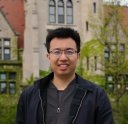
 Chao Zhang
· 2 previous affiliations
- Georgia Institute of TechnologySince 2019
- Assistant Professor · Since 2019
- PhD student · 2013–2018
18 other authors named Chao Zhang: Chao Zhang (Tsinghua University · 171 papers), Chao Zhang (University College London · Shanghai Artificial Intelligence Laboratory · Tsinghua University · 84 papers), Chao Zhang (Peking University · 84 papers), Chao Zhang (Zhejiang University · 54 papers), Chao Zhang (Nanjing University · 44 papers), and 13 more
Research Overview
Chao Zhang focuses on large language model agents, trustworthy artificial intelligence, and AI for scientific discovery. His early work developed weakly supervised methods and spherical text embeddings for semantic analysis. Currently, he investigates post-training algorithms for intelligent agents, uncertainty quantification in language models, and the application of foundation models to accelerate chemical synthesis and materials science.
Research Trajectory
Chao Zhang's early research concentrated on foundational natural language processing, semantic analysis, and data-efficient learning. He developed TaxoGen: Unsupervised Topic Taxonomy Construction by Adaptive Term Embedding and Clustering, a method for building topic taxonomies by clustering semantically coherent concept terms rather than relying on traditional pattern-based hypernym extraction. He also participated in developing unsupervised word and paragraph embeddings, contributing to the research direction of Spherical Latent Spaces for Directional Semantic Modeling through his collaborative work on Spherical Text Embedding. Around the same time, his research addressed the bottleneck of manual annotation in NLP. He advanced the area of Text Classification with Minimal Supervision by co-developing frameworks like LOTClass in Text Classification Using Label Names Only: A Language Model Self-Training Approach, which trains high-performing classifiers using only category names and unlabeled data. With collaborators, he further explored data efficiency in BOND: BERT-Assisted Open-Domain Named Entity Recognition with Distant Supervision, leveraging pre-trained language models to mitigate the noise and incompleteness inherent in distantly supervised entity recognition.
A persistent theme in his trajectory is model reliability, robustness, and uncertainty quantification. He co-developed SDE-Net: Equipping Deep Neural Networks with Uncertainty Estimates, utilizing stochastic differential equations to provide scalable uncertainty estimation for deep learning models. As the field transitioned toward large language models (LLMs), his lab adapted these reliability principles to generative AI. His group advanced the broader area of Uncertainty Calibration for Large Language Models by identifying semantically crucial tokens in reasoning chains, as detailed in Language Model Uncertainty Quantification with Attention Chain. To ensure models adhere to human objectives without the instability of traditional fine-tuning, his lab also addressed test-time alignment in Aligning Large Language Models with Representation Editing: A Control Perspective, framing autoregressive LLMs as discrete-time stochastic dynamical systems manipulated via external control signals. In a related vein of robust decision-making under uncertainty, he guided research on predict-then-optimize problems, addressing model mismatch and gradient approximation errors in DF: Distribution-Free Decision-Focused Learning.
As LLMs evolved into interactive agents, his research shifted toward improving their reasoning capabilities, tool use, and in-context learning dynamics. He investigated how the choice of prompt examples impacts model performance in Misconfidence-based Demonstration Selection for LLM In-Context Learning. To help autonomous agents navigate complex API environments, his group developed heuristic search techniques in ToolChain: Efficient Action Space Navigation in Large Language Models with A Search. He also explored using self-reflexive LLMs to generate structured, attribute-rich training data in ProgGen: Generating Named Entity Recognition Datasets Step-by-step with Self-Reflexive Large Language Models. To rigorously evaluate these increasingly complex systems, he contributed to the research direction of Shifting from Static Benchmarks to Dynamic Evaluation, participating in the design of automated pipelines that transform raw datasets into competition-style benchmarks in MLE-Smith: Scaling MLE Tasks with Automated Multi-agent Pipeline.
Most recently, his trajectory has heavily emphasized the application of foundation models and agents to scientific discovery, particularly in chemistry and materials science. His lab introduced MOLLEO, a framework that replaces random mutations in evolutionary algorithms with LLM-guided chemical intuition in Efficient Evolutionary Search Over Chemical Space with Large Language Models. Similarly, he developed LLM-Syn-Planner to navigate multi-step retrosynthesis pathways in LLM-Augmented Chemical Synthesis and Design Decision Programs, ensuring that computationally designed molecules are viable for laboratory synthesis. Expanding on this theme, he collaborated on frameworks for autonomous goal-evolving agents in Accelerating Scientific Discovery with Autonomous Goal-evolving Agents and contributed to methods for maintaining search diversity in LLM-based scientific hypothesis generation in Towards Diverse Scientific Hypothesis Search with Large Language Models.
Current Directions
Recent work investigates the intersection of foundation models and scientific discovery, focusing on how autonomous agents can accelerate research in chemistry, materials science, and biology. The most recent papers in the evidence address the use of large language models as heuristic guides within evolutionary algorithms to navigate complex chemical spaces and plan multi-step retrosynthesis pathways. Additionally, current research explores the design of multi-agent pipelines for generating scalable machine learning benchmarks and frameworks that allow scientific agents to dynamically evolve their own objectives while maintaining diversity in hypothesis generation.
Profile updated
Loading new papers…
Other researchers whose papers cluster into the same research directions — a proxy for overlapping technical interests and shared intellectual neighborhoods.
See something wrong? Report a mistake